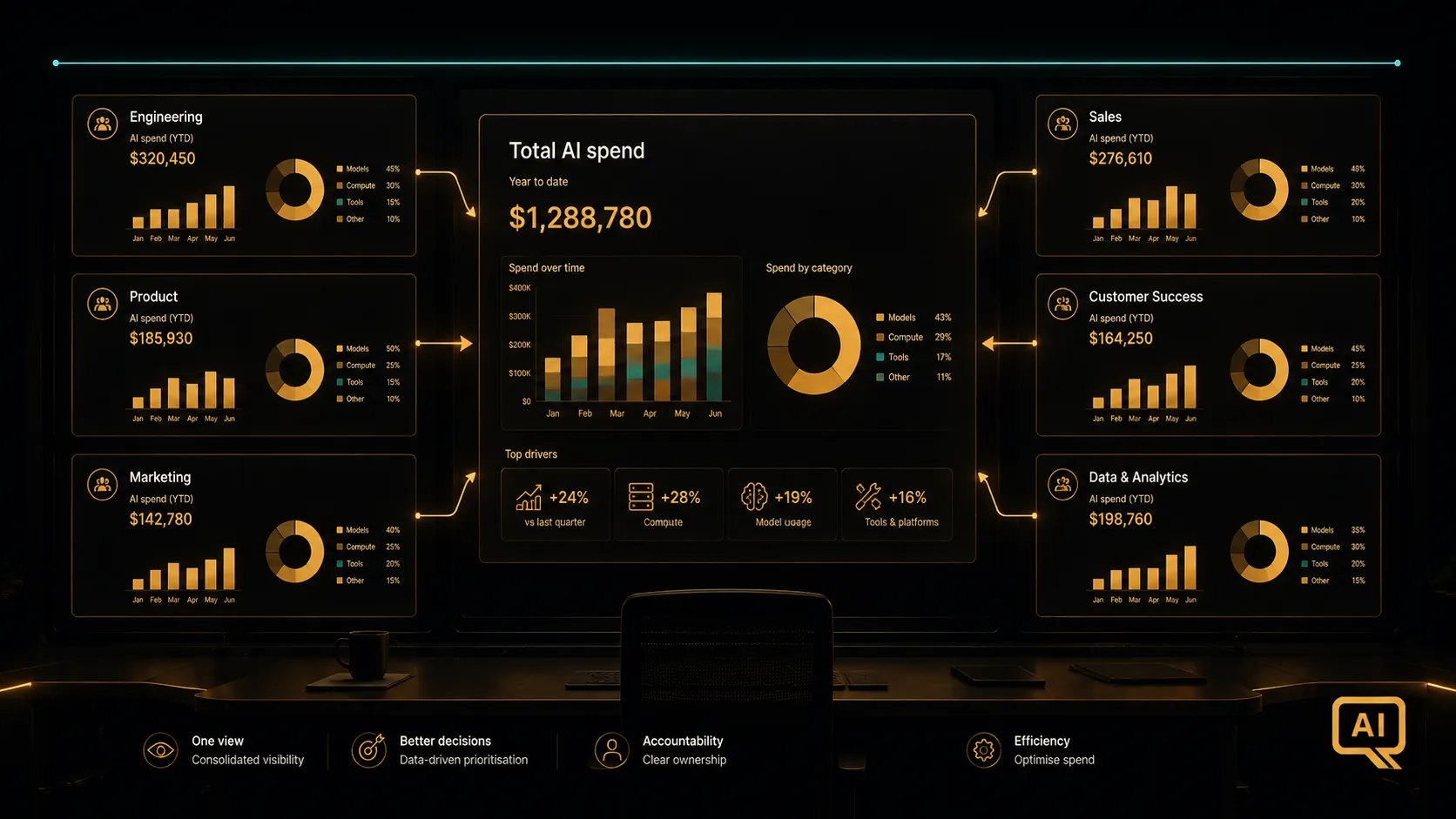
The FinOps Foundation’s 2026 survey found that 98 percent of organisations now actively manage AI spend, up from 63 percent in 2025 and 31 percent in 2024. That is the fastest adoption curve the foundation has ever recorded. AI moved from an emerging category to everyday FinOps scope in two years.
The bad news underneath that number is that most of those organisations are managing AI spend badly. The tooling is nascent, the allocation logic breaks in specific ways, and the discipline of connecting AI cost to business value is genuinely harder than the equivalent discipline for cloud infrastructure. This article is about how to actually do it, based on the practices that have been emerging through 2025 and 2026.
Why traditional FinOps breaks for AI
Cloud FinOps solved a hard problem: how to give engineering teams visibility into the cost consequences of their decisions, allocate cost fairly to the teams generating it, and enforce budgets without slowing innovation. The tooling that emerged (Cloudability, CloudZero, Vantage, and many others) built on a common assumption: costs are tied to discrete, persistent resources you can tag.
AI breaks that assumption. An LLM API call is a transaction, not a resource. It has no persistent identity you can tag. It happens, it costs money, and it is gone. The billing arrives from the model vendor with attribution by API key or project, not by team, cost centre, or customer. The tagging strategy that anchors traditional FinOps has no direct analogue in the AI stack.
There are three specific breaks worth naming. First, token consumption can spike 10 times in a week when a team ships a new feature, breaking the predictability that traditional FinOps forecasting relies on. Second, agentic workloads have retry and loop dynamics that make usage patterns highly nonlinear. Third, the vendor invoice does not tell you which team, product, or customer generated the spend, so you have to build the attribution yourself.
The application-layer metadata pattern
The pattern that is emerging as the standard solution is to capture attribution metadata at the application layer and propagate it to the billing analytics separately.
Every AI call gets tagged at the point of origin with the identifying metadata: team ID, feature ID, user segment, customer (if applicable), cost centre. The application logs this metadata alongside token counts, model used, cache status, and latency. A downstream pipeline aggregates these logs into a spend attribution model, joined against the vendor’s actual billing to close the loop on total spend.
This is more work than traditional cloud tagging. It requires engineering discipline (every call must carry the metadata), pipeline infrastructure (the logs have to flow somewhere they can be queried), and reconciliation logic (the metadata-tagged spend has to sum to the vendor invoice within acceptable tolerance).
The organisations that do this well have engineering and FinOps working together from day one. The organisations that treat it as a finance-only problem end up with attribution that fails at production scale. This is the core reason FinOps for AI has been described as “an engineering problem as much as a finance problem” in the 2026 industry commentary.
Showback first, chargeback later
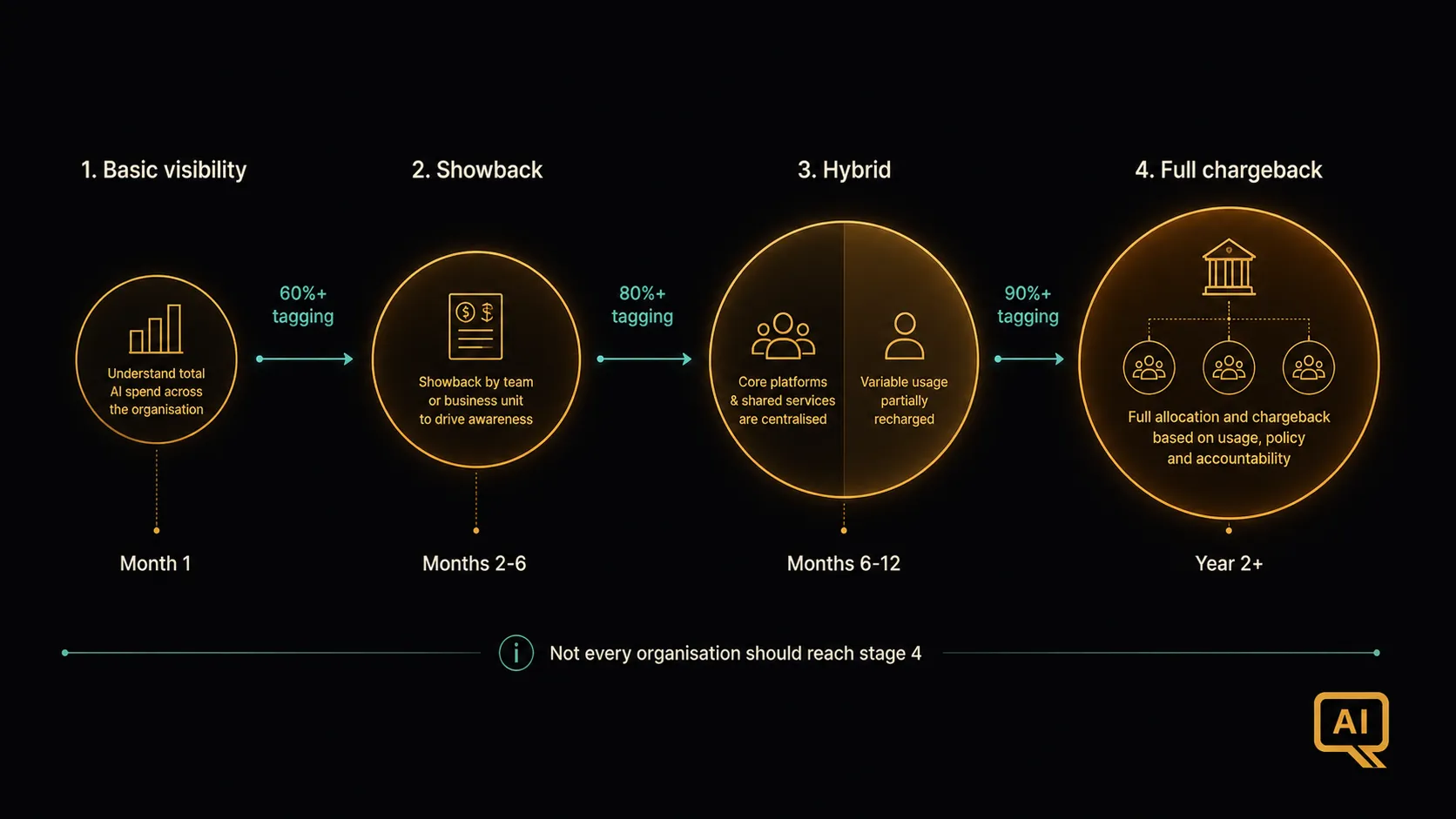
Figure 1 shows the maturity progression I recommend for AI FinOps. It has four stages, and skipping any of them is a common failure mode.
Stage one in Figure 1 is basic visibility. You know your total AI spend, split by vendor, model tier, and rough workload category. This is where most organisations were in 2024 and where a surprising number still are. It is not enough to govern spend, but it is where you start.
Stage two is showback. You attribute AI spend to teams, products, or cost centres and report it back to them. The spend stays on a centralised budget; the teams see what they are consuming. Showback creates visibility and accountability without moving money, which lets you build the tagging and attribution discipline before you have to defend it in a formal billing dispute.
Stage three is a hybrid. Some workloads move to chargeback (well-tagged, mature use cases where the team owns the outcomes), while shared services and experimental workloads stay on showback. This is where most mature FinOps programmes settle rather than pushing all workloads to full chargeback.
Stage four is full chargeback. AI spend moves to the consuming team’s budget or P&L. This requires roughly 90 percent tagging coverage across all AI spend, formal integration with finance systems, and a defined dispute process. It also requires organisational readiness: teams have to be prepared to actually manage the cost, not just receive the bill.
The failure mode I see most often is organisations jumping from stage one to stage four without stopping at two and three. The chargeback fails because tagging is not mature enough, or because teams cannot absorb the cost accountability without support, or because the dispute process breaks down. The programme retreats to stage one, and the credibility damage sets back FinOps for another year.
Stage two to three to four is not a maturity ranking. The FinOps Foundation is explicit that some organisations should stay on showback permanently because their accounting policies do not benefit from moving money around internally. The right stage depends on your organisation, not on a maturity checklist.
Budgets, quotas, and guardrails
FinOps for AI extends beyond attribution into active spend governance. Three mechanisms matter.
Budget alerts trigger when a team’s spend crosses thresholds (typically 50, 80, and 100 percent of the monthly budget). The alerts go to the team and to their FinOps partner, not just to a central dashboard. The point is to give teams a chance to adjust before they blow through the budget, not to punish them after the fact.
Token quotas limit the maximum consumption for a specific use case, API key, or team. Hard quotas stop consumption at the limit; soft quotas allow continued consumption with escalation. Quotas are the mechanism that keeps runaway agent loops from consuming an entire budget in a bad week, and they are essential for any team running agentic workloads.
Guardrails restrict which models, features, or providers a team can use. A team building a low-stakes internal tool probably should not be running Opus 4.8; the guardrail keeps them on Haiku or Sonnet. Guardrails prevent architectural drift toward expensive default choices, which is one of the most common cost sprawl patterns.
The tooling for these mechanisms varies widely. The mature FinOps platforms (Cloudability, CloudZero, Vantage) are beginning to support them natively for AI. Many organisations build proxy layers that enforce quotas and guardrails at the API level. Either approach works; what matters is that the mechanisms exist and are actively used.
Unit economics: from cost to value
The endpoint of AI FinOps is not lower cost. It is unit economics: cost per meaningful business outcome, tracked over time, connected to the value the outcome produces.
Cost per successful customer support case. Cost per accepted code suggestion. Cost per generated report. Cost per approved fraud investigation. Cost per closed opportunity. The unit depends on the use case, but the pattern is consistent: pick the outcome that matters, measure it consistently, divide the cost by it, and track the ratio.
The 2026 FinOps X conference specifically named “value per token, not cost per token” as the metric to chase, and that is the right framing. Cost per token is an operational metric; value per unit outcome is a business metric, and finance and engineering can only have a productive conversation about the second one.
The 2026 State of FinOps data shows that only 43 percent of organisations currently track cost at the unit level. That is the frontier of FinOps discipline for AI, and it is what separates programmes that can defend their spending from programmes that can only report it.
The organisational structure question
Who owns AI FinOps? The answer varies, and it matters.
The pattern I see working most consistently in 2026 is a small central FinOps team (2 to 5 people at typical enterprises) that partners with engineering and finance. The central team owns the tooling, the reporting, the attribution logic, and the enforcement mechanisms. Individual teams own their spend and the outcomes it produces. Finance owns the budgeting relationship and the integration with corporate P&L.
The 2026 State of FinOps data shows 78 percent of FinOps teams now report to CTO or CIO organisations, and teams with VP-and-above engagement have 2 to 4 times more influence over technology selection decisions. This matters: FinOps that only reports after the fact has minimal impact. FinOps that is embedded in architecture and procurement decisions before the spend happens is where the real leverage sits.
The FinOps loop for AI
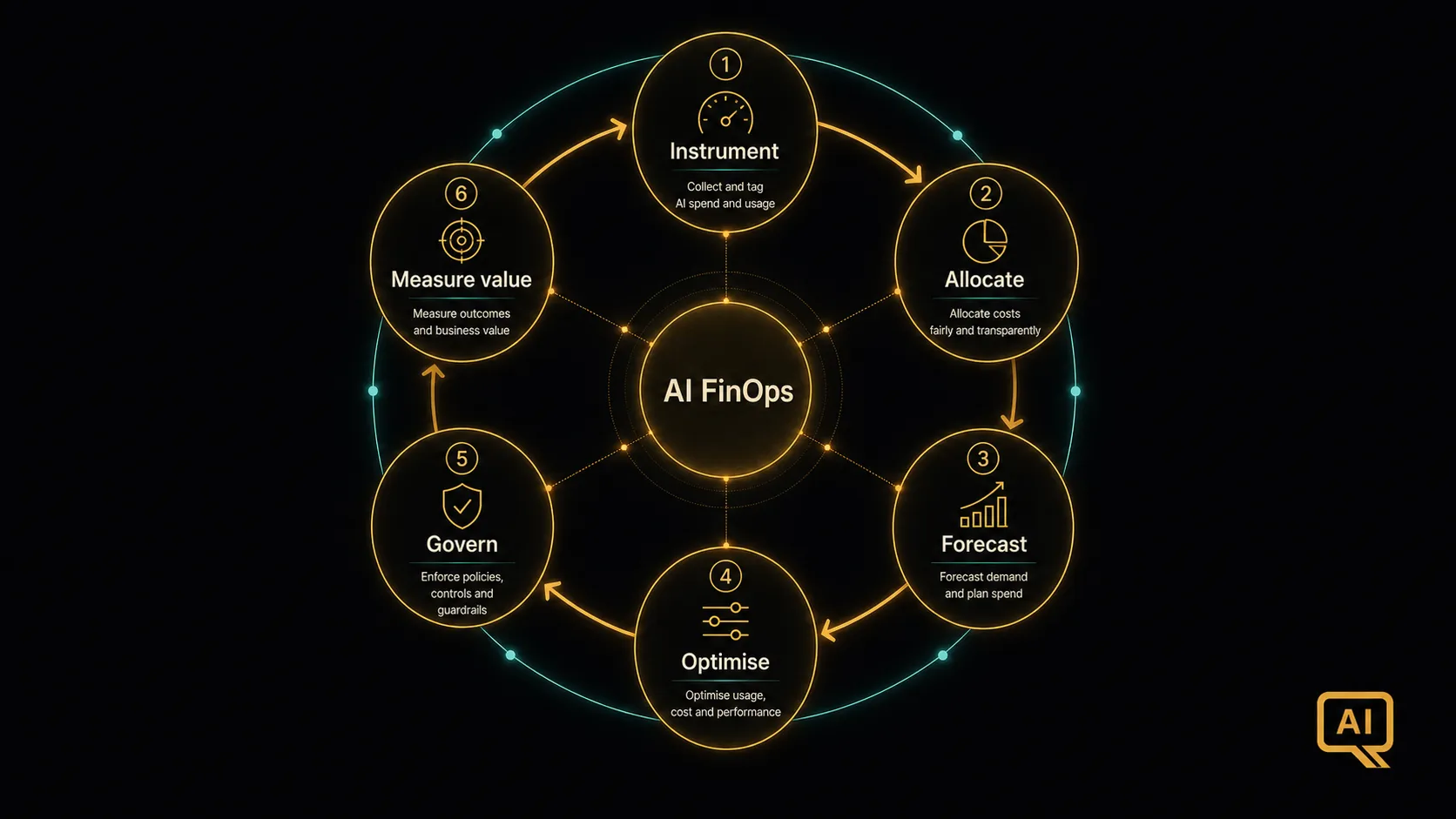
Figure 2 shows the operational loop that sustainable AI FinOps runs on. Six stages, each connected to the next.
Instrument: capture the attribution metadata on every AI call. Log it, aggregate it, join it to vendor billing.
Allocate: attribute spend to teams, products, customers, and outcomes. Reconcile against vendor totals. Publish showback or chargeback reports.
Forecast: project spend under different adoption scenarios. Update models as actuals come in. Feed the projections into finance planning cycles.
Optimise: apply the levers from BCR-06 (routing, caching, compression, batching) and BCR-13 (loop caps, framework choice) to reduce cost per outcome. Prioritise the workloads with the biggest cost impact.
Govern: enforce budgets, quotas, and guardrails. Handle exceptions through defined processes. Escalate breaches.
Measure value: track cost per business outcome. Connect the operational spend to the enterprise value it produces. Report on the ratio, not just the total.
The loop in Figure 2 runs continuously. Programmes that treat FinOps as a quarterly report miss the current-state visibility they need to make decisions. Programmes that treat it as a real-time discipline can adjust course when things start drifting, which is often the difference between the programmes that stay within budget and the programmes that surprise finance.
AI FinOps is one of the most consequential capabilities an organisation can build for a mature AI programme. The organisations that get it right are the ones that will scale their AI investments confidently through 2027 and beyond. The organisations that do not get it right will spend the next few years being surprised by their AI bills, and their programmes will suffer for it.