
Not every AI use case has the same economics. Some are almost always in the money, some are almost always underwater, and the difference is largely predictable from the shape of the use case rather than the sophistication of the deployment.
I want to walk through the reference economics for the categories I see most often in enterprise deployments. The point is not to give you specific numbers you can plug into your business case (the specifics vary too much by industry and scale). It is to give you a mental map of which use cases tend to have honest positive ROI, which tend to disappoint, and why. If your target use case looks like the ones on the disappointing side of the map, that is not fatal, but it is a signal that the case needs to work harder to be credible.
The characteristics that predict good ROI
Before getting into specific use cases, it is worth naming the shape of use case that tends to produce good economics. Four characteristics matter most.
High volume. The AI system needs to run enough times that the amortised setup cost gets spread over enough transactions to be meaningful. A workflow that runs a hundred times a year is almost never worth automating, regardless of how well the AI could do it.
High cost per unit of work. The savings on a workflow that costs $2 per transaction is limited by physics; even if AI reduces it to zero, you save $2 a transaction. Workflows where the human cost per unit is meaningful (skilled professional time, specialised expertise, high-touch customer interactions) have more room for AI to move the economics.
Measurable outcome. The result of the workflow has to be something you can define, capture, and evaluate. Case resolved. Document produced. Recommendation generated. Diffuse workflows where “success” is subjective are much harder to build cases around because the value hypothesis cannot be validated.
Bounded scope. The workflow needs to have identifiable inputs and outputs and known constraints. Workflows that require open-ended judgment or draw on tacit context are much harder to automate reliably, and the failure modes are more expensive.
Use cases that hit all four characteristics have the best odds. Use cases that hit two or three can work with good execution. Use cases that hit fewer than two usually should not be at the top of the roadmap.
Support and customer service copilots
Support has been one of the most consistently positive AI use cases since 2023. High volume (typical enterprise handles thousands to millions of tickets a year). High cost per unit (loaded agent cost per interaction typically runs $8 to $25 in Western markets). Measurable outcome (case resolution, customer satisfaction). Bounded scope (most tickets fall into a known distribution of types).
Reference economics typically look like: 15 to 30 percent handle-time reduction, 5 to 15 percent first-contact resolution improvement, 10 to 25 percent agent capacity redeployment. Total value in the range of 8 to 20 percent of the support operating cost, achievable at 30 to 60 percent adoption within 6 to 12 months.
Caveats. The quality trade-off matters: customers can tell if the agent is reading from a copilot, and poor prompting leads to worse experience. Full self-service AI (customer talks to bot, not to human) has much less consistent ROI, because the failure mode of a bad interaction is customer defection, which is expensive.
Coding copilots
Coding has produced dramatic individual productivity claims: GitHub research on Copilot puts code produced per week 40 to 55 percent higher for adopters, and 90 percent of Fortune 100 companies have deployed it. But the enterprise ROI story is more mixed, because the redeployment question is harder for engineering than for support.
Reference economics: 15 to 40 percent cycle-time reduction on well-defined coding tasks, 20 to 40 percent time savings on boilerplate and refactoring, minimal improvement on complex architectural work. The Uber case study from March 2026 is illustrative: adoption of Claude Code jumped from 32 percent to 84 percent of the 5,000-engineer organisation in four months, and monthly API costs ran $500 to $2,000 per engineer, consuming the entire annual AI budget before the fiscal year ended.
The lesson is not that coding copilots are bad. The lesson is that inference costs on power users are much higher than pilot economics suggest, and the value case has to include realistic power-user cost projections. When it does, coding copilots typically do have positive ROI, but it is smaller than the raw productivity numbers imply because the token bill is bigger and the redeployment question is harder to close.
Marketing content generation
Marketing content generation looks like an easy win on the surface. Content production has moved from “write from scratch” to “AI-assisted draft plus human polish” at most enterprises, and the individual time savings are large.
Reference economics: 40 to 70 percent time reduction on first drafts, 20 to 40 percent overall content production cost reduction, 2 to 4 times increase in content volume produced.
The trap is that the value hypothesis assumes the additional content produced is worth the cost of producing it, and often it is not. If you triple the volume of blog posts, emails, and social content, but the incremental content generates minimal additional engagement or revenue, the cost savings on production are real but the enterprise value is small. The best marketing content use cases pair AI production with a demand-side story (personalisation, market segmentation, campaign volume expansion) that gives the additional output somewhere to go.
Sales enablement and productivity
Sales tools using AI for prospecting, personalisation, meeting notes, follow-up drafting, and pipeline management have been aggressively marketed and adopted since 2024.
Reference economics vary widely. The strongest cases sit around administrative time reduction: 5 to 15 hours per rep per week on non-selling activities. The weaker cases claim direct revenue lift from better personalisation or timing, and those claims have the attribution problems described in BCR-10.
The realistic story is that sales AI is good for capacity redeployment (fewer hours on admin, more on selling) but weaker for direct conversion improvement. Business cases that lean heavily on conversion uplift claims should discount them heavily unless there is a randomised test to support the number.
Back-office and shared services automation
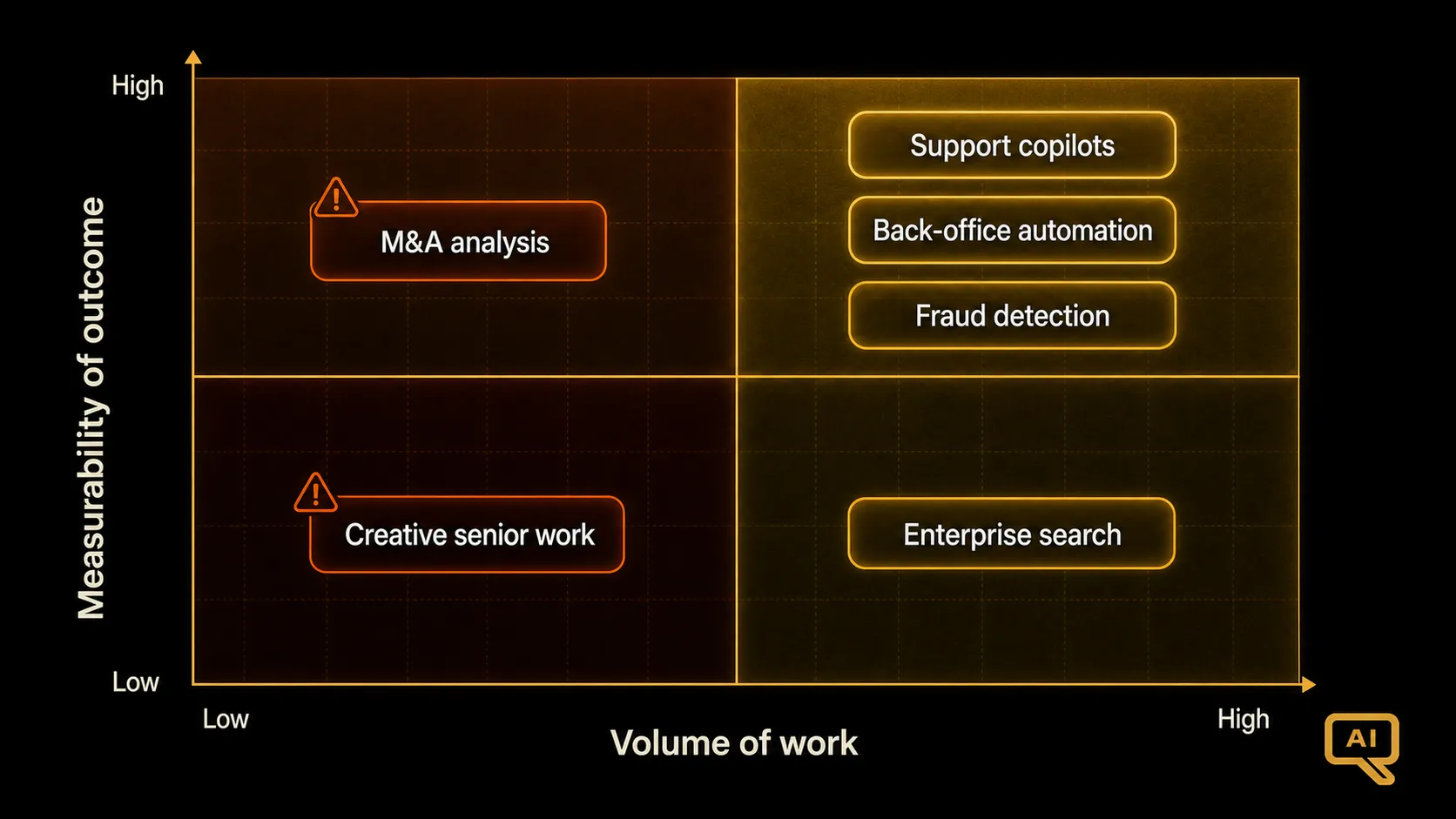
Figure 1 places the common use case categories on a matrix by volume and measurability, which is my rough heuristic for which cases tend to have honest positive ROI.
Back-office automation (finance operations, HR administration, procurement, accounts payable) sits in the upper right of Figure 1. These functions have high volume of repetitive work, well-defined outputs, and clear cost baselines. MIT NANDA’s research specifically calls out back-office as the area where the 5 percent of successful AI programmes have concentrated their wins.
Reference economics: 20 to 50 percent processing time reduction, 30 to 60 percent cost reduction on the specific tasks addressed, 40 to 80 percent straight-through processing rates achievable. Payback periods can be under 12 months, which is fast by AI programme standards.
The reason back-office wins consistently is that it hits all four characteristics of good ROI use cases: high volume, measurable outcome, bounded scope, and enough cost per unit for savings to matter.
Fraud, risk, and compliance
AI for fraud detection, anti-money-laundering, credit risk, and compliance monitoring is a category where the ROI story has been positive for years but the framing matters.
Reference economics on the risk reduction lens: 15 to 40 percent improvement in fraud catch rates, 30 to 60 percent reduction in false positives (which drives operational cost reduction on investigation teams), 10 to 30 percent regulatory workload reduction.
The tricky part of these use cases is that the primary value is often risk reduction rather than direct cost savings, and risk reduction is hard to price because the counterfactual (the losses avoided) is invisible. The best cases pair a defensible base-case value with explicit acknowledgment of the option value: the ability to detect emerging risk patterns faster than rules-based systems.
Knowledge management and internal search
Enterprise search and knowledge management with AI have been widely deployed and produce mixed ROI stories. The problem is that value depends heavily on how much time people spend finding information (which varies enormously across roles) and on whether the AI actually returns better information than existing tools.
Reference economics for the strong cases: 5 to 15 percent knowledge worker time reduction on search-heavy tasks, faster onboarding for new hires, better utilisation of institutional knowledge.
The trap is that this is the category where individual “hours saved” claims are most inflated, because search time is highly variable and easy to overstate. Business cases in this category should be built on specific role cohorts with documented baseline search patterns.
The categories that tend to disappoint
Creative work at the top of the craft ladder (senior writer, senior designer, senior strategist) rarely produces the ROI stories the promotional materials suggest. The value of these roles is in judgment and taste, and while AI can accelerate drafts, the amortisation of setup cost against a small number of high-value outputs typically does not work.
Low-frequency high-value decisions (M&A analysis, executive planning, one-off strategic reviews) are similarly difficult. The volume is too low to justify the specific AI investment, and general-purpose AI tools tend to serve better than bespoke systems.
Workflows where the human process is genuinely fast and cheap already (a well-designed digital form, an efficient team meeting) have very little room for AI to improve, and business cases in these areas usually fail the size test.
Building a use case portfolio
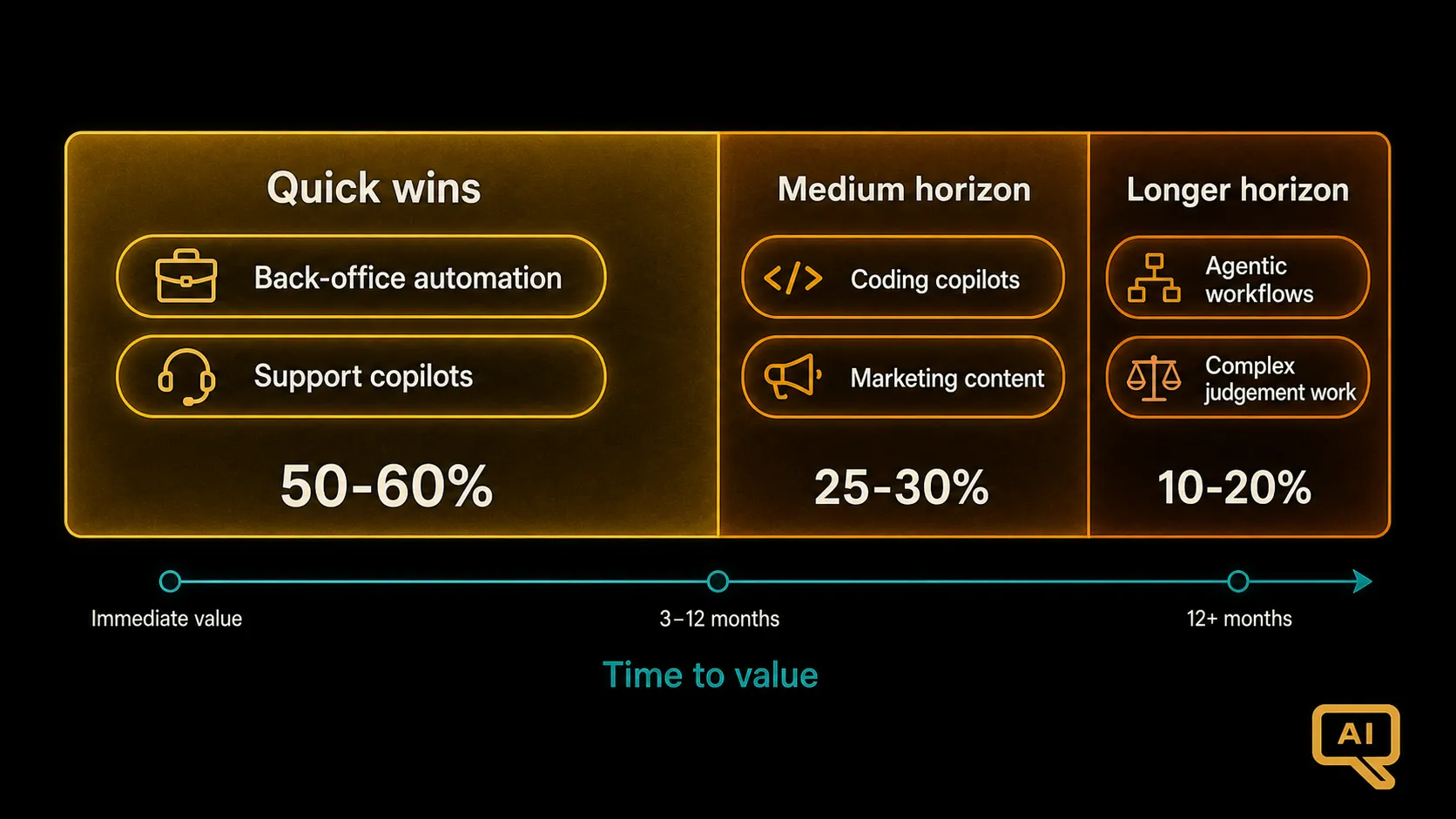
Figure 2 shows how I recommend building an initial use case portfolio. The heavy weight sits on the categories with predictable ROI: back-office automation and support copilots. These are the workhorse investments that fund the more speculative ones. Medium weight sits on coding copilots and marketing content, which have real value but require careful economics work. Small allocations go to the categories with harder economics: creative work, sales conversion, knowledge management for diffuse audiences.
The point of the portfolio view in Figure 2 is that the same organisation can be simultaneously right and wrong about AI ROI depending on which use cases it emphasises. Organisations that lead with back-office and support see the positive ROI story. Organisations that lead with creative work and low-frequency high-value decisions see the disappointing ROI story. Both are looking at real data. The choice of use case is doing most of the work.
If your programme’s early wins are concentrated in the high-ROI categories, you buy the political and financial capital to pursue the harder cases later. If your early wins are absent, the programme rarely gets to the point where the harder cases could have delivered. This is why the use case selection question is often more consequential than the technology choice, and why the portfolio view belongs in the business case from the start.