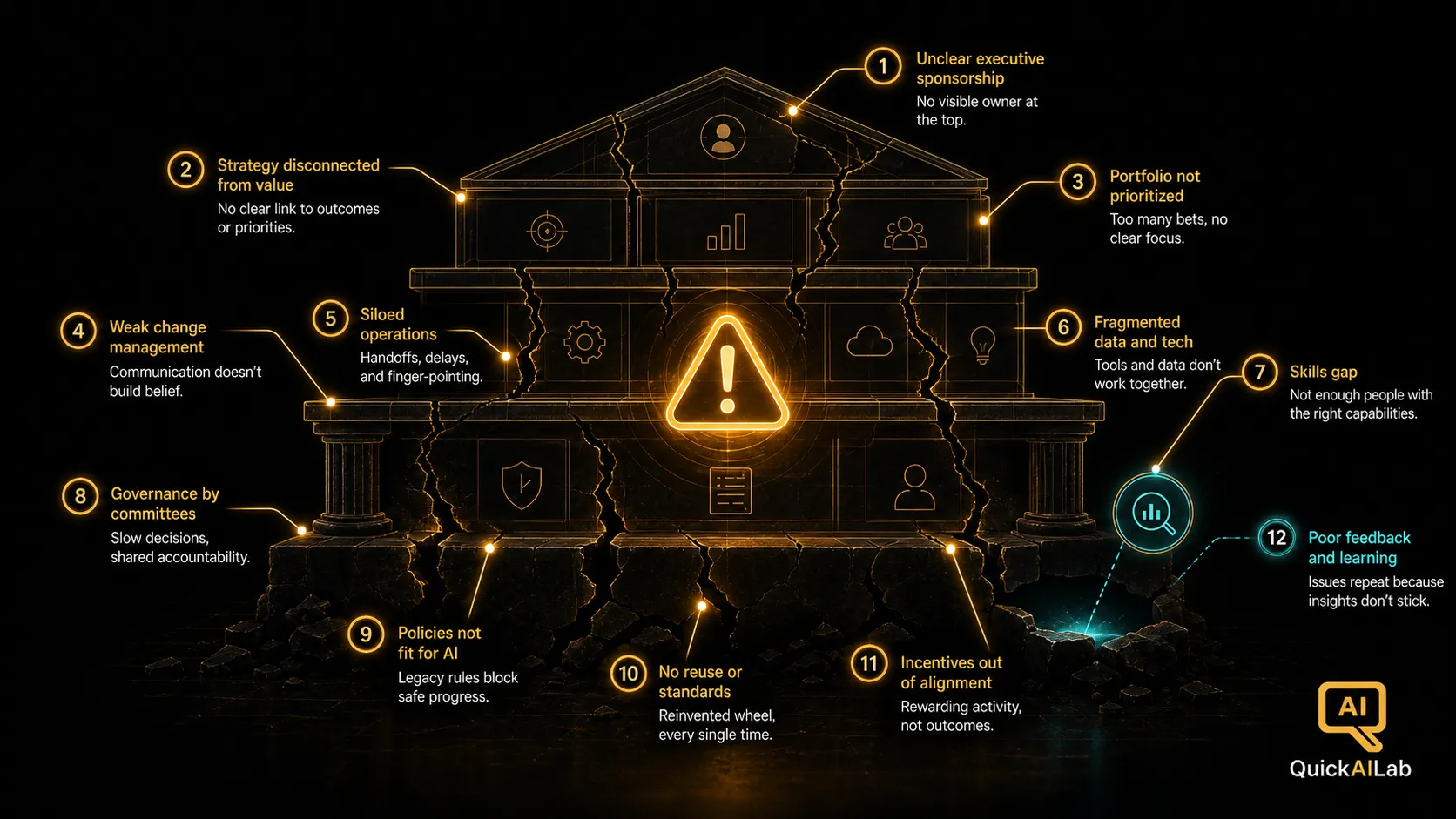
Every long consulting career eventually accumulates a mental catalogue of patterns that go wrong. Not the exotic failures that appear in case studies, but the mundane, recurring ones that show up in enterprise after enterprise, quarter after quarter, always looking slightly different on the surface and identical underneath. The Data & AI Strategy track closed with an anti-patterns article because naming failures is a specific form of teaching. This track closes the same way for the same reason.
What follows is twelve named anti-patterns from the AI operating model literature and, more importantly, from the enterprises quietly working through them right now. Each has a signature, a set of symptoms, an underlying cause, and an antidote. Most enterprises will recognize themselves in at least three. That is not a criticism; it is the point. Anti-patterns are diagnoses, and diagnosis is the first move toward treatment.
The structural anti-patterns
1. The gatekeeper Center of Excellence. Signature: a CoE with formal approval authority over every AI initiative. Symptoms: a backlog stretching past a quarter, business units running “unofficial” pilots with contractors, a growing gap between what the CoE reports and what your expense reports show. Cause: leadership tried to solve risk with a queue, and the queue produced the risk it was meant to prevent by driving activity into the shadows. Antidote: shift the CoE from gate to enabler; embed control in the platform and the standards rather than in a human approval path. This is the failure mode the third article of this track was written to prevent, and it is still, in 2026, the single most common structural anti-pattern in enterprise AI.
2. The federated wild west. Signature: no central team, every business unit doing its own thing. Symptoms: five teams solving the same problem five ways on five stacks, no consolidated inventory, and a shrug in the room when a regulator asks how AI is governed. Cause: leadership confused decentralization with lack of standards, or the central team never coalesced. Antidote: start a hub-and-spoke transition with the spokes’ consent; use the platform investment as the carrot rather than mandating with a stick. The hub does not need to be big. It needs to be real.
3. The steering committee with no service. Signature: an “AI CoE” that consists of a monthly leadership meeting and a shared drive. Symptoms: strategy documents, roadmaps, and few actual services delivered. Cause: leadership stood up governance without standing up capability. Antidote: name the platform team, name the enablement lead, name what the CoE will deliver by next quarter that a business unit will actually consume. If the answer is nothing, it is not a CoE; it is a committee.
The people anti-patterns
4. Unicorn-first hiring. Signature: the first requisition opened is a senior ML engineer or, worse, an AI researcher. Symptoms: an 89-day search, a premium salary, and a hire who spends six months looking for someone to define the problem. Cause: leadership confused technology talent with delivery talent. Antidote: hire the AI product manager first, embed a domain expert, hire the AI engineer third. The order matters, and it is the sequence the fifth article of this track specifically prescribed.
5. Training theater. Signature: a video library, a completion dashboard, and no measurable change in workflow. Symptoms: high completion rates in reports, low actual usage in platform telemetry, and continued shadow tool consumption. Cause: leadership confused activity with capability. Antidote: role-based curricula anchored in the sandbox, hands-on work on real use cases within weeks, and measurement against tool telemetry, not certificates. The literacy article of this track was written to prevent exactly this pattern; it recurs anyway because it is easy to fund and easy to look busy inside.
6. The extraction culture. Signature: relentless demand from leadership for AI-driven productivity with no reinvestment in the humans producing it. Symptoms: rising employee cynicism, quiet sabotage numbers climbing toward the 29 percent Writer’s 2026 research measured, and the “AI elite versus everyone else” split executives openly plan for. Cause: leadership treated AI adoption as a cost-reduction lever rather than a capability lever, and the workforce noticed. Antidote: pair every productivity ask with a matching capability, career, and compensation reinvestment; treat freed capacity as a strategic resource, not a headcount reduction opportunity. Organizations that get this wrong will spend the next decade retaining nobody they wanted to keep.
The delivery anti-patterns
7. Pilot purgatory. Signature: a portfolio full of proofs of concept, few in production, and everyone busy. Symptoms: shipping cadence measured in years, use cases that die at the “let’s productionize” gate, and a growing sense inside delivery teams that nothing they build ever really goes live. Cause: an operating model that funds pilots but does not fund the operational surface, monitoring, ops team, integration effort, that real production requires. Antidote: fund the operational tail as part of every initiative from day one; refuse to green-light a pilot without a named path and budget for production if it works. The Data & AI Strategy track’s pilot-to-production article covered the shape of the problem; this is its operating model reflection.
8. Bolted-on AI. Signature: AI tools deployed without any workflow redesign. Symptoms: tools sit unused; the small fraction who use them extract personal productivity that never aggregates to enterprise value; adoption is stuck around IBM’s 25 percent line. Cause: leadership confused deployment with transformation. Antidote: the entire tenth article of this track is the antidote, and there is no shortcut to it. Workflows must be redesigned around AI as a participant, or the deployment is inventory.
9. Point-in-time governance. Signature: models and agents pass a rigorous review at launch and are never meaningfully assessed again. Symptoms: drift going uncaught, incidents that surprise everyone in the room, and eventually an external event, an audit, a customer complaint, or an incident that reveals the assurance gap. Cause: leadership treated governance as an event rather than a discipline. Antidote: continuous assurance embedded in the ops culture, monitored at output level, with real evaluation coverage as a portfolio metric. The MLOps and LLMOps culture article of this track sketches the shape; the Governance track fills in the compliance detail.
The financial anti-patterns
10. Invoice-anchored budgeting. Signature: the AI budget is set based on the API provider’s monthly invoice. Symptoms: repeated budget overruns as consumption grows; the FinOps team reporting that costs mysteriously appear that were not on the plan; the total AI spend turning out to be several times what was budgeted. Cause: leadership budgeted for one of the nine cost buckets FinOps X 2026 identified and ignored the other eight. Antidote: the full stack view from the funding article of this track; budget against fully loaded cost, not the API line, and track token consumption on the same dashboard as latency and error rate.
11. Adoption gamification. Signature: internal leaderboards of who is using AI the most, prizes for high consumption, executive dashboards celebrating token throughput. Symptoms: consumption growth that outpaces value creation; use cases where cost per outcome is measurably worse with AI than without; a rising discomfort in the finance function that everyone else is treating as a rounding error. Cause: leadership confused activity with value. Antidote: gamify value per token or cost per outcome, not raw consumption, and be prepared to name and celebrate teams that reduced token spend by finding a smaller model that works. This is the mistake FinOps X 2026 explicitly warned about, and it is still recurring in enterprises that read the same conference reports.
The accountability anti-patterns
12. The nameless agent. Signature: an agent runs in production and no single named human owns it. Symptoms: incidents where escalation delays because nobody knows who to call; a growing gap between the population of production agents and the population of humans who could accurately describe what any specific one does; kill switch inventory that reveals, on inspection, that no one is authorized to actually pull. Cause: leadership treated agent proliferation as a technical trend rather than a workforce reality. Antidote: the five-role accountability model from the fourteenth article of this track, applied per agent, without exception, before deployment. Every agent has a business owner, a technical owner, an oversight authority, an escalation contact, and a kill switch owner, all named, all reachable, all deputized. If any is missing, the agent does not run.
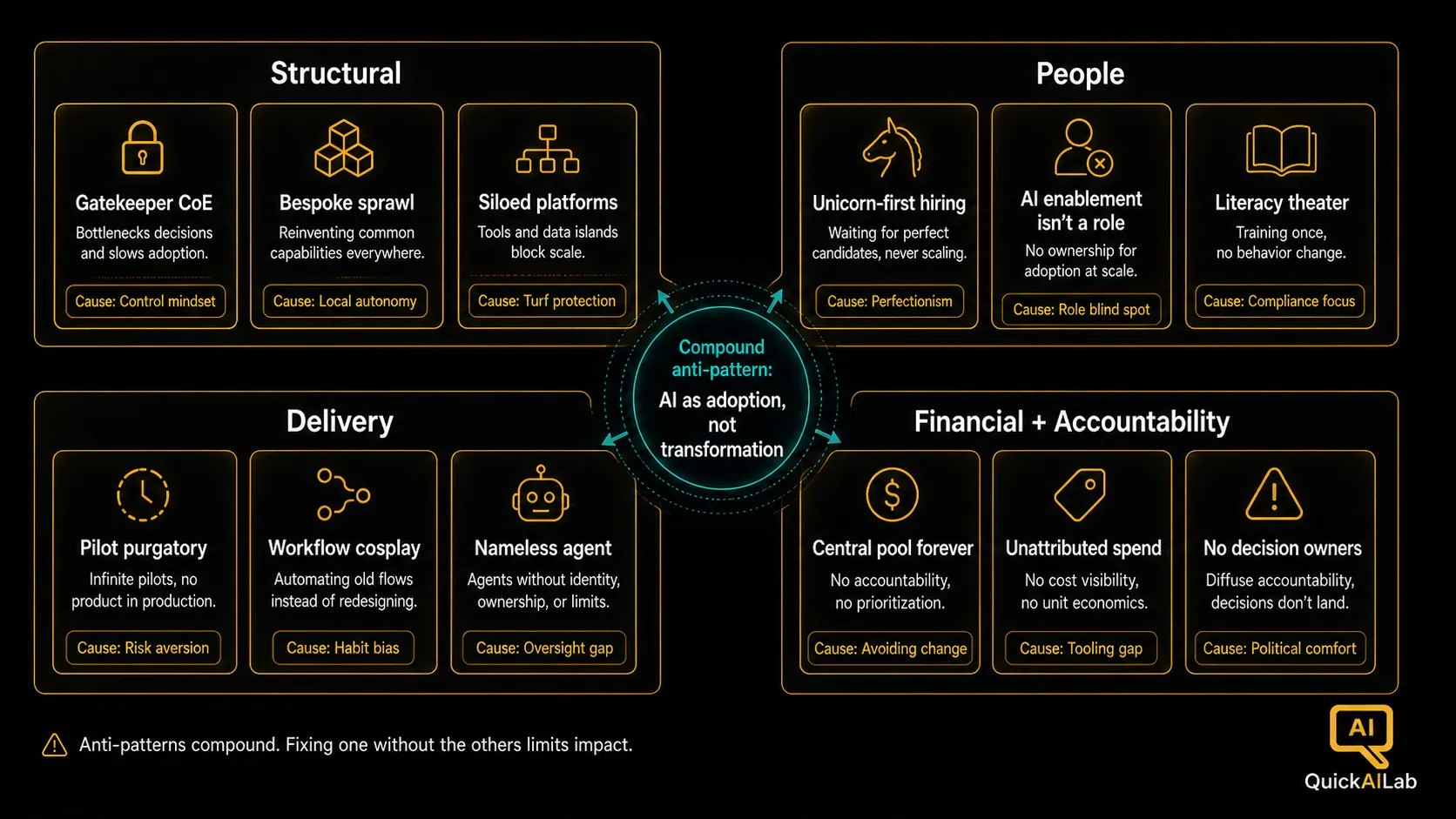
Figure 1 groups the twelve anti-patterns into the four categories, structural, people, delivery, and financial-plus-accountability, with the underlying cause and the antidote reference for each. Reading the diagram as a diagnostic tool, rather than a criticism, is the intended posture.
The compound anti-pattern
There is a thirteenth failure worth naming separately because it produces most of the twelve above. Call it the compound anti-pattern: operating model design that treats AI as a technology adoption program rather than as an organizational transformation. Every specific failure above traces back to this larger misdiagnosis. Gatekeeper CoEs, training theater, bolted-on AI, invoice-anchored budgeting, and nameless agents all descend from the same original confusion: that AI is a thing you install, not a thing you redesign around.
The Deloitte 2026 finding that 48 percent of organizations introduced AI without redesigning workflows or roles, and only 12 percent redesigned at scale with a new operating model behind it, is really a measurement of this compound anti-pattern. It is the failure that shows up in every quarterly review as “why is our ROI not materializing,” and the answer keeps being the same: because the operating model has not moved. Each of the twelve entries in Figure 1 is a specific symptom of that larger drift.
The organizational tell
There is a subtle indicator worth watching for, because it appears before most of the specific anti-patterns become visible. Call it the tell. In organizations that are drifting into anti-pattern territory, leadership conversations about AI shift from being about outcomes to being about programs. “How is the AI initiative going” replaces “how has AI changed how we serve customers this quarter.” “What is the CoE’s roadmap” replaces “which workflows have we redesigned and what did we get from it.” The vocabulary tilts toward the delivery mechanism and away from the value delivered.
That tilt is not necessarily a fatal sign. Every transformation goes through periods where the delivery mechanism needs attention. But when the tilt becomes durable, when three consecutive quarterly reviews spend more time on the CoE headcount than on the workflow outcomes, the operating model has started to see itself as the end. Which is the moment it stops working.
What the good ones do differently
Turn the anti-patterns upside down and you get, roughly, the operating model this track has spent sixteen articles describing. The best programs are not the ones with the best models, the biggest CoEs, or the largest platform investments. They are the ones with these specific habits.
They design for the operating model as a system, not as a stack of independent decisions. Structure, platform, people, culture, funding, accountability, and adoption all move together, because moving one without the others produces failure modes the others cannot compensate for.
They redesign work around AI, not the other way around. Every workflow is revisited on a cadence, and the reinvestment of freed capacity is treated as a strategic decision, not an afterthought.
They keep the accountability skeleton crisp. Every production system has named owners at every role, and the operating model treats those names as first-class artifacts, updated as people move, revisited quarterly, tested under incident conditions.
They read shadow signals as product feedback. Unauthorized tools are a signal about platform inadequacy; low adoption is a signal about workflow friction; cost surprises are a signal about attribution gaps. The organizations that pull ahead have made the reflex of learning from these signals faster than the ones that discipline them out of view.
They fund the J-curve honestly. The financial arc of a scaled AI program is understood by leadership from the start, defended against year-over-year scrutiny with the phase model, and matched with the operational discipline that makes it recoverable if it slips.
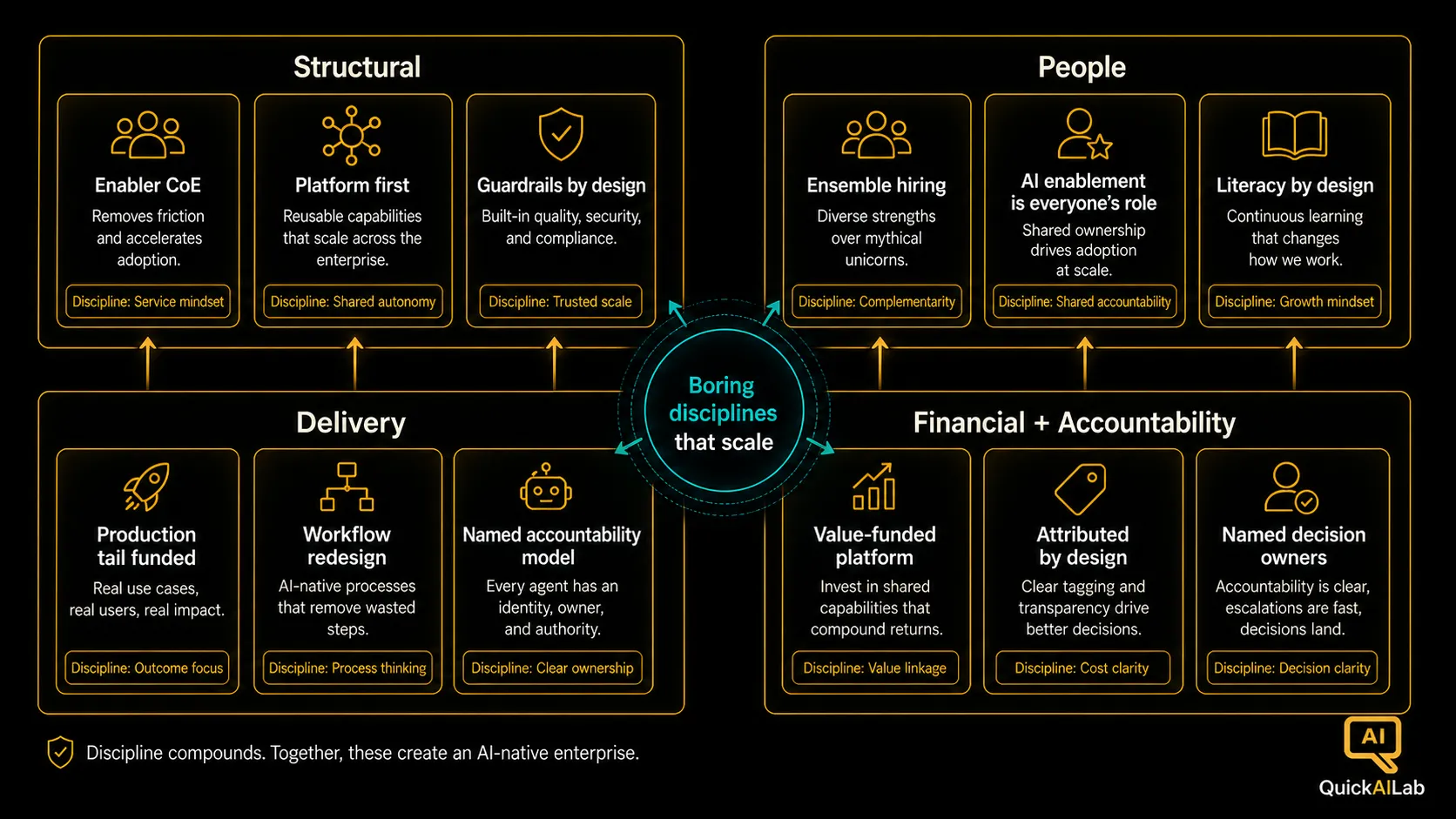
They build the operating model as a permanent capability, not a project. The AI world does not stop moving. Neither does the operating model, in the organizations that are pulling ahead. Every discipline in Figure 2 is boring; that is precisely why it works, because boring things scale and exciting ones do not.
Figure 2 shows the antidote pattern as a positive mirror of the anti-patterns: the same twelve failure categories reframed as the twelve disciplines that resist them. The picture is deliberately simple, because the message is simple. Every anti-pattern has an antidote. The antidote is usually less exotic than the anti-pattern, because it is just the discipline the anti-pattern skipped.
Closing the track
Sixteen articles ago, this track opened with a data point: two companies buy the same AI tools in the same quarter, and eighteen months later one has embedded AI as a capability while the other has a graveyard of pilots. The technology was the same. The operating model was not.
Everything in between has been an unpacking of that difference. Structures, people, ways of working, funding, accountability. Each chapter is separately learnable and separately implementable. Together they form the system that separates AI adoption from AI transformation, which is the difference this era is now measuring and, increasingly, rewarding.
The next tracks in the QuickAILab library will unpack the ROI mechanics (Business Case and ROI), the use cases and tutorials that make the abstractions concrete, and the quick-reference guides that turn all of this into daily practice. But this track’s work is now done. If the ideas in these sixteen articles have earned a place in your operating model, the payoff will not be a single quarterly result. It will be a compounding advantage that gets easier to see over years and harder to reverse. That is what AI-native looks like when the fog clears.
Build for it deliberately, or find, as the Deloitte research warned, that someone else, an auditor, a regulator, a customer, or a competitor, has built it for you. The choice, it turns out, is what an operating model is for.