
Ask a leadership team about their AI skills strategy and you will usually hear about hiring engineers. Ask what the other 95 percent of the workforce knows about AI, and the room goes quiet. Yet that silence is where AI programs actually fail. Deloitte’s 2026 enterprise research names the AI skills gap as the single biggest barrier to integrating AI into workflows, and notably, education was the number one way companies adjusted their talent strategies in response, ahead of role redesign or restructuring.
The numbers behind the silence are stark. Ninety-four percent of CEOs identify AI as their top in-demand skill, yet only 35 percent of leaders believe they have actually prepared their employees for AI-driven ways of working. Only about a third of organizations mandate any AI awareness training at all. Meanwhile AI literacy now ranks among the top two global skills shortages, second only to AI development itself. Literacy is not the soft edge of the operating model. It is the substrate every other article in this track silently assumes.
What literacy actually means
AI literacy is not “everyone learns to code” and not a compliance video with a quiz. Usefully defined, it is the ability to use AI with judgment: knowing what the tools can do, what they cannot, when to trust an output, when to challenge it, and what the rules of engagement are in your organization. That definition scales from the board to the warehouse floor, but the content changes radically by altitude, which is why one-size-fits-all programs fail.
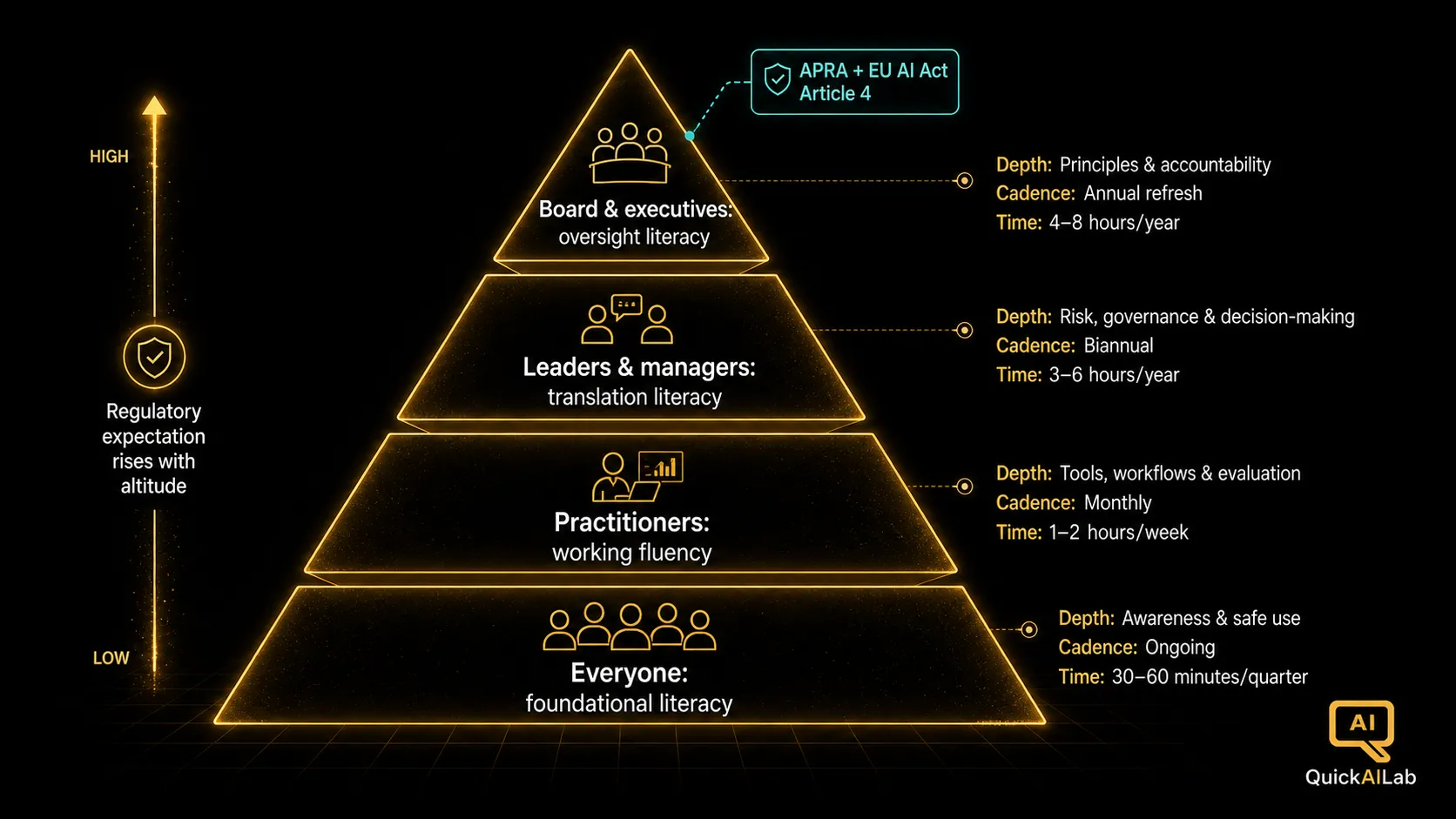
The board and executive tier needs strategic and oversight literacy: enough understanding of AI capabilities, economics, and risk to allocate capital wisely and challenge management effectively. This is no longer optional courtesy. Regulators have made it supervisory expectation: APRA has signalled that it expects boards to maintain AI literacy sufficient for effective challenge and oversight, and the EU AI Act’s Article 4 obliges providers and deployers to ensure adequate AI literacy in their staff, an obligation that has been live since February 2025. A board that cannot interrogate an AI investment case or an AI incident report is now a governance finding waiting to happen.
Leaders and managers need translation literacy: the ability to spot AI opportunities in their domain, redesign workflows around the technology, and manage teams whose daily work involves reviewing machine output. The middle layer is where adoption lives or dies, because managers set the incentives and model the behavior.
Practitioners in AI-exposed roles need working literacy: hands-on fluency with the approved tools, context and prompting skill, output validation habits, and clear knowledge of escalation paths. This tier is where the productivity is, and where the premium sits: trained employees demonstrate nearly three times the proficiency of untrained ones on the same tools.
Everyone else needs foundational literacy: what AI is, how the organization uses it, what the policies allow, how to recognize AI-generated content and AI-driven fraud, and where to take ideas. Foundational literacy is also your shadow-AI defense: people who know the sanctioned path and why it exists are far less likely to paste customer data into a random consumer tool.
Figure 1 arranges these four tiers with the competencies, depth, and delivery format appropriate to each, from board briefings measured in hours per year to practitioner enablement measured in hours per week.
Why programs fail
Most organizations have already tried something, and most of it has not worked. The failure patterns are consistent enough to name.
Training theater. A library of generic videos, a completion dashboard, a certificate. Completion is a lagging and unreliable proxy for capability, and everyone involved knows it. Skills that are not applied within weeks evaporate.
The one-and-done launch. A big enablement push at rollout, then nothing, in a field where the tools change quarterly. AI literacy has a half-life, and skills in AI-exposed roles are churning more than twice as fast as elsewhere. Literacy must be an ongoing operating rhythm, not an event.
Ignoring the fear. A meaningful fraction of every workforce hears “AI training” as “redundancy preparation.” Programs that never address the elephant, how roles will change, what the organization owes people through the transition, get quiet non-participation no dashboard will explain. The adoption psychology deserves its own article and gets one later in this track.
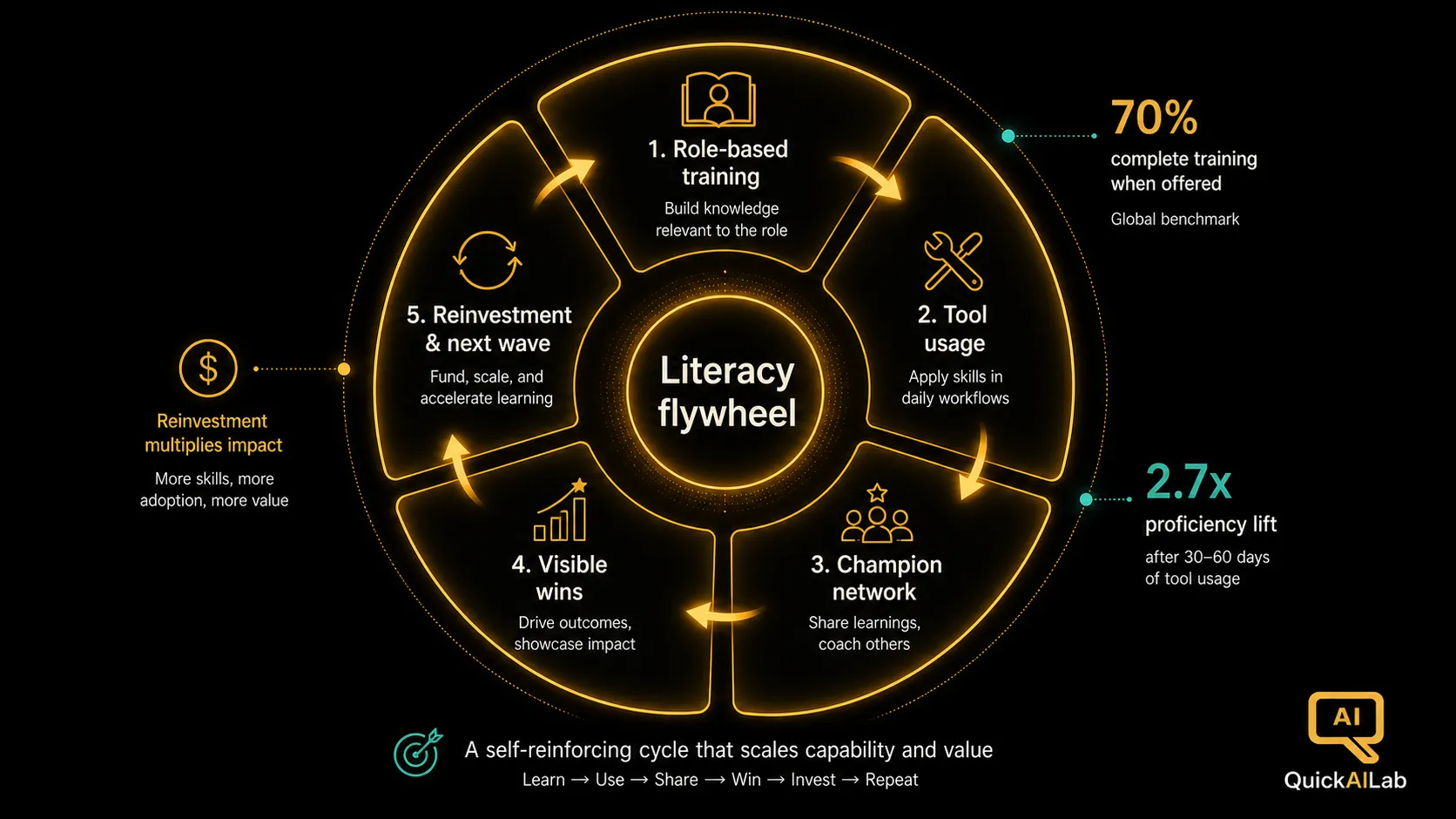
Starving the time. Training offered on top of full workloads is a filter for personal circumstance, not a capability program. The demand side is not the problem: when employers make AI training genuinely available, around 70 percent of workers complete it. Appetite exists. Hours do not, unless leadership allocates them.
The program that works
The organizations doing this well, and the case studies now include enterprises rolling AI literacy out to tens of thousands of employees, converge on a recognizable design.
Role-based curricula, built backward from work. Not “Introduction to AI” but “AI for claims assessors,” anchored in the actual tools, actual data, and actual decisions of the role. The enablement lead from the previous article owns this mapping, in partnership with the business.
Hands-on from day one, on the sandbox. The platform article’s sandbox earns a second mission here: a safe environment with approved tools and non-sensitive data is the best classroom ever built. People learn AI by using AI on their own work, then comparing notes.
A champions network. Every team has its early adopters. Name them, train them deeper, give them time allocation and visible status, and let peer influence do what mandates cannot. Champions also serve as the sensing network that surfaces use case ideas upward, feeding the portfolio intake from the strategy track.
Leadership goes first, visibly. When executives demonstrably use the tools, share their own prompts, and talk about their own learning curve, the permission structure changes overnight. When they delegate literacy downward while remaining personally exempt, everyone notices that too.
Measurement beyond completion. Mature programs assess capability, not attendance: scenario-based assessments, tool telemetry showing actual usage patterns, quality metrics on AI-assisted work, and manager observation. Verified skill data then feeds workforce planning, closing the loop with the build-buy-borrow portfolio from two articles back.
Figure 2 assembles these elements into the literacy flywheel: role-based training drives tool usage, usage generates champions and use case ideas, ideas produce visible wins, wins fund and legitimize the next training wave.
The governance dimension
One more reason literacy has moved from nice-to-have to operating requirement: the regulatory perimeter now runs through it. Article 4 obligations, board oversight expectations, and the general supervisory shift toward continuous assurance all presume a workforce competent to operate, monitor, and challenge AI systems. An organization can outsource models and platforms; it cannot outsource the judgment of its own people. When an incident review asks “was the human overseer equipped to catch this,” the literacy program is the evidence, and as Figure 1 makes clear, that evidence needs to exist at every tier, not just among the engineers.
There is also a quieter strategic argument. In a market where AI literacy is one of the two scarcest skills on earth, an organization that manufactures it internally at scale has built an asset competitors must buy retail, one expensive hire at a time. Literacy programs are slow and unglamorous, and that is precisely why they compound: the flywheel in Figure 2 spins for years once it starts, and it is very hard to copy from outside.
Closing the people arc
This article closes the first half of the AI Operating Model track. We have covered the structures: the archetypes, the Center of Excellence, and the platform team. And we have covered the people: the core team, the sourcing portfolio, the new roles, and now the literacy substrate underneath them all.
What remains is the harder half: the ways of working. Structures and skills create potential; behavior converts it. The next article opens that arc with the AI adoption gap, why capable people with good tools so often quietly decline to change how they work, and the change management discipline that decides whether all the capability this batch described ever becomes value.