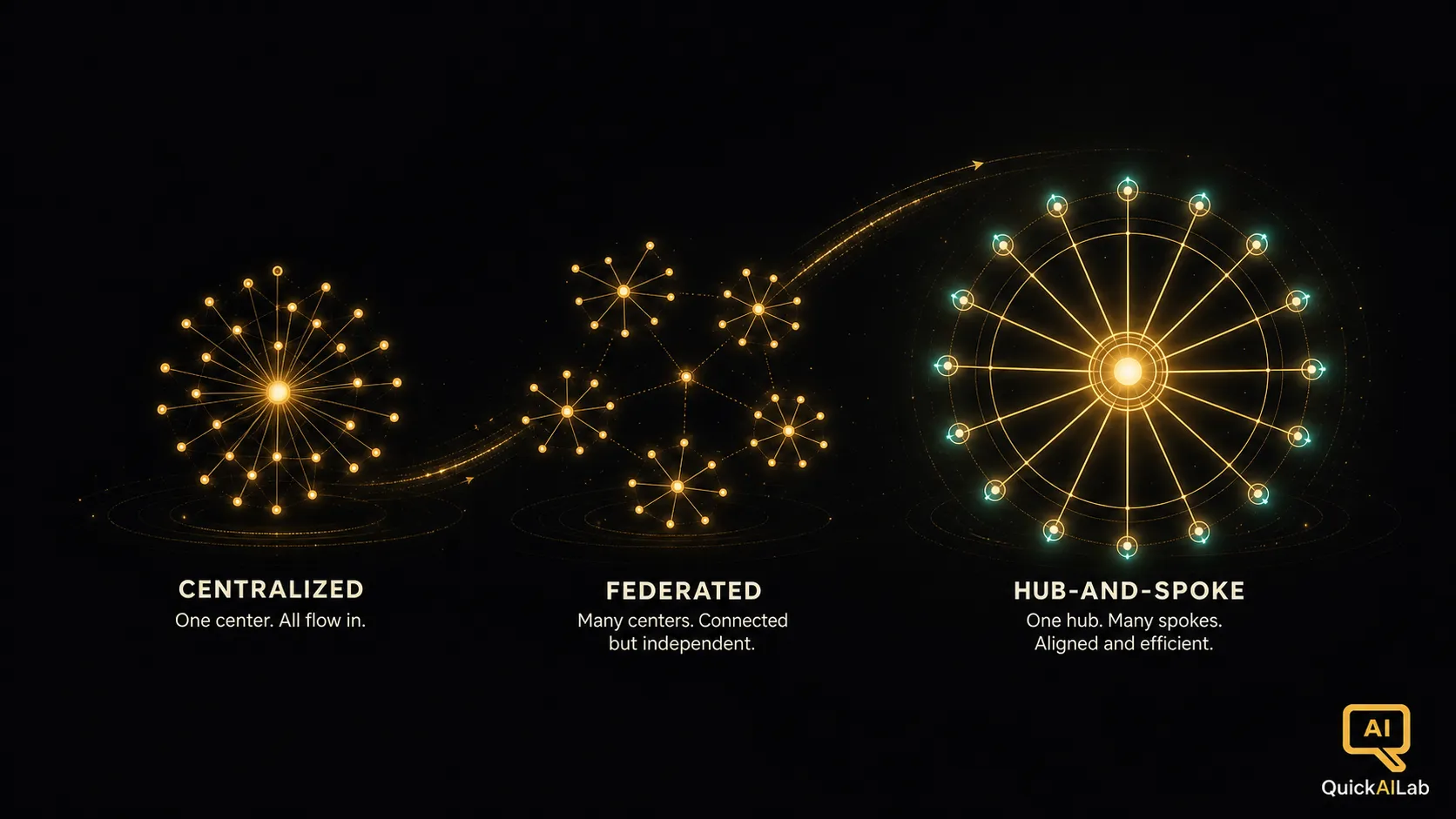
Every AI operating model conversation eventually arrives at the same whiteboard moment: someone draws three diagrams. A single box with everything inside it. A scatter of boxes with no center. And a wheel, with a hub in the middle and spokes reaching out to the business.
The drawings take thirty seconds. Living with the choice takes years. Where your AI capability sits determines who moves fast, who gets frustrated, what gets duplicated, and whether your standards mean anything. It is the most consequential structural decision in this entire track, so let’s give the three archetypes the scrutiny they deserve.
The centralized model: one team to rule them all
In the centralized archetype, a single AI function owns everything: strategy, platform, delivery, governance, and talent. Business units bring problems; the central team builds solutions.
The appeal is real. You concentrate scarce talent instead of scattering it. Standards are consistent because one team enforces them by doing the work. Governance is airtight because nothing ships without passing through the center. For organizations early in their AI journey, in heavily regulated industries, or with genuinely scarce AI skills, centralization is often the right starting posture.
The failure mode is just as real, and it arrives on a schedule. Demand outgrows the team. A queue forms. Business units wait months for a slot, and the ones with urgent problems stop waiting: they hire their own people, buy their own tools, and build in the shadows. The central team, built to ensure quality, becomes the reason quality happens elsewhere without supervision. I have seen centralized AI teams celebrated in year one and routed around by year three.
The signal to watch is the intake queue. When the backlog stretches past a quarter and shadow tools start appearing in expense reports, the structure is telling you it is done.
The federated model: let a thousand flowers bloom
At the other pole, each business unit builds and runs its own AI capability. Marketing has its team, operations has its team, and the corporate center provides little more than encouragement.
Speed is the headline benefit. Teams closest to the problem build solutions for the problem, with domain context no central team can match, funded by leaders who directly feel the value. There is no queue because there is no gate.
The costs accumulate quietly. Five teams solve the same document extraction problem five ways, on five vendor stacks, with five security postures. Nothing is reusable. Talent is spread too thin for anyone to develop depth. And when a regulator or a board member asks “how do we govern AI here,” the honest answer is a shrug. The federated model produces AI activity in abundance and AI capability almost by accident.
Pure federation tends to be something organizations discover they have rather than something they choose. It is the default state of unmanaged enthusiasm.
Hub-and-spoke: the convergence point
Which brings us to the archetype that most scaled AI programs converge on. In hub-and-spoke, a central function, usually a Center of Excellence, serves as the hub for strategy, enablement, platform, and governance, while business units, the spokes, own delivery, funding, and outcomes.
The critical design detail, and the one most often botched: the hub enables rather than gates. It provides infrastructure, reusable assets, training, and guardrails. It does not sit in the approval path for every use case. CIO’s 2026 reporting on enterprise AI describes exactly this shift among Fortune 500 firms: the center of excellence as a hub for strategy and enablement rather than a gatekeeper for approvals, precisely because no central team can meet the demand pull AI generates from the business.
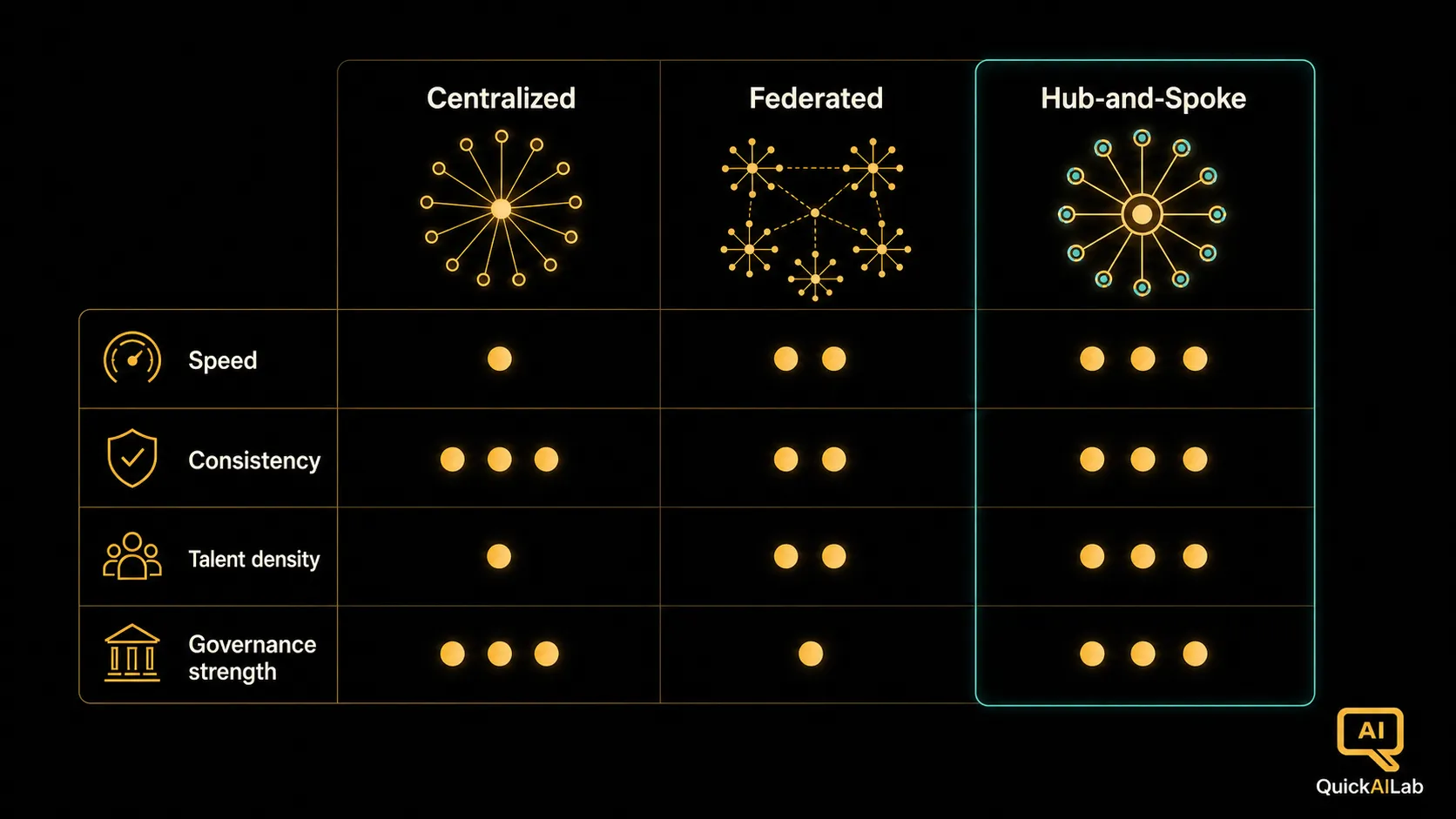
Figure 1 lays the three archetypes side by side, with the trade-offs each one makes on speed, consistency, talent density, and governance strength. No archetype wins on every axis, which is exactly why the choice has to be made consciously rather than inherited.
How to actually choose
The right structure is a function of four variables, and being honest about them matters more than any framework.
Maturity. Early-stage programs benefit from centralization because standards do not yet exist and talent is thin. As playbooks solidify and literacy spreads, the balance shifts toward the spokes.
Regulatory intensity. A bank and a consumer app company should not have the same structure. High-stakes, heavily supervised domains justify a stronger, more involved hub for longer.
Talent reality. If you have eight AI engineers, splitting them across six business units guarantees mediocrity everywhere. Concentration is a forced move until the bench deepens.
Demand distribution. If AI value is concentrated in one or two functions, a targeted structure beats an enterprise-wide one. If demand genuinely comes from everywhere, and in 2026 it usually does, the hub-and-spoke wheel earns its complexity.
Notice what is not on the list: what your competitor did, what the analyst deck recommends, and what your most senior technologist prefers. Structure follows situation.
The evolution nobody tells you about
Here is the insight that separates operating model design from operating model drawing: the structure is not a destination, it is a trajectory. The best programs define an interim state and an end state, and plan the migration between them.
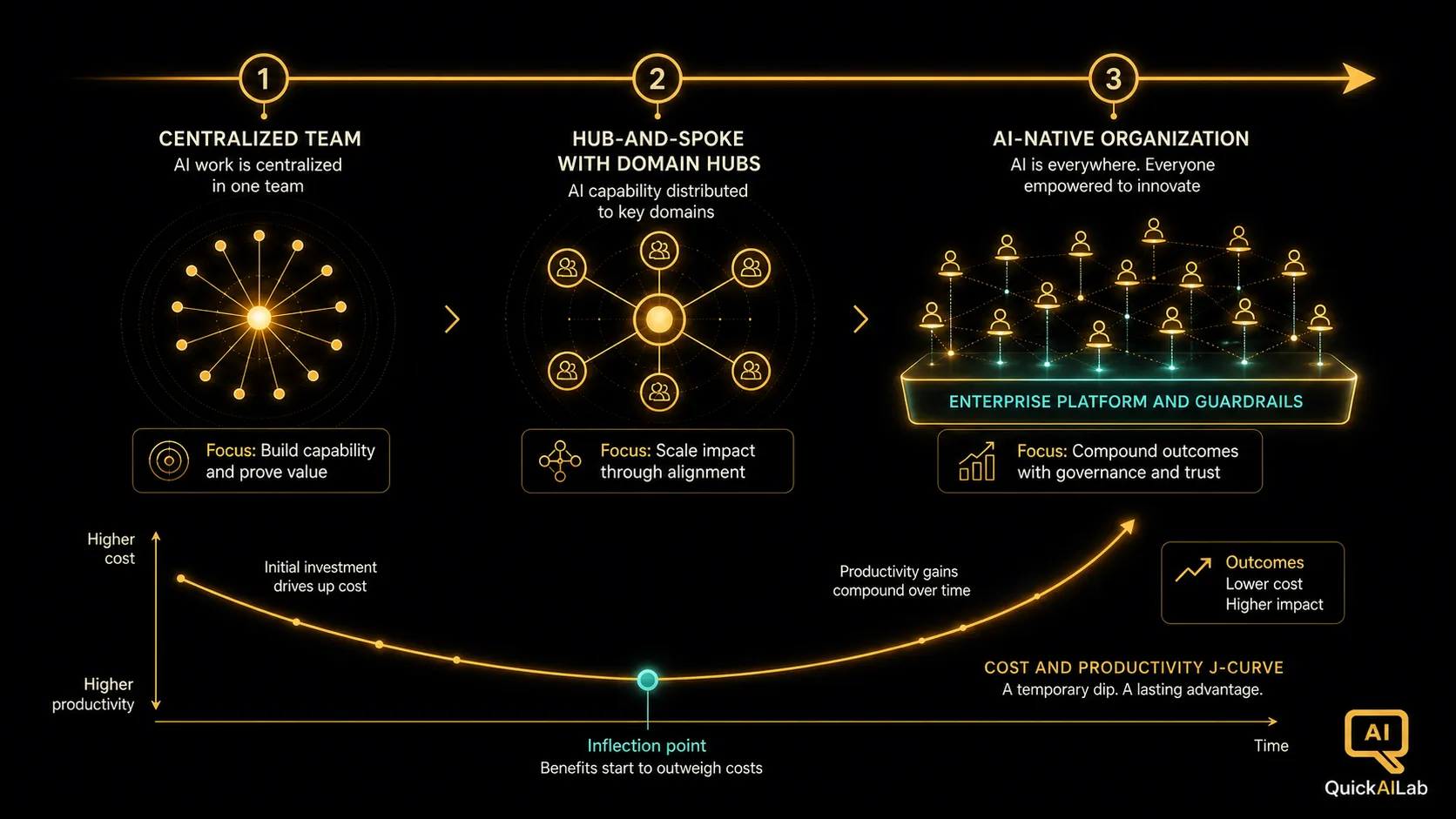
A pattern now visible among large enterprises runs like this. The interim state establishes domain-based AI hubs inside each major business area, staffed with platform specialists, responsible AI advisors, and data engineers, accelerating local delivery while staying aligned to enterprise standards. The end state sees those domain hubs dissolve into smaller AI-empowered teams that operate independently on top of shared enterprise platforms and policies. The center never disappears; it gets thinner and more foundational as the spokes get stronger.
Figure 2 sketches this maturity path: centralized beginnings, a hub-and-spoke middle passage with domain hubs, and an AI-native end state where the capability lives everywhere and the hub runs the platform and the guardrails.
Two things make this migration survivable. The first is sequencing discipline: you strengthen the spokes before you thin the hub, never the reverse. Organizations that dismantle central capability on the promise of federated maturity that has not yet arrived get the worst of both worlds.
The second is financial patience. Leaders mapping this journey should expect a J-curve: costs rise in the early phases as platform investment and dual structures ramp up, and productivity accelerates later as the model beds in. Boards that expect linear returns from a structural transformation will lose their nerve exactly when holding it matters most. We will come back to the funding mechanics in a later article on AI FinOps, because paying for the wheel is its own design problem.
The questions that stress-test your choice
Before you commit, run your preferred structure through five scenarios and see if it survives:
A business unit wants to deploy a customer-facing agent next quarter. Who says yes, who owns the risk, and how long does the path take? If the answer is “six committee meetings,” you have rebuilt the gate.
Two units are about to build the same capability. Who notices, and what happens next? If the answer is “nobody,” you have federation with extra steps.
A model behaves badly in production at 2 a.m. Who gets paged? If the answer involves an org chart debate, the structure has a hole where accountability should be.
Your best AI engineer wants a career path. Does one exist outside the central team? If not, your spokes will never staff themselves.
The regulator asks for an inventory of every AI system in production. Can anyone produce it inside a week? As Figure 1 suggests, this is where pure federation quietly fails the exam.
Structures that pass all five are rare on the first draft. That is the point of the exercise.
Where this leads
The hub-and-spoke consensus is not fashion; it reflects something true about AI in 2026. Demand is too distributed to centralize and too risky to fully federate, so the equilibrium is a strong, thin center and empowered edges, with the balance shifting edge-ward as maturity grows, exactly the trajectory Figure 2 traces.
But an archetype is just a silhouette. The hub only works if it is a real thing with a real mandate, real services, and a real funding model, not a steering committee with a logo. Building that hub properly is the subject of the next article: the AI Center of Excellence, what it should own, what it should never own, and how to keep it from becoming the bottleneck it was created to prevent.