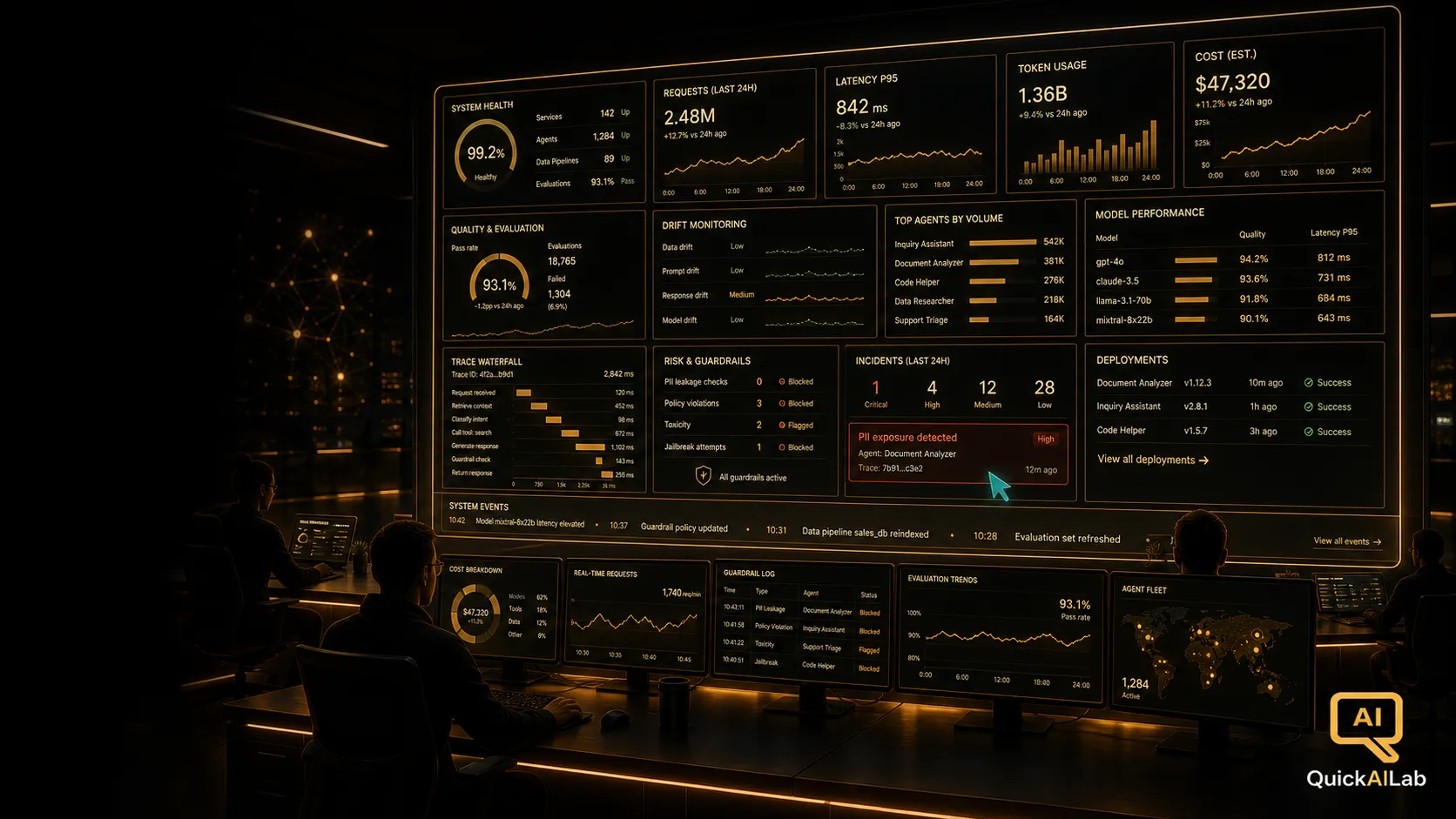
Most organizations describe MLOps and LLMOps in terms of tooling: pipelines, model registries, evaluation harnesses, monitoring dashboards, deployment frameworks. All of that matters. None of it is the point. Ops discipline for AI is not primarily a tool problem, and the organizations pulling ahead are the ones who have figured that out early. It is a culture: a set of habits about how models are shipped, watched, changed, and retired, embedded in the daily work of engineering and delivery teams. The tooling supports the culture. The culture is the operating system.
I want to make this argument concretely, because “culture” is one of the words most likely to produce eye-rolling in engineering rooms, and rightly so when it is a stand-in for slogans. What I mean is specific: a pattern of behavior that shows up predictably in code review comments, incident post-mortems, model release checklists, and the small daily decisions that decide whether an AI system stays reliable at scale. The pattern is teachable, measurable, and either present or absent in a way that everyone on the team can feel within a week of joining.
Why point-in-time discipline fails for AI
Classical software development learned, over decades, that quality is a function of continuous discipline: tests that run every commit, code review that catches problems early, deployments that are boring because they happen constantly, monitoring that alerts before users complain. AI systems need all of that, and something more, because they have three properties that break point-in-time assurance.
They drift. A model that scored well on last quarter’s benchmark can degrade quietly as the world shifts underneath its training distribution. Nothing in the code changed, and yet the system is now worse. Catching drift requires monitoring the system’s outputs continuously, not just its uptime.
They regress on retrain. A model retrained on more recent data may fix one class of errors and introduce another. Without a regression suite that tests the specific behaviors the organization cares about, a well-intentioned update can silently break behaviors people relied on.
They fail differently every time. Deterministic software fails predictably; if you saw one instance of a bug, you can reproduce it. Probabilistic systems produce a distribution of behaviors, most correct, some subtly wrong. Individual failures are not root-cause-able the way traditional bugs are, and the discipline required is statistical rather than deterministic.
These properties are why regulators, and increasingly boards, have shifted their expectation from point-in-time assurance to continuous assurance. A model that was audited in Q2 is not, by that fact, safe to run in Q3. The Governance track goes deep on this shift; the operating model implication is that the daily habits of the teams running these systems must produce continuous evidence, or the evidence does not exist.
The five habits of a working ops culture
Strip the tooling and what remains, in the teams that do this well, is a recognizable set of habits.
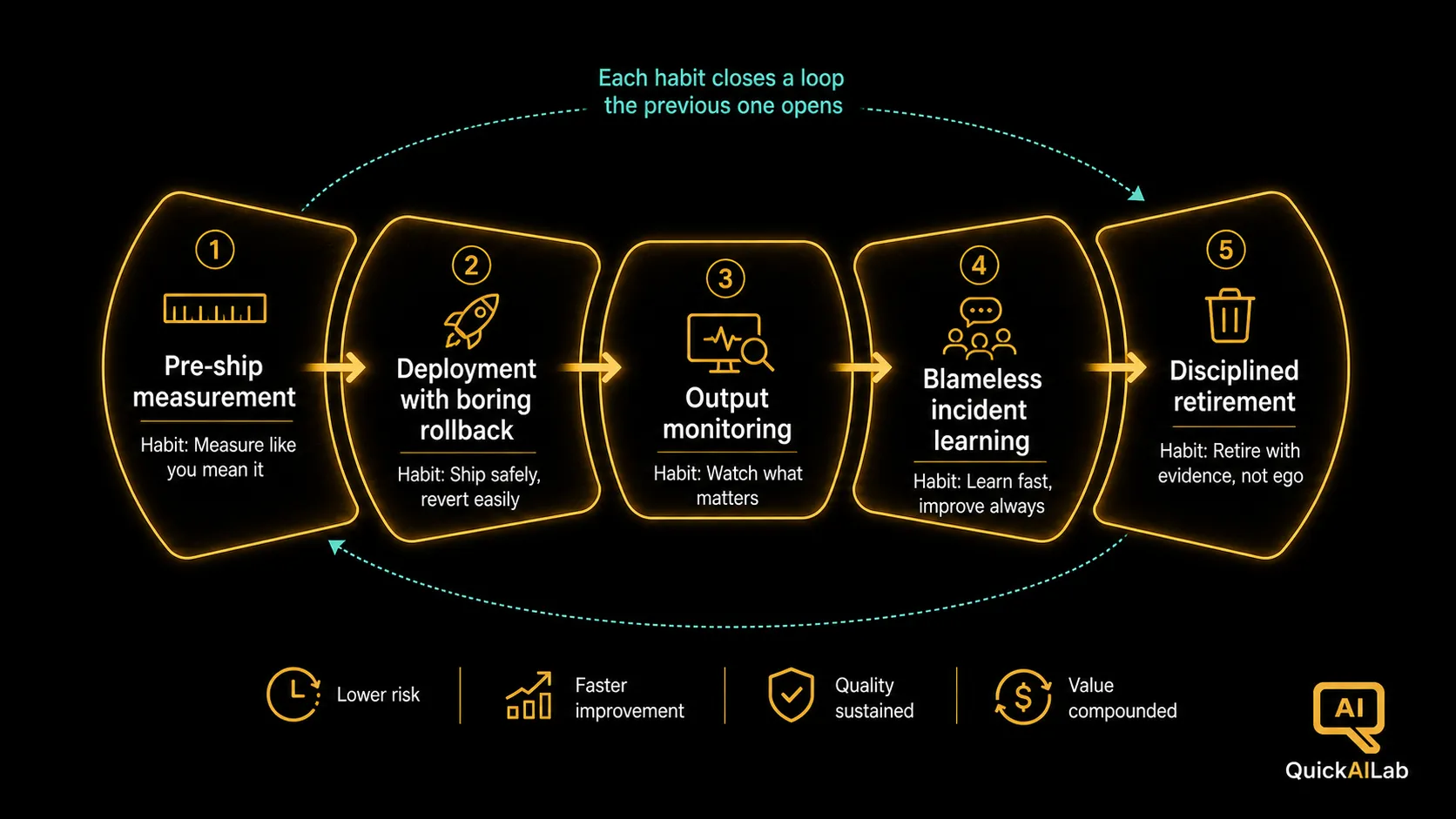
Everything is measured before it ships. Every model, prompt change, agent modification, or retrieval tweak passes through the evaluation harness before it reaches production. The habit is not “we have tests”; it is “nothing ships without running them, no exceptions, and the expected accuracy delta is stated in the pull request.” The evaluation engineer role introduced earlier in this track exists to build and defend this habit.
Rollbacks are boring. Rolling back a bad model or a bad prompt is a one-command operation, practiced regularly, understood by every team member. If a rollback is a heroic event, the team is one incident away from delaying rollbacks past the point where they help. Boring rollbacks are the psychological safety that makes bold releases possible.
Monitoring watches the outputs, not just the infrastructure. GPU utilization and latency dashboards catch infrastructure problems. What catches model problems is monitoring the shape of the outputs: distribution shifts, confidence changes, escalation rates, downstream user behavior. Ops cultures that treat output monitoring as first-class are the ones that catch drift before customers do.
Incidents produce learning, not blame. AI systems will fail. The question is what the organization does with the failure. Cultures with a blame reflex produce risk-averse teams that hide problems until they become disasters. Cultures with a learning reflex produce evaluation improvements, playbook updates, and the accumulated pattern recognition that makes the next incident smaller. Blameless post-mortems are not soft; they are the fastest way to a resilient system.
Retirement is a decision, not neglect. Models and use cases age out. Mature ops cultures treat retirement as an active decision, with the same discipline as deployment, and free up the platform capacity, human oversight bandwidth, and mental model budget the retired system was consuming. Portfolios that grow indefinitely, because nothing ever leaves, become unmanageable well before they become unaffordable.
Figure 1 lays these five habits along a lifecycle: pre-ship measurement, deployment with rollback readiness, output monitoring, incident learning, and disciplined retirement. Each habit closes a loop that the previous one opens. Skip any of the five and the loops leak.
The LLMOps additions
Everything above applies to classical ML. LLM and agent systems layer on additional patterns, and skipping them is where a lot of promising programs stumble.
Prompts are code. Prompt changes are software changes. They belong in version control, they belong in code review, and they belong in the evaluation harness. Teams that let prompts drift in configuration files or, worse, in unversioned production tweaks, lose the ability to explain their own system’s behavior over time.
Evaluation datasets are living assets. They need to be curated, expanded to cover new failure modes discovered in production, and kept honest as the model’s real-world use evolves. A stale eval set is worse than none, because it produces confident answers to the wrong question.
Retrieval is a system to be evaluated. When a system’s behavior depends on what it retrieves, retrieval performance is as important as generation performance. Monitoring retrieval hit rates, index freshness, and downstream impact of retrieval errors is core ops discipline, not a niche concern of the search team.
Agent traces are the primary observability signal. When agents chain actions across tools, the useful observability object is the full trace: what the agent decided, what tools it called, what it saw, what it did next. Teams that only log the final action lose the ability to diagnose why agents go wrong.
Cost is a first-class ops signal. Token spend behaves like a live system metric: it can spike overnight, it can drift, and it can reveal misuse or misconfiguration faster than functional monitoring can. The FinOps article coming next in this track gets specific, but the ops implication is that cost monitoring belongs on the same dashboard as latency and error rate, not in a separate finance report that arrives a month late.
Culture as a hiring and onboarding problem
You cannot install culture. You can, however, hire and onboard for it, and the ops-mature organizations are ruthless about this. In interviews, they ask about rollbacks, about the worst production incident the candidate has been part of, about how they set up evaluation for a new model. The answers reveal whether the candidate has lived the discipline or read about it.
Onboarding follows the same principle. New engineers pair with senior ones on a real production ops rotation in their first weeks, not in month three. They participate in a real incident, blamelessly. They ship a real change with a real evaluation harness. The habits become their default before the alternatives ever take root.
The CoE and platform team from the earlier articles play a specific role here: they codify the habits into the paved road, so that following the culture is easier than not following it. Evaluation harnesses that plug into the CI pipeline. Deployment tooling with rollback baked in. Trace collection wired into every agent by default. Monitoring dashboards that come free with any workload on the platform. Every one of these lowers the activation energy of the good habit and raises the effort of the bad one.
The measurement that keeps culture honest
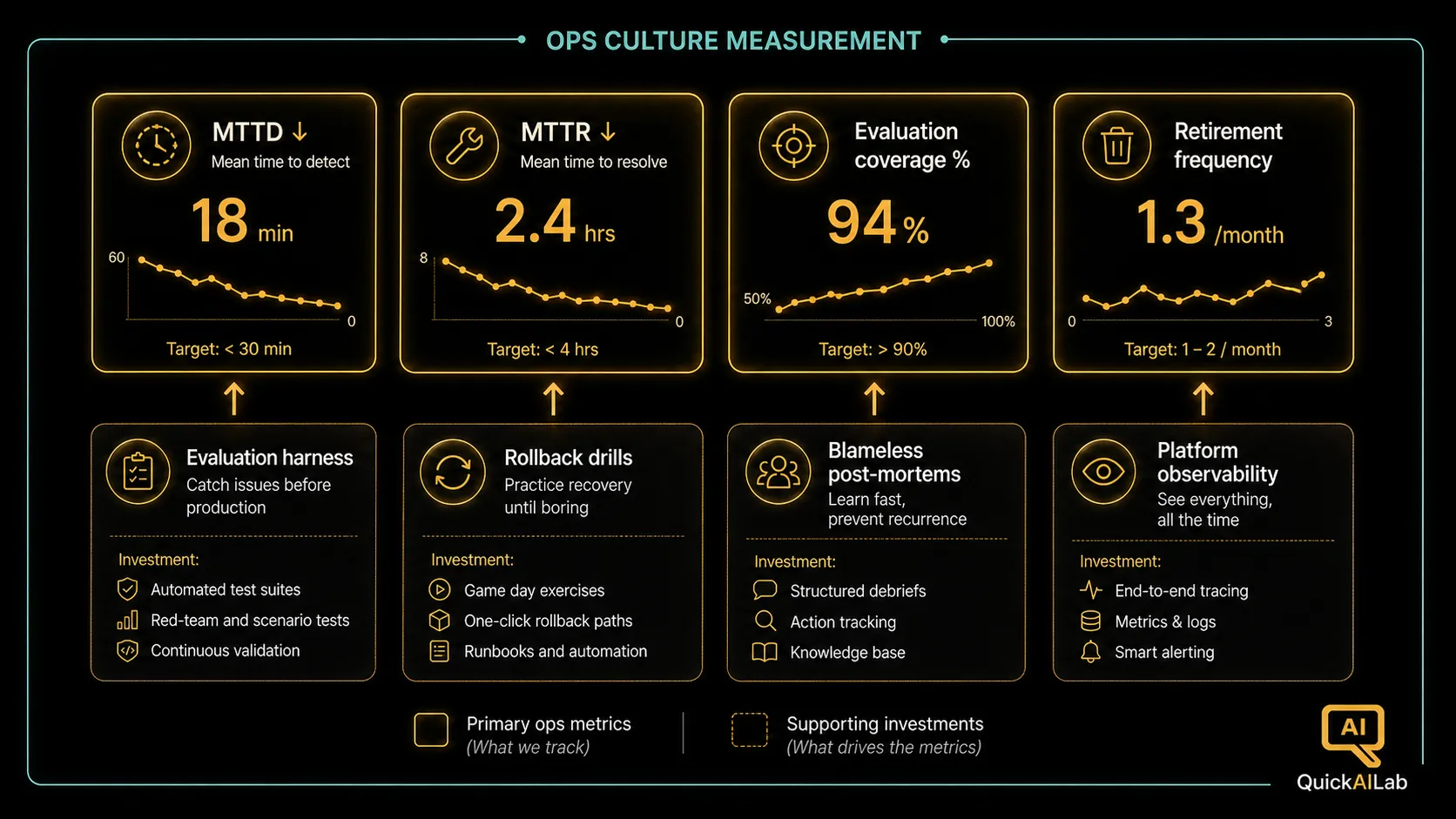
Culture claims are cheap; measurement is what keeps them accountable. Three metrics, watched over quarters, tell you whether the ops culture is real.
Mean time to detect (MTTD) and mean time to remediate (MTTR) for AI incidents. Both trending down over quarters is a proxy for a maturing culture; both trending up despite investment in tooling is a sign the discipline is not landing.
Percentage of production models and agents with active evaluation coverage. If a growing fraction of production systems have no meaningful evaluation running on them, the culture is not scaling with the deployment volume, and something will break.
Frequency of retirements. Zero retirements in a year of active development is not a good sign. It usually means the organization has lost the discipline to say “this use case did not work, and we are turning it off,” which then means it has lost the discipline that keeps portfolios healthy.
Figure 2 stacks these three metrics as an ops culture dashboard, alongside the enabling investments that move them, evaluation harness coverage, rollback drills, blameless post-mortem cadence, and platform-provided observability. The dashboard is not for the CoE alone; every business unit running AI in production should be answerable to a version of it.
Where regulation is pushing everyone
One reason this article can afford to lean on culture rather than just tools: the regulatory expectation has moved. Continuous assurance is now the baseline expectation for high-risk AI in the EU AI Act, in Australian prudential guidance, and in emerging Singapore and US supervisory practice. The organizations building an ops culture now are pre-positioned for that expectation. The organizations still treating deployment as the milestone will discover, uncomfortably, that regulators care about what happens after the ribbon-cutting.
There is a competitive angle worth naming too. AI systems in production are living infrastructure, and the ability to run them reliably at scale is itself a durable advantage. Foundation model quality is converging; production reliability at scale is not. The organizations that build the ops muscle now compound that advantage for years, because reliability is expensive to fake and slow to buy. The measurement dashboard in Figure 2 is not a compliance instrument; it is the honest scoreboard that tells you whether the culture in Figure 1 is landing or just being described.
Culture, in the end, is what shows up when the pressure is on and no policy document is being consulted. In an AI operating model, that is most weeks. The habits described in this article are what a mature program looks like at 3 a.m. when a model is misbehaving and a decision has to be made. Get them right and the rest of the operating model has a firm floor. Get them wrong and every other investment sits on sand.
Which brings us to the question every capable ops program eventually has to answer: how does it get paid for. Token consumption, GPU spend, platform investment, and the ops teams themselves all cost real money, and the funding model shapes behavior more than any policy. That is the AI FinOps question, and it is where we go next.