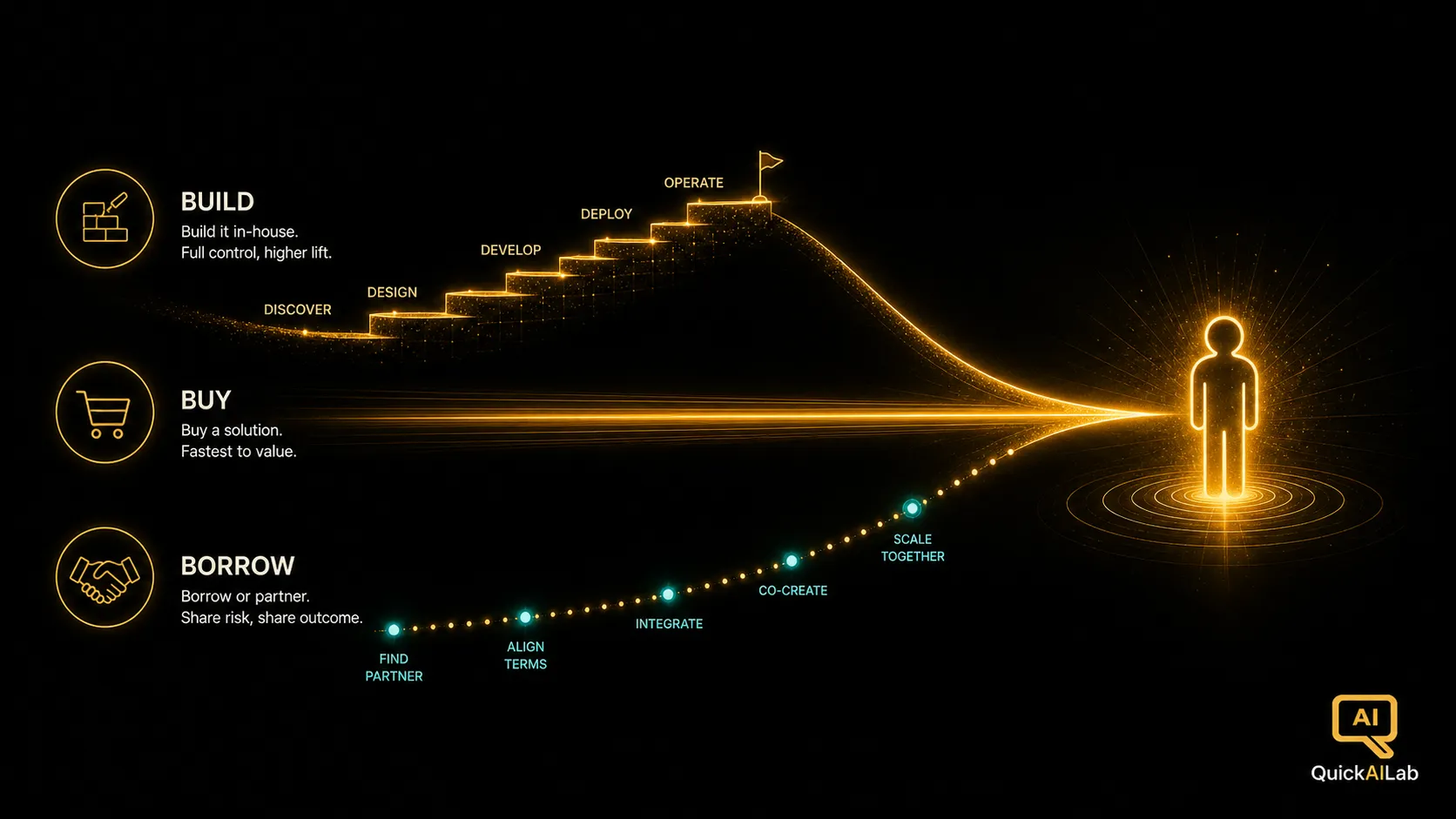
Here is the market you are hiring into. Seventy-two percent of employers worldwide report difficulty filling roles, and for the first time, AI capabilities top the global shortage list: AI model and application development leads the ranking, with AI literacy right behind it. Demand for AI talent outruns supply by roughly three to one. AI and machine learning roles take an average of 89 days to fill, the longest of any technology category, and workers with AI skills command a wage premium north of fifty percent over peers in the same roles without them.
You cannot hire your way out of that market. Neither can your competitors, which is the only comforting part. The organizations that solve AI talent in 2026 treat sourcing as a portfolio decision with three instruments, build, buy, and borrow, and they choose per capability rather than declaring one strategy for everything. This article is the decision framework.
The three instruments, honestly appraised
Build: upskill the people you have. The quiet revolution of the past two years is how decisively the market has swung this way. Organizations are now roughly three and a half times more likely to upskill existing staff than to hire externally for strategic technology skills, and upskilling leads the list of employer responses to scarcity in the big 2026 workforce surveys.
The logic is compounding. Your existing people already carry the asset no market can sell you: institutional knowledge. They know the codebase, the data landscape, the customers, and the politics. Layering AI skills onto that foundation is faster to productivity than onboarding a stranger who must learn your organization from zero. Strong backend engineers become capable AI engineers in months. Analysts become skilled AI-augmented practitioners. QA professionals evolve into evaluation specialists. The raw material is on your payroll.
The build route has two failure modes. The first is training theater: generic video libraries with completion certificates and no connection to real work. Trained employees show dramatically higher proficiency than untrained ones, but only when the training is role-specific and embedded in actual workflows. The second is the retention paradox: newly skilled people are newly marketable, so upskilling without a career path and a pay review is a gift to your competitors’ recruiters.
Buy: hire from the market. Sometimes there is no substitute. Capabilities you have never had, platform architecture, evaluation engineering, agent operations at scale, cannot be bootstrapped from adjacent skills fast enough, and a senior external hire brings pattern recognition from having done it before. Buying is also how you import standards: one excellent platform engineer who has seen a paved road work can save a year of internal debate.
The costs are the 89 days, the premium, and the integration risk. External senior hires fail most often not on skill but on context: they arrive with a playbook from a different organization and run it without translation. Buy sparingly, buy senior, and buy people who have explicitly done the translation job before.
Borrow: partners, contractors, and services. Consultancies, staff augmentation, and AI-as-a-service arrangements now feature in the majority of enterprise AI programs, and used well they solve the timing problem: capability today, while build programs mature. Borrowing is the right answer for spiky work (a migration, a first implementation), for genuinely rare specialisms you need occasionally, and for the enabling-squad pattern where outsiders build the first use case with your team and leave skills behind.
The failure mode is permanent scaffolding: the “temporary” partner still running your AI program three years later, at consulting rates, holding all the institutional knowledge you were supposed to accumulate. The test for any borrow arrangement is the exit: if knowledge transfer is not a contracted deliverable with named internal recipients, you are not borrowing capability, you are renting dependency.
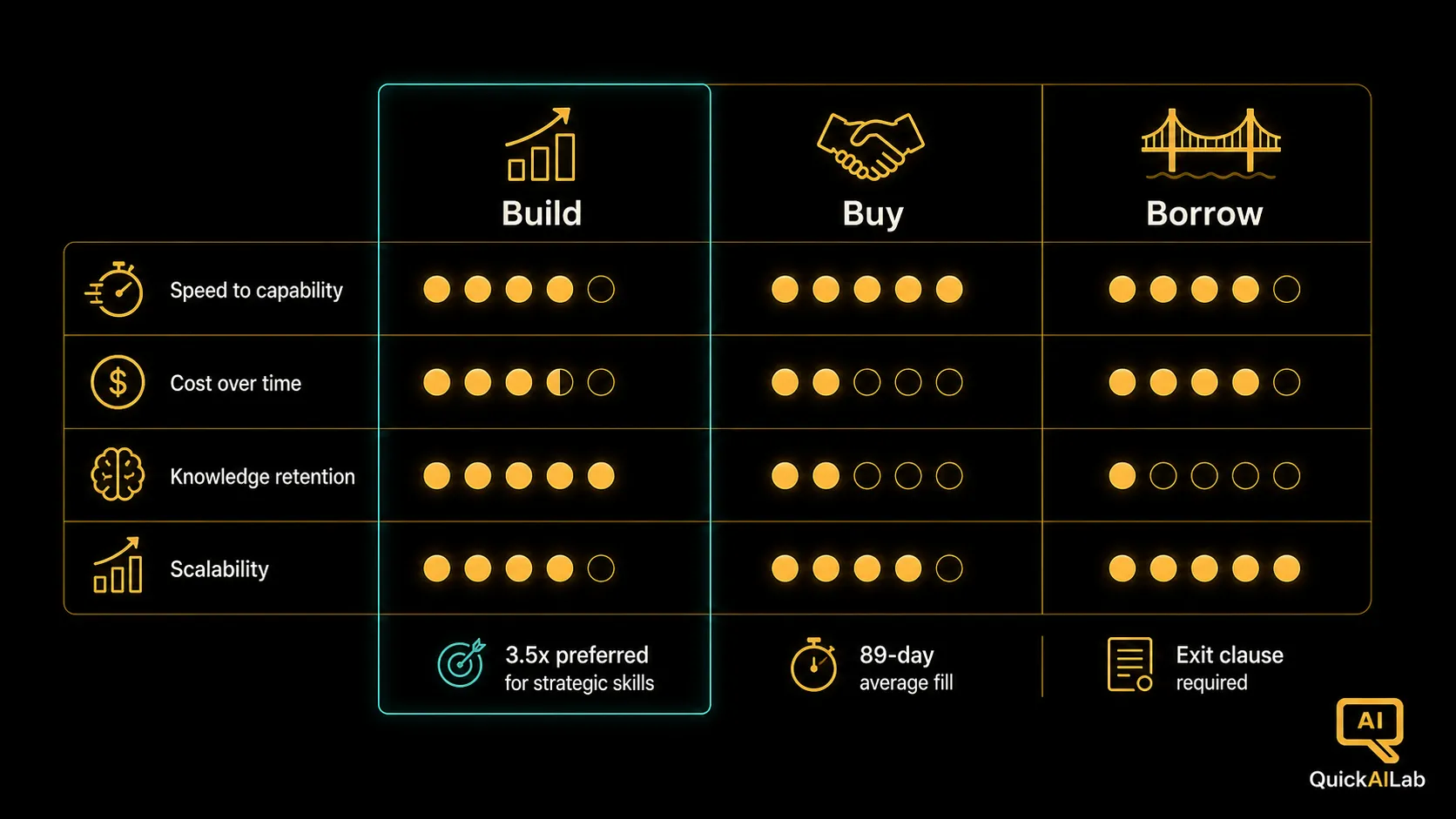
Figure 1 lays the three instruments across the dimensions that matter: speed to capability, cost over time, knowledge retention, and scalability. No instrument dominates, which is precisely why this is a portfolio decision.
The decision framework: durability and differentiation
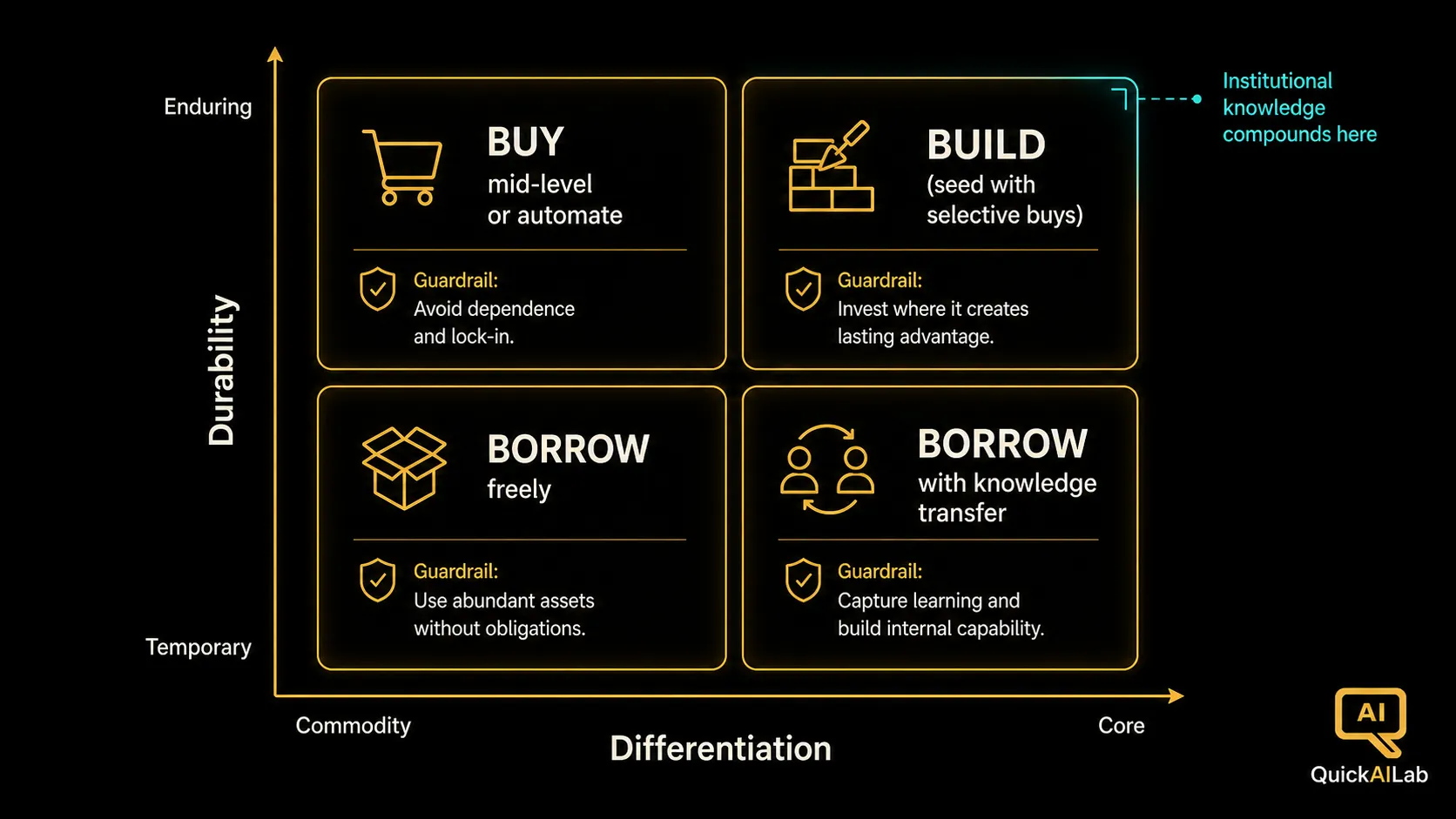
For any given capability, two questions pick the instrument.
How durable is the need? A capability you will need for years belongs in permanent headcount, built or bought. A capability you need for one quarter is a borrow. The trap is misjudging durability: agent operations looked like a niche specialism in 2024 and is core infrastructure in 2026. When in doubt, assume AI capabilities are more durable than they look.
How differentiating is it? Capabilities that touch your competitive core, your domain data, your customer-facing systems, your proprietary workflows, should live in-house, built by preference, because that is where institutional knowledge compounds into advantage. Commodity capabilities, generic integration work, standard deployments, can be borrowed without strategic loss.
Cross the two questions and the portfolio writes itself. Durable and differentiating: build, seeded with selective buys. Durable but commodity: buy mid-level or automate. Temporary but differentiating: borrow with aggressive knowledge transfer. Temporary and commodity: borrow freely and do not look back.
Figure 2 turns this into the two-by-two decision flow, with the instrument recommendation in each quadrant and the guardrail conditions, exit clauses on borrows, career paths on builds, translation checks on buys, attached to each.
Running the build engine
Since build is the instrument the evidence favors and the one most organizations run worst, it deserves operational detail.
Start from roles, not courses. Define the destination role profiles, the AI engineer, the AI product manager, the evaluation lead from the previous article, and work backward to the skills gap per person. Aptitude and appetite matter more than current title: your best future AI engineer might be sitting in the data warehouse team.
Make it real work, fast. The most effective programs put learners onto actual use cases within weeks, paired with seniors, on the platform, with the sandbox from the platform article as the training ground. Adults learn AI by shipping AI. Certificates are exhaust, not fuel.
Fund the time honestly. Upskilling that must happen after hours is a filter for personal circumstance, not talent. Serious programs allocate real working hours, and the workforce data says people show up when they do: when employers make AI training available, the large majority of workers complete it. Appetite is not the constraint. Investment is.
Close the loop with recognition. New skills, new title, new pay, new work. Skip any link in that chain and the program leaks its graduates to the open market, where that fifty-plus percent premium is waiting for them.
The borrow clause everyone forgets
One more operational note, because it saves organizations real money. Every borrow contract should carry three clauses: named internal counterparts who shadow the work, documentation and handover as paid deliverables, and a declining-involvement schedule written into the statement of work. Partners worth hiring will accept all three without flinching. Partners who resist them are telling you their business model, and it is not your capability.
The portfolio view
Zoom back out. A healthy AI talent portfolio in 2026 looks roughly like this: a build engine running continuously across the whole organization, from engineers to the frontline literacy programs we will cover two articles from now; a short, sharp buy list of senior catalysts, platform leads, evaluation leads, the occasional domain-changing hire; and a disciplined borrow book with exit dates. The blend shifts with maturity, heavier on buy and borrow early, progressively heavier on build as the engine spins up, exactly the trajectory the hub-and-spoke evolution predicts. It also deserves an annual re-run through the Figure 2 quadrants, because durability judgments age: yesterday’s temporary specialism has a habit of becoming tomorrow’s core capability.
What the portfolio produces, if you run it well, is not just filled seats. It is optionality: the ability to staff the next initiative from three sources instead of one queue, priced against each other, as Figure 1 frames it. In a market where nine in ten enterprises face critical skills shortages, that optionality is itself a competitive capability.
And some of the seats you will be filling did not exist three years ago. Agent operations, context engineering, AI product management, responsible AI advisory: the AI era is minting genuinely new roles faster than job architectures can absorb them. Mapping those roles, and deciding which ones your organization actually needs, is where we go next.