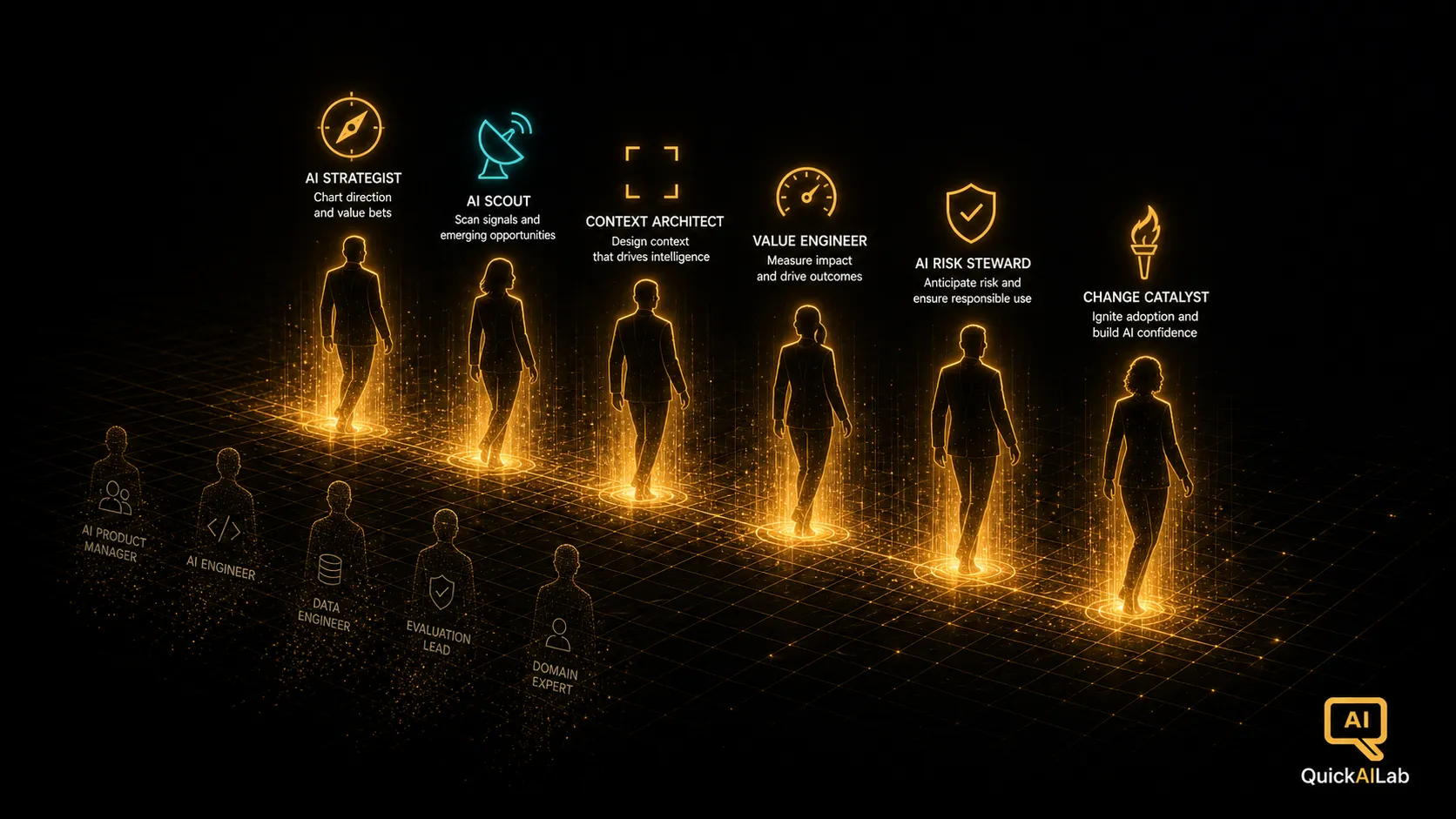
Job architectures are slow-moving documents. HR systems, salary bands, and career frameworks were designed to change every few years, and the AI era is not giving them that courtesy. The skills demanded by the most AI-exposed jobs are now changing more than twice as fast as those in the least exposed roles, a gap that widened by 75 percent in a single year. Roles that existed five years ago require fundamentally different capabilities today, and roles that did not exist three years ago are now among the hardest to fill.
The result is a strange dissonance inside most enterprises. The work has already changed. The org chart has not. People are doing jobs their titles do not describe, being evaluated against competency frameworks written for a different decade, and looking outside the organization for careers their employer has not yet named. This article maps the genuinely new roles of the AI era, the old roles being rewritten in place, and how to decide which of these your operating model actually needs.
The genuinely new roles
Six roles have crossed the line from experiment to necessity, and if your AI program is scaling, you are already paying for these functions whether or not anyone holds the title.
The AI product manager. Introduced in the team article, but worth placing at the top of this list because it is the era’s defining role. Classical product management assumed deterministic software; the AI product manager manages probabilistic systems, deciding what accuracy is acceptable, what failure costs, where humans belong in the loop, and which risk tier a use case occupies. It is a judgment-heavy role sitting exactly at the intersection of value and risk, and it is chronically underhired relative to engineering.
The agent operations specialist. The newest and fastest-rising role in the set. Once autonomous agents run in production, someone must own their fleet: monitoring behavior, managing permissions and identities, tuning escalation thresholds, investigating incidents, and running the orchestration layer that the platform article described as a command center. Think site reliability engineering, reinvented for a workforce of software colleagues. As organizations climb the autonomy ladder from humans approving everything toward humans auditing, this role is who does the auditing infrastructure.
The context engineer. The evolution of the prompt engineer, and the retitling is substantive, not cosmetic. Early prompt engineering was clever phrasing; context engineering is the systematic design of everything a model sees, retrieval strategies, tool definitions, memory structures, instruction hierarchies, and evaluation of the results. It is a real engineering discipline with real leverage: the same model, given professionally engineered context, can be transformed from a liability into an asset.
The evaluation engineer. Quality assurance for probabilistic systems. Builds and maintains the benchmark datasets, regression suites, and automated judges that answer “is this system good, and is it still good after the change we shipped Tuesday?” As regulators shift toward expecting continuous assurance rather than point-in-time testing, this role becomes the load-bearing wall of compliance as well as quality.
The responsible AI advisor. The translator between governance frameworks and delivery teams: applying the risk-tiering, running the impact assessments, and making responsible AI a design input rather than a launch obstacle. The Governance track covered the frameworks; this is the person who operationalizes them one use case at a time. Domain hubs in federated models increasingly staff one per business area.
The AI enablement lead. Owner of the literacy engine we will detail in the next article: role-based curricula, champion networks, and the adoption programs that decide whether tools become value. In a market where AI literacy sits near the top of global skills shortages, this role builds the asset internally that cannot be hired externally at scale.
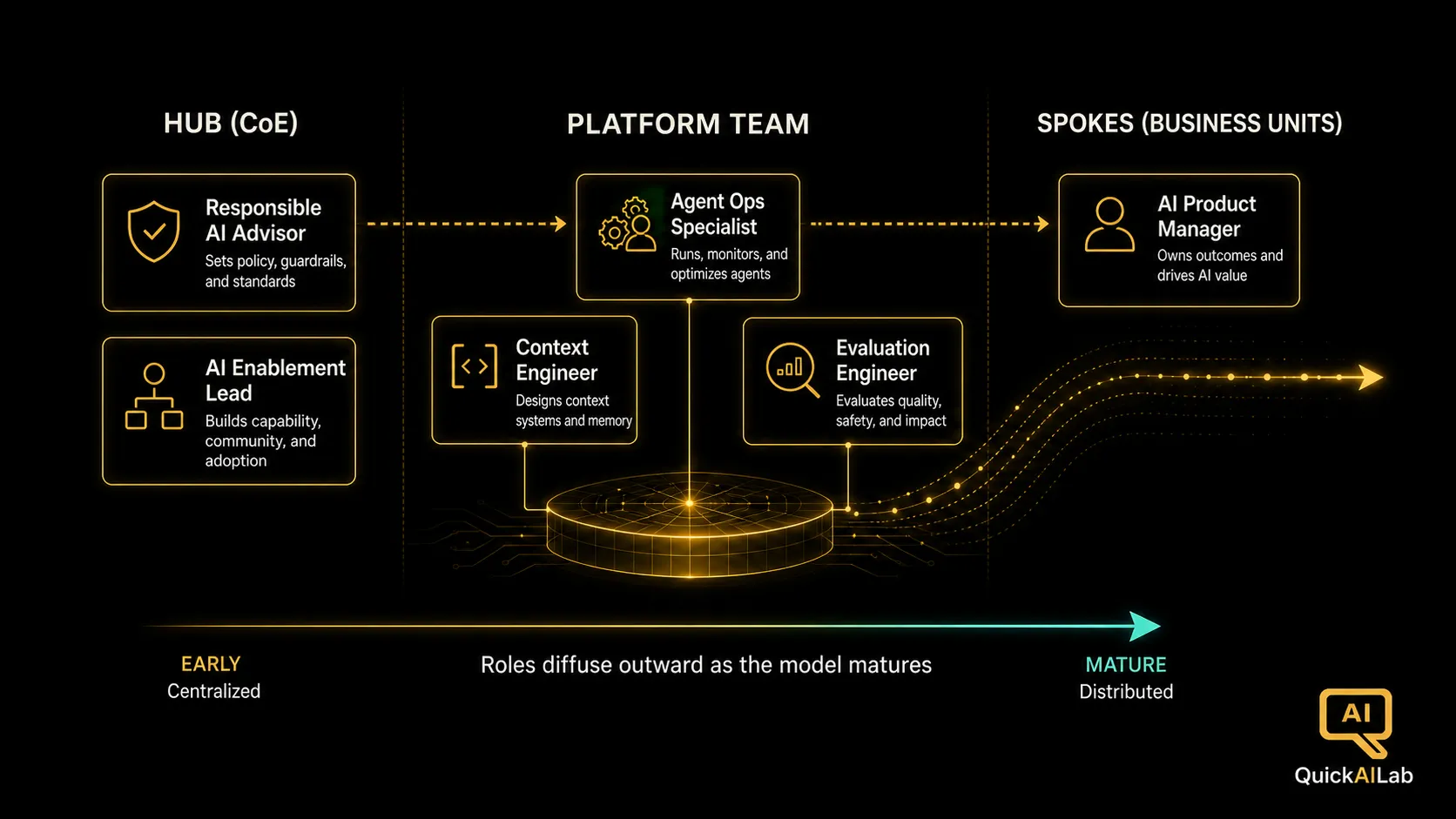
Figure 1 maps these six against the operating model structures from earlier articles, showing where each role typically sits, hub, spoke, or platform team, and how their reporting lines shift as the model matures from centralized toward hub-and-spoke.
The rewritten roles
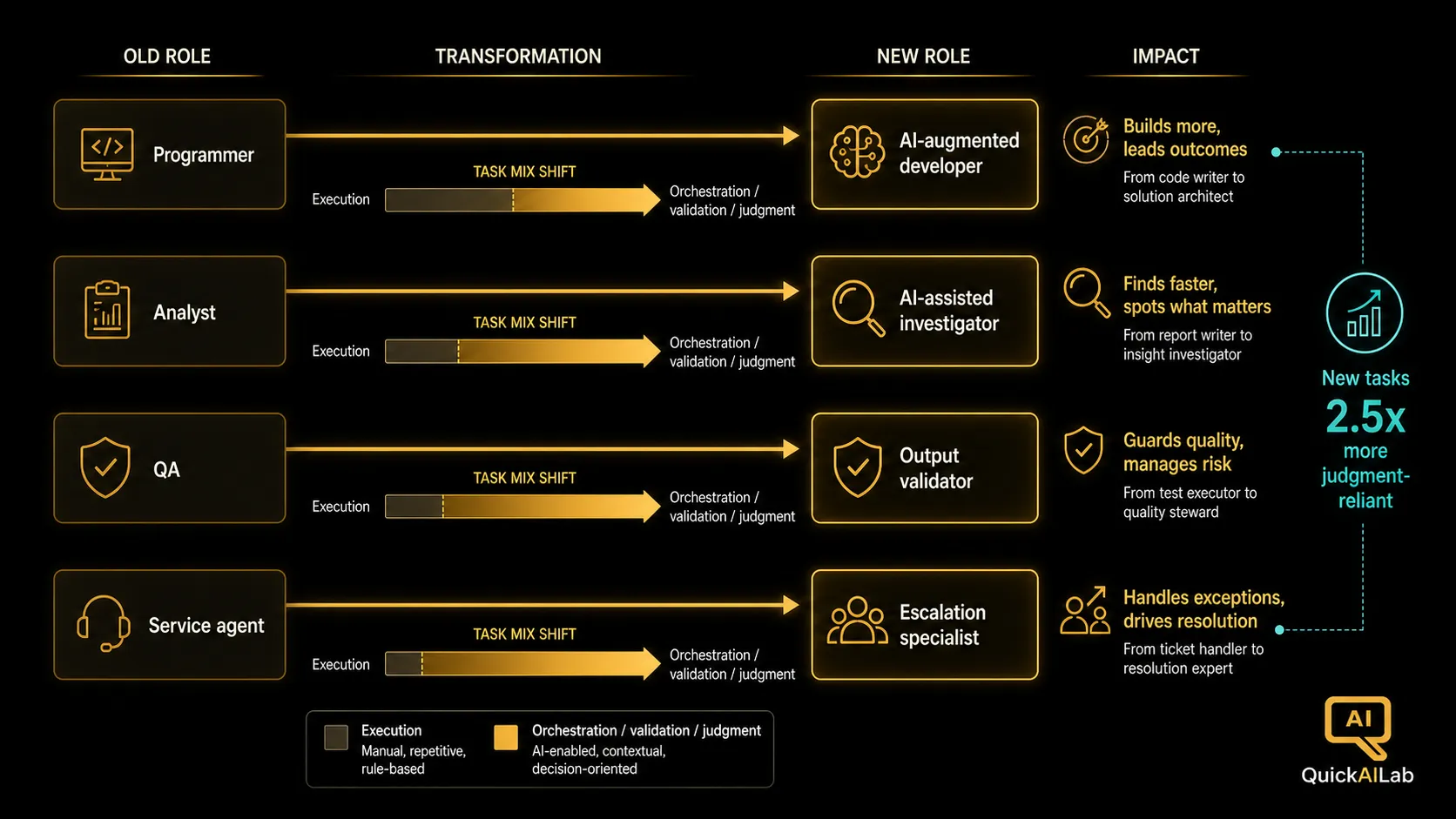
The second category is quieter but larger: existing roles being transformed in place. The pattern across the 2026 workforce research is reclassification rather than replacement, and the smartest organizations are managing it deliberately. Programmers are becoming AI-augmented developers, orchestrating agents and reviewing machine-written code rather than typing every line. Analysts are becoming AI-assisted investigators whose craft is asking the right questions and validating machine answers. QA professionals are evolving into AI output validators. Customer service agents are becoming escalation specialists who handle what the AI tier cannot, which concentrates their work into precisely the cases requiring the most human judgment.
Two facts make this transformation urgent rather than gradual. First, the new tasks being added to AI-exposed roles are two and a half times more likely to rely on distinctly human capabilities, judgment, empathy, creativity, than the tasks being removed. The jobs are not shrinking; they are moving up the value stack. Second, the traditional career ladder is compressing beneath them: entry-level roles in AI-exposed fields are seven times more likely to demand traditionally senior skills like strategic thinking, and “seniorised” entry-level roles have grown 35 percent since 2019 even as ordinary junior postings flatline. The bottom rungs of the ladder are being sawn off, which forces a redesign of how juniors become seniors at all.
Figure 2 traces four representative role evolutions, developer, analyst, QA, and service agent, showing the task mix shifting from execution toward orchestration, validation, and judgment, and the new skills each transition demands.
What this means for job architecture
If the work changes and the architecture does not, three predictable failures follow: your best people leave for organizations whose titles match their actual work, your hiring targets the wrong profiles, and your incentive systems reward yesterday’s tasks. Avoiding that requires operating on the architecture itself.
Rewrite role profiles around judgment, not tasks. A job description listing tasks an agent can perform is a deprecation notice. Profiles built around decision quality, oversight responsibility, and outcomes survive the technology’s movement.
Create the dual ladder before you need it. Context engineers and evaluation engineers need senior destinations that are not “manager.” Organizations that force their deepest technical people into people management to progress will donate them to the market.
Rebuild the apprenticeship. If entry-level roles now demand near-senior judgment, juniors need deliberately designed exposure: rotations through pods, supervised oversight duties, and mentorship structures that compress a decade of pattern recognition into a few years. This is a solvable design problem, but only for organizations that admit the old osmosis model is gone.
Re-level compensation honestly. AI-skilled practitioners carry a wage premium above fifty percent in the open market. Pretending your internal bands are exempt is how you fund your competitors’ teams with alumni you trained.
Which roles do you actually need?
Not every organization needs all six new roles tomorrow, and title inflation is its own anti-pattern. The sequencing heuristic follows the operating model maturity we have been tracking across this track. At the prove-value stage, you need exactly two of the new roles: an AI product manager and someone wearing the context engineering hat. At the repeatable stage, add evaluation engineering and the responsible AI advisor, because use case volume makes informal quality and risk management unsustainable. At scale, agent operations and the enablement lead become mandatory, and the roles begin appearing in spokes rather than only the hub, exactly the diffusion Figure 1 depicts.
The deeper point is that roles are the operating model made flesh. Structures and platforms from the earlier articles are inert until someone holds the responsibilities they imply, and every gap between the work and the org chart is paid for in shadow effort: the analyst doing agent operations without the mandate, the engineer doing evaluation at midnight without the tooling. As Figure 2 makes plain, the transformation is already underway inside your existing roles; the only choice is whether to architect it or absorb it.
One thread runs through every role in this article, new and rewritten alike: they all assume a workforce that understands AI well enough to use it with judgment. That assumption is doing enormous load-bearing work, and in most organizations it is not yet true. Building it, from the boardroom to the front line, is the subject of the next article: AI literacy as an organizational capability.