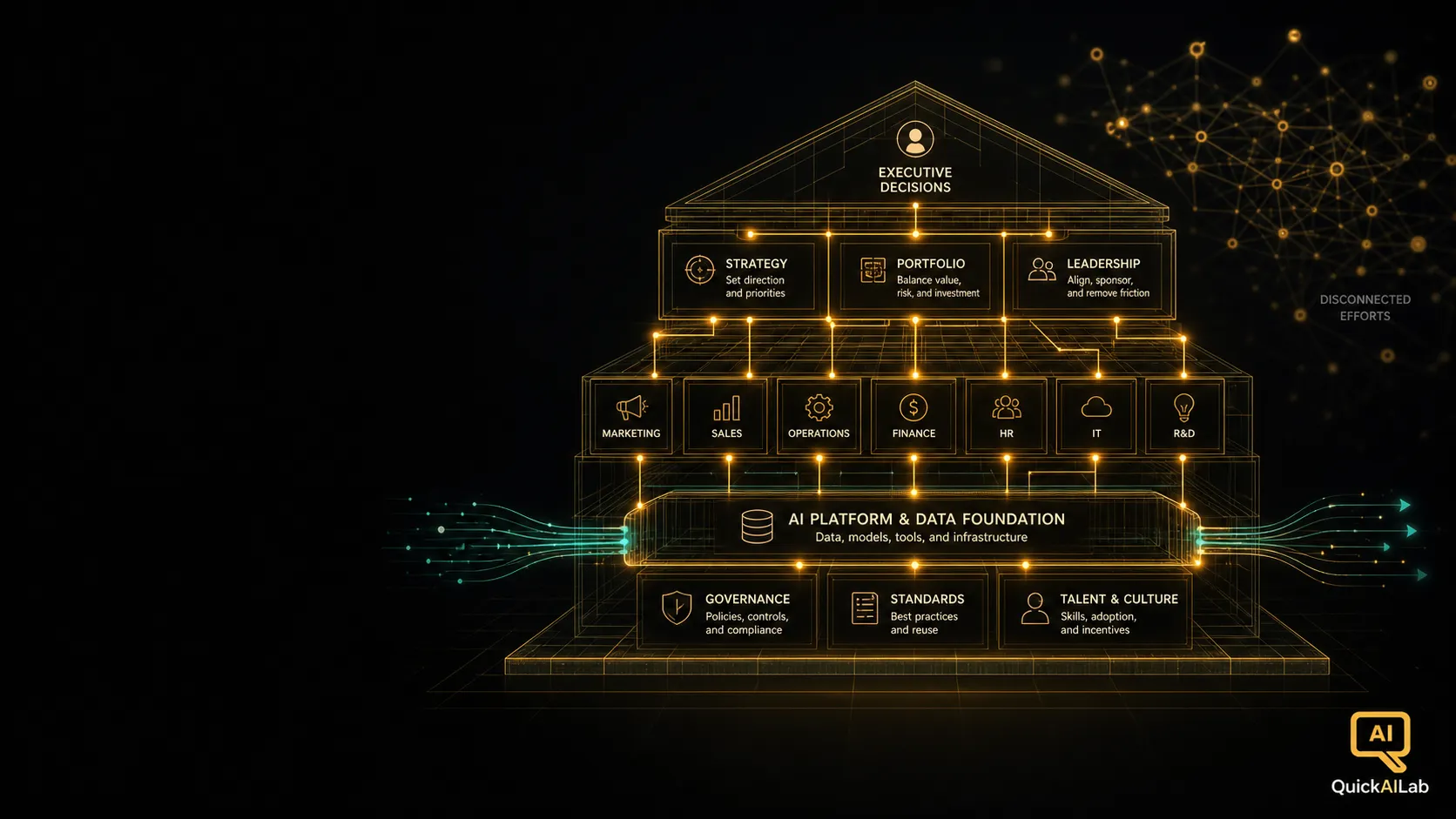
Two companies buy the same AI tools in the same quarter. Same vendor, same models, roughly the same budget. Eighteen months later, one of them has AI woven into how work actually gets done: agents handling first-pass claims triage, a shared platform every team builds on, and a leadership dashboard that shows exactly where the value lands. The other has a graveyard of pilots, a dozen disconnected chatbots, and a CFO asking pointed questions.
I have watched this play out enough times to stop believing the difference is the technology. The difference is the operating model: the invisible structure of decision rights, teams, funding, platforms, and habits that determines whether AI becomes a capability or stays a collection of experiments.
This article opens the AI Operating Model track. Over the next fifteen articles we will get concrete about structures, teams, talent, culture, and scale. But first we need to name the thing itself, because most organizations skip this step entirely and pay for it later.
The definition that actually helps
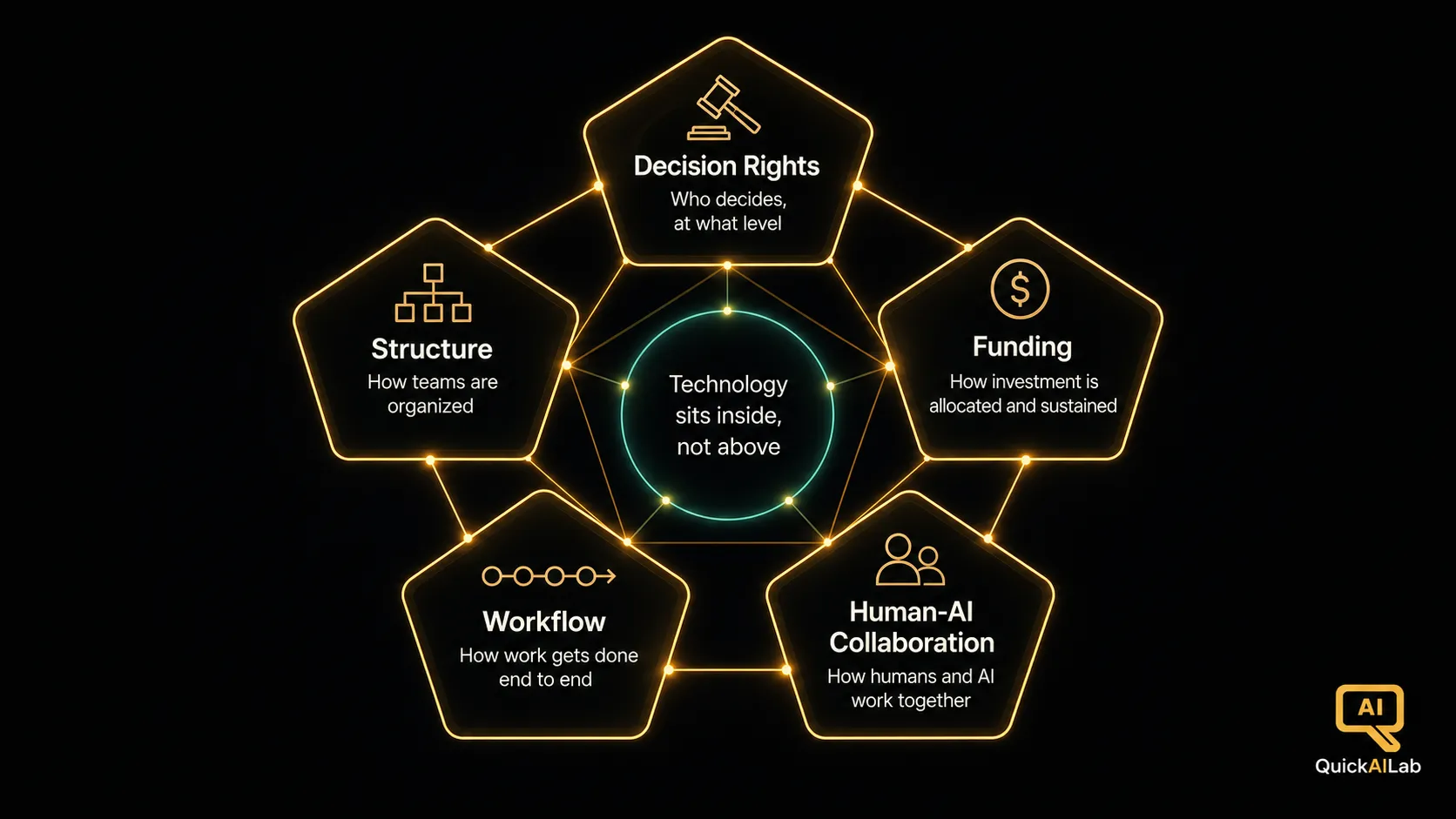
An AI operating model is the answer to five questions, asked together rather than separately:
Who decides? Which AI initiatives get funded, who approves a use case, who can say no, and who is accountable when an AI system makes a mistake. Decision rights are the skeleton of the model.
Who builds and runs? Where do AI skills live: in a central team, inside business units, or in some federated arrangement? Who owns the platform, and who owns the individual solutions built on it?
How is it funded? Central budget, business unit budgets, chargeback, or a blend. Funding shape quietly determines behavior more than any policy document.
How does work flow? The path from idea to production: intake, prioritisation, development standards, evaluation, deployment gates, and monitoring. This is where governance stops being a PDF and becomes a process.
How do humans and AI work together? Which decisions AI can make alone, which need review, and how oversight evolves as trust grows. This question barely existed three years ago. In 2026 it is arguably the most important one.
Figure 1 shows how these five elements interlock. Notice that technology is not one of the five. Models and platforms matter, but they sit inside the operating model, not above it.
The gap nobody budgets for
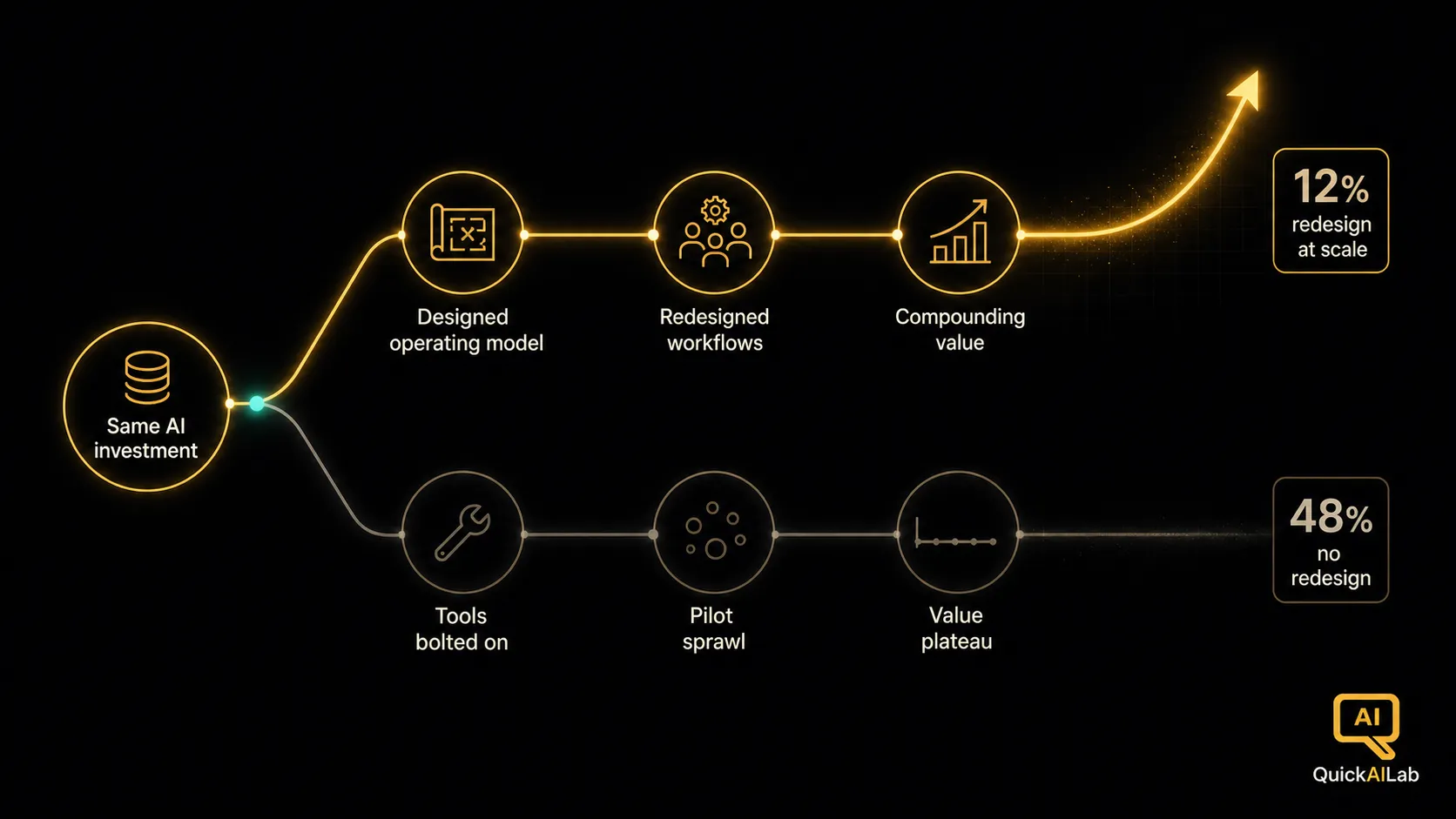
Here is the uncomfortable data point that motivates this entire track. Deloitte polled nearly 3,700 professionals for its 2026 pulse research and found that 48 percent of organizations have introduced AI without redesigning the workflows or roles it sits within. Only 12 percent report redesign at scale, with a new operating model behind it.
Read that again. Nearly half of organizations bolted AI onto their existing way of working and changed nothing else. The tools arrived; the org chart, the approval chains, the job descriptions, and the incentives stayed frozen in 2022.
The same research stream found that while twice as many leaders as the previous year report transformative impact from AI, only about a third are truly reimagining the business around it. The technology is moving faster than the structures wrapped around it, and the gap between deploying AI and transforming with it is wider than most leadership teams assume.
This is why identical technology investments produce wildly different outcomes. A model is a capability multiplier, and it multiplies whatever it finds. Point it at a well-designed operating model and it compounds value. Point it at organizational confusion and it multiplies the confusion, now at machine speed.
Why the old operating model breaks
You might reasonably ask why AI needs its own operating model at all. Companies absorbed cloud, mobile, and analytics without rewriting the corporate constitution. Three properties make AI different.
Demand comes from everywhere. No previous technology has generated this much pull from the business side. Marketing wants content generation, finance wants reconciliation agents, legal wants contract review, and every one of them can sign up for a SaaS tool with a credit card this afternoon. Central teams cannot gate that demand, and pretending they can just drives it into the shadows.
The technology is probabilistic. Traditional software either works or throws an error. AI systems produce plausible output that is sometimes wrong, which means quality assurance, risk ownership, and human oversight need to be designed into the workflow rather than tested in at the end. Your existing SDLC was not built for this.
Autonomy changes accountability. Once agents start taking actions rather than drafting suggestions, the question of who is accountable for an automated decision becomes operational, not theoretical. Deloitte’s 2026 analysis puts it starkly: organizations that have not designed their accountability model by the end of this year risk finding it designed for them, by an audit finding, a regulatory requirement, or a visible AI failure.
What good looks like
The organizations pulling ahead share a recognizable pattern, and it is worth sketching before we spend the rest of the track unpacking it.
They run a hub that enables rather than gates. A central function, often a Center of Excellence, owns the platform, the standards, and the guardrails, while business units own delivery and outcomes. The hub is a service provider, not a checkpoint.
They treat the platform as a product. Shared infrastructure, approved model access, reusable components, and evaluation tooling, offered to internal teams the way a vendor would offer them, with roadmaps and support.
They redesign work, not just tasks. Instead of asking “which tasks can AI do,” they ask “what should this workflow look like if AI is a participant,” then rebuild roles and handoffs around the answer.
They climb the autonomy ladder deliberately. Oversight starts with humans approving everything and progresses toward humans auditing, one reversible, well-measured step at a time. Trust is earned by track record, not declared by policy.
They make literacy universal. From the board to the front line, everyone understands enough about AI to use it with judgment, challenge it when needed, and spot when it is wrong.
Figure 2 contrasts this pattern with the default that most organizations drift into: scattered pilots, tool sprawl, governance as paperwork, and value that never quite shows up in the P&L. The two paths start from the same technology and diverge on everything else.
The maturity connection
If you have read the Data & AI Strategy track, you will recognize the shape of this argument. Strategy defines where AI should create value; the operating model determines whether the organization can actually deliver it, repeatedly, at acceptable risk. The maturity model we explored there has an organizational spine running through it, and this track is that spine examined up close.
The connection runs in both directions. An ambitious portfolio with a weak operating model produces the 88 percent agent pilot failure rate that haunted the agentic strategy discussion. A strong operating model with no strategy produces beautifully governed irrelevance. You need both, and they need to be designed together.
One more framing before we move on, because as Figure 1 makes clear, none of the five components stands alone. Decision rights without funding authority are theater. A platform without literacy is shelfware. Workflow redesign without new roles collapses back into the old pattern within two quarters. The operating model is a system, and systems fail at their weakest joint.
Where this track goes
Here is the road ahead. We start with structure: the centralized, federated, and hub-and-spoke archetypes, and how to choose among them. Then the two engine rooms: the Center of Excellence and the AI platform team. From there we turn to people: building the core team, sourcing scarce talent, the genuinely new roles this era is creating, and literacy across the whole organization.
The second half of the track tackles ways of working: change management and the adoption gap, redesigning work around AI, managing a hybrid workforce of humans and agents, operational culture, funding mechanics, decision rights, and the journey from one AI team to an AI-native organization. We close with the anti-patterns: the recurring operating model failures I see often enough to catalogue.
The organizations that win with AI in the next three years will not be the ones with the best models. Models are increasingly a commodity, refreshed every quarter. They will be the ones whose structure lets a good idea travel from a business problem to a production system to measured value without dying in a committee along the way. That structure does not emerge on its own. As Figure 2 shows, drift has a destination, and it is not the one in the board deck.
Designing the alternative is what the rest of this track is about. Let’s start with the most consequential structural decision: where the AI capability should live.