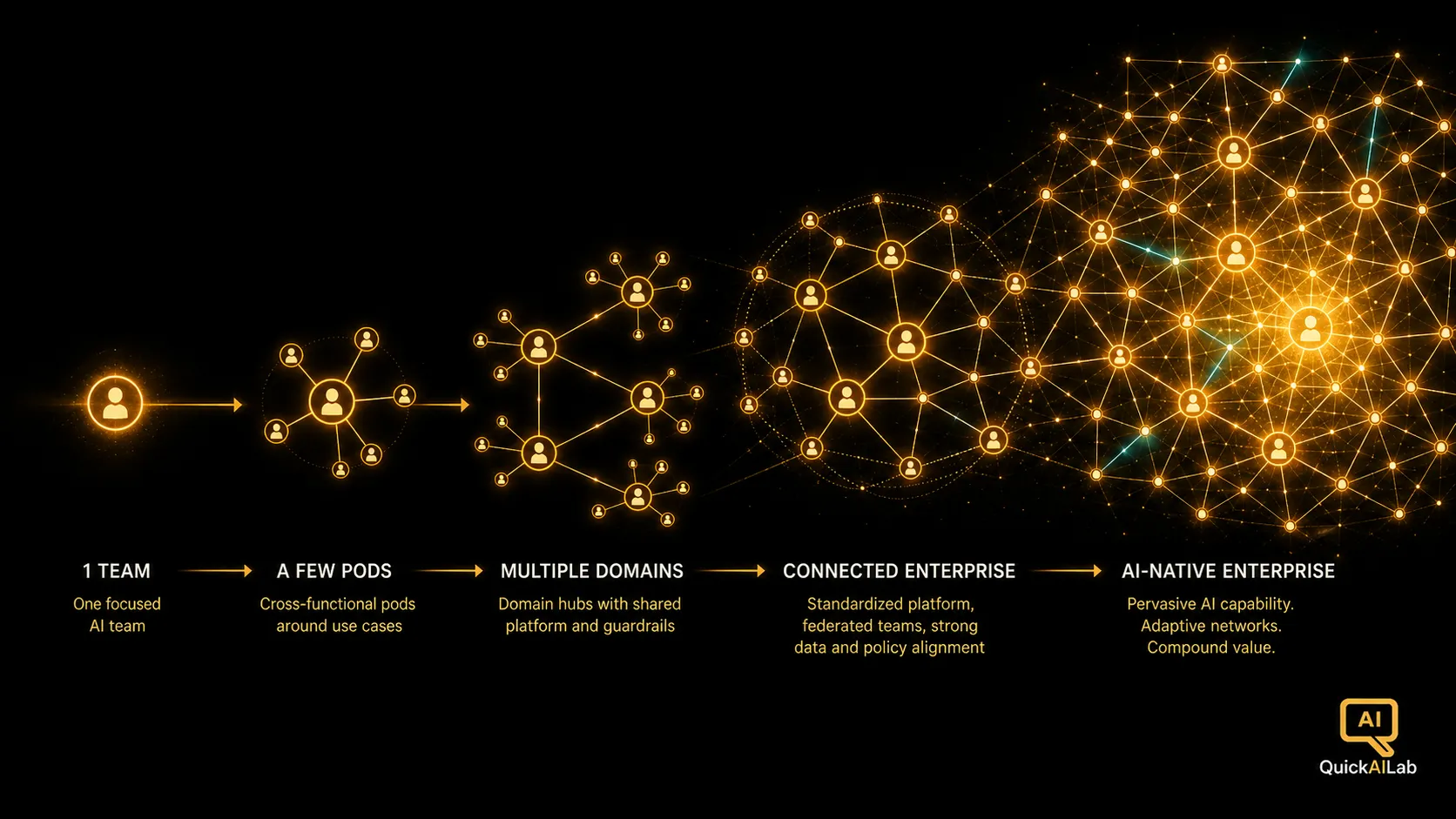
There is a particular moment in a scaled AI program that leaders remember. It usually arrives in year two or three. The founding team has shipped its first three or four production systems. The Center of Excellence has stood up. The platform has real workloads on it. A handful of business units are running their own initiatives on shared rails. And then, quietly, the demand curve outpaces the central team’s ability to serve it. A dozen conversations start in parallel about whether to expand the CoE headcount, whether to embed engineers in business units, whether to license a new vendor, whether to slow down. Everyone wants more AI. Nobody quite knows what shape the organization should take to give it to them.
This is the scaling problem, and it does not solve itself. Left alone, it produces exactly the pattern the CoE article warned about: business units routing around the center, unmanaged tool proliferation, and a hub that was designed for growth turning into a bottleneck for it. Handled deliberately, it produces the AI-native organization the earlier articles have been implicitly building toward: an enterprise where AI capability lives everywhere, standards are automatic, the platform is invisible because it is universal, and value accrues without any single team having to broker it.
This article is about that transition. Not about the destination alone, because the interesting engineering is the journey.
What “AI-native” actually means
The phrase gets abused, so let me define it operationally. An AI-native organization has four properties that a merely AI-adopting organization does not.
AI is present in most workflows, not selected ones. Not every use case is AI-heavy, but every workflow has been examined for AI participation, and the ones that benefit have been redesigned to include it. The default question during any workflow review is “how does AI participate here,” not “is AI relevant to this.”
The platform is universal and mostly invisible. Employees interact with AI through the tools they already use, not through a separate AI portal. The model gateway, the governed data access, the evaluation harness, and the observability layer are all present but present as infrastructure, the way electricity is present in a building.
Governance is embedded rather than enforced. Risk classification, evaluation, monitoring, and documentation happen automatically as part of building, not as a separate gate. The paved road carries the guardrails. Off-road paths still exist but are used sparingly and with awareness.
Literacy is universal and continuously refreshed. From the board to the front line, everyone knows enough about AI to use it with judgment, and the literacy program from the earlier article is running on a permanent cadence, not as a launch event.
None of these properties is a destination that is either “reached” or not. They are gradients. And the scaling journey is really the process of moving each of them from partially true to broadly true, without breaking the parts that already work.
The three phases of scaling
Actual enterprise programs move through three recognizable phases, roughly aligned with the maturity model from the Data & AI Strategy track and the archetype evolution from earlier in this track.
Phase one: prove it. One central team, one or two use cases, a shared platform in early form, a small CoE, a governance framework that is mostly a policy document. The goal is to demonstrate that AI can produce measurable value in this specific organizational context, on this specific data, for this specific customer. This phase typically runs six to eighteen months.
Phase two: replicate it. Multiple use cases running in parallel, a real platform team, spokes emerging in business units, a governance framework that is starting to be operationalized. The goal shifts from “can we do this at all” to “can we do this repeatably without the founding team being personally involved.” This is where most enterprises live in 2026, and it is also where the most programs stall.
Phase three: distribute it. AI capability lives inside business units as a natural extension of their operating model. The central hub concentrates on platform, standards, and portfolio view, and shrinks as delivery capability grows in the spokes. Adoption is high because the tools live in the workflows that already exist. This is the AI-native state, and very few enterprises are fully there yet.
The transitions between phases are the interesting part, because they require the operating model to actively rearrange itself rather than simply grow. And the transitions fail predictably when leaders treat them as continuous growth rather than as discontinuous change.
The transition from prove-it to replicate-it
This transition looks easy on a slide deck and hard in practice. What changes:
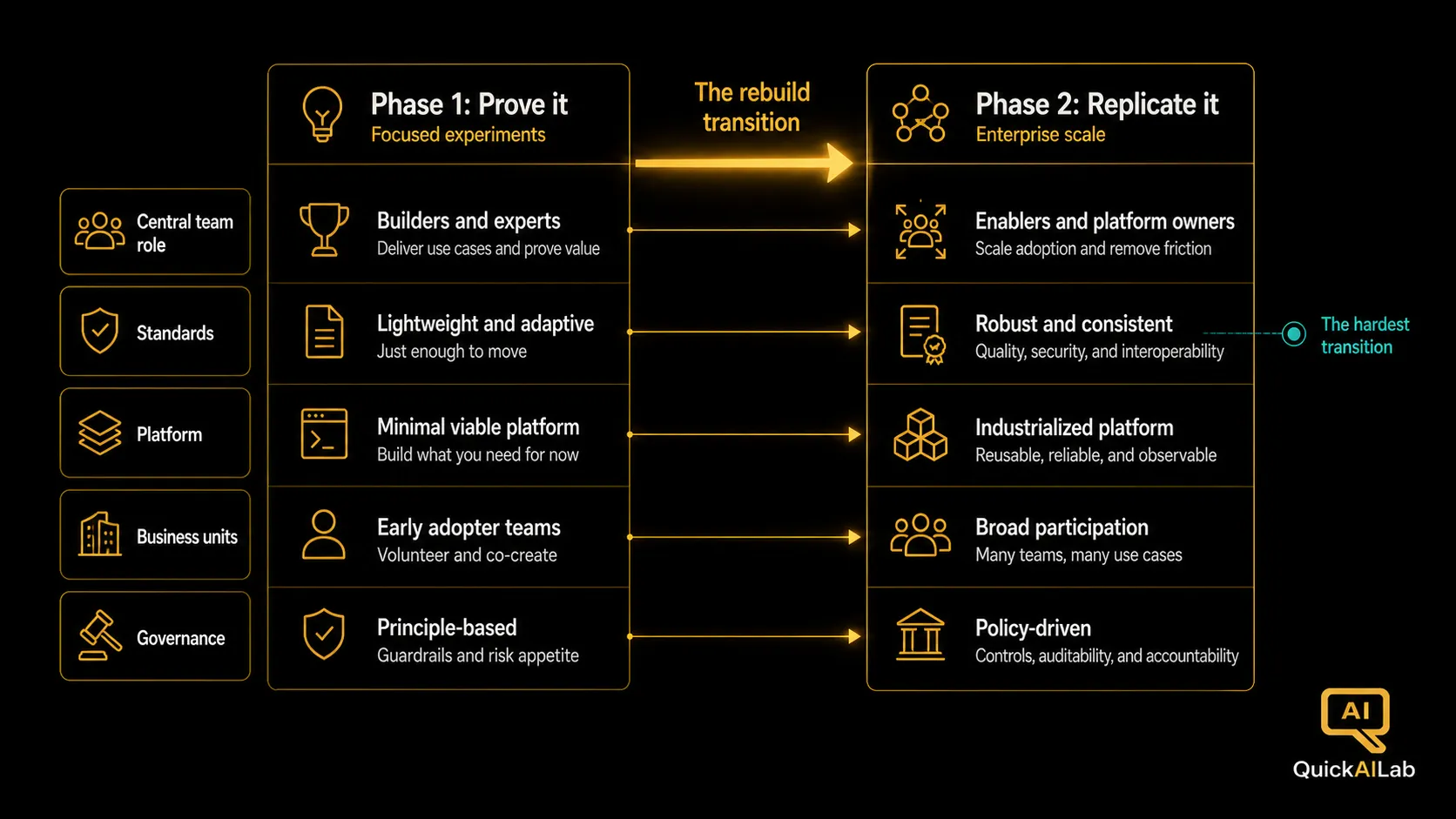
The central team, which was doing everything in phase one, now cannot. Demand outstrips capacity. The team’s job shifts from “build everything” to “build the platform that lets others build,” and this is a different job requiring different people. Some of the founding team will not want to make this shift, and they will need to be moved to new roles, replaced, or repositioned as domain leads in emerging spokes.
Standards, which were tribal knowledge in phase one, need to be written down. Evaluation, documentation, risk-tiering, deployment gates, all of it needs to exist as documentation, tooling, and codified defaults, not as “how the founding team does it.” The responsible AI advisor role becomes real in this phase, because there is no longer one person who knows what “safe” means.
The platform, which was internal in phase one, needs to be productized. Onboarding docs, self-serve provisioning, support channels, roadmap communication. Internal teams are now customers of the platform team, not colleagues of it, and the platform’s success metric becomes voluntary adoption from those customers.
Business units, which were passive recipients in phase one, start hiring. AI engineers, AI product managers, and increasingly context engineers and evaluation specialists. The dual career ladder from the roles article now needs to exist across the organization, not just in the central team, or the spokes cannot staff themselves.
Governance, which was informal in phase one, needs to scale without becoming a bureaucracy. This is the hardest single design problem in the transition, and it is where the Governance track’s risk-tiering earns its keep: standard-tier initiatives ship on paved roads with minimal friction, high-tier initiatives get the deeper review, and the categorization itself is the pressure valve.
Figure 1 lays out the phase-one to phase-two transition as a set of specific role, structure, and mechanism changes, showing which things stay the same and which have to be rebuilt. Programs that treat the transition as continuous evolution miss the rebuild, and the rebuild is where the multiplier lives.
The transition from replicate-it to distribute-it
If phase-one to phase-two is where most programs stall, phase-two to phase-three is where the most cautious programs plateau. What changes here:
The CoE, which was still doing significant delivery in phase two, mostly stops. Its remaining work concentrates in three areas: the platform (still central), the standards (still central), and the enterprise portfolio view (still central). Delivery capacity has migrated to the spokes, and if the CoE keeps building use cases, it is competing with its own customers.
Domain hubs in business areas, staffed with platform specialists, responsible AI advisors, and data engineers, become the primary delivery unit for AI. These hubs are the evolution the CIO 2026 research described as an interim state: strong local capability aligned to enterprise standards. Over further time, in the fully AI-native end state, even these domain hubs give way to smaller AI-empowered teams operating independently on top of enterprise platforms.
The platform, which was voluntarily adopted in phase two, becomes the default. Off-platform work still exists but requires explicit justification, and the maturity of the platform makes off-road paths genuinely more expensive rather than just symbolically discouraged.
Governance shifts from continuous assurance operated by the CoE to continuous assurance embedded in every delivery team. Every team, in a mature phase-three organization, has evaluation, monitoring, and documentation running as a normal part of their work, and the CoE audits rather than gates.
Literacy has diffused to the point where AI-adjacent competency is a general expectation of most roles, not a specialist attribute. Continuous learning is embedded in the operating rhythm.
The subtle risk in this transition is dismantling central capability faster than the spokes have absorbed it. Sequencing discipline matters: strengthen the spokes before you thin the hub, never the reverse. Organizations that dissolve the central capability on the promise of federated maturity that has not yet arrived get the worst of both worlds, exactly as the archetype article warned.
The financial arc of the journey
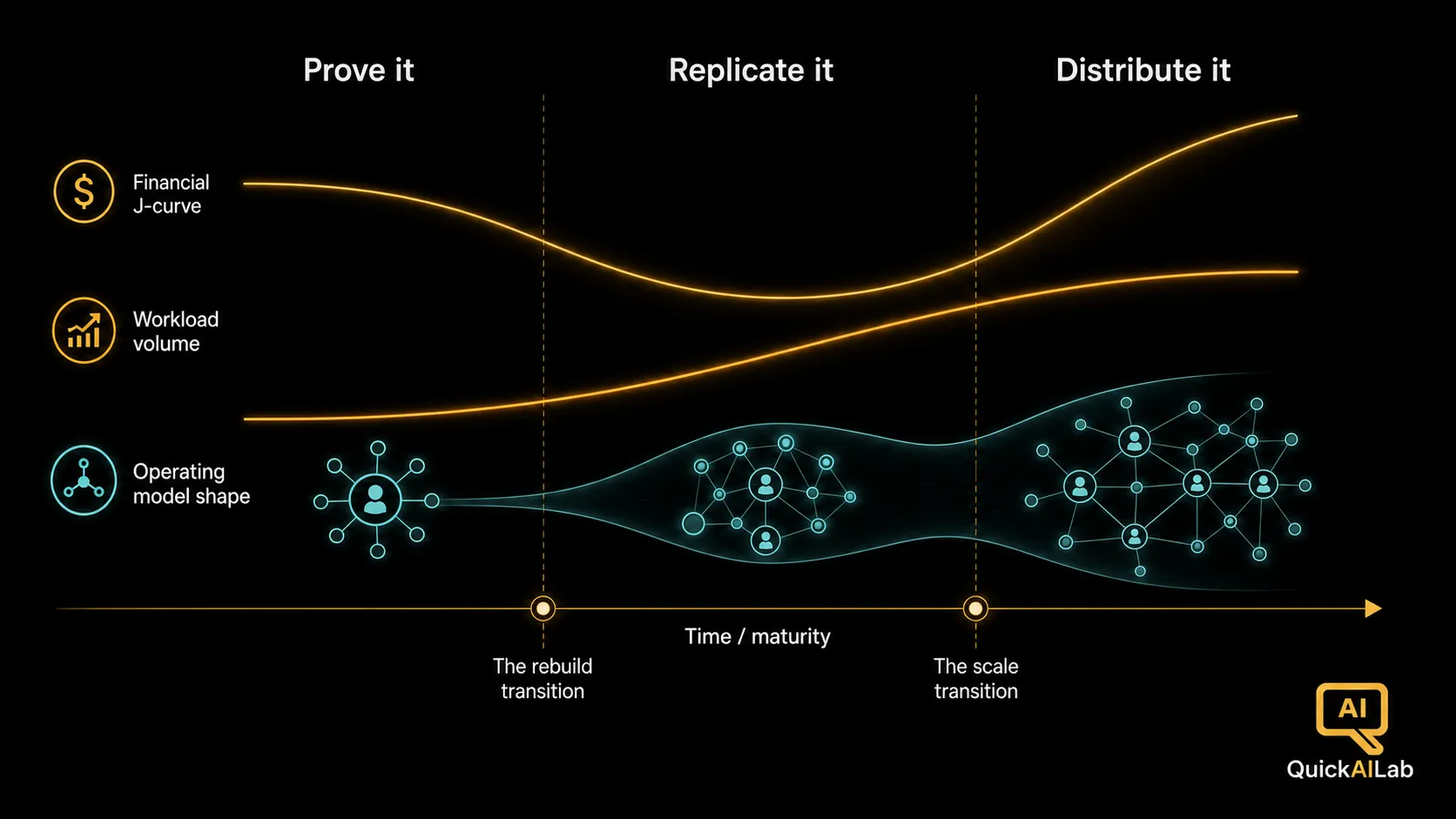
There is a specific financial pattern worth naming because it shows up predictably and creates predictable political stress. Phase one produces investment with limited returns, because volume is low. Phase two produces rising costs (platform investment, hiring, dual central-and-spoke structures) with returns that are visible but not yet at scale. Phase three produces the payoff, as the platform investment amortizes across many workloads, the CoE thins, and the value flows through the workflows the earlier phases built.
This is the J-curve the funding article described. Boards that expect linear returns lose their nerve in the second phase, exactly when the investment case looks worst on a spreadsheet, and pull back precisely at the moment where holding steady would have produced the compound returns. The operating model implication is that the funding narrative has to be presented against the phase model, not against year-over-year spend, and the specific evidence that phase two is going well is the growth in on-platform workloads and the shrinkage of shadow AI. Those are leading indicators; ROI is a lagging one.
What breaks when you push too fast
A closing observation from the enterprises that have tried to skip phases. There is no version of the journey that goes from phase one to phase three in a single leap. Attempts to do so, usually driven by pressure from a board that wants faster returns or a CEO who has read one too many AI-native op-eds, produce recognizable failure modes.
Federated delivery without a shared platform produces fragmentation, duplicated stacks, and inconsistent governance. Everyone builds; nothing scales.
Distributed accountability without literate leaders produces incidents nobody catches until they are large. The literacy substrate has to precede the distribution of authority.
Aggressive hub thinning without spoke maturation produces a governance vacuum. When the CoE dissolves its own capacity before the business units have absorbed it, standards become theoretical.
Universal platform mandates without a genuinely competitive platform produce compliance theater. If the platform is not actually the best way to do the work, mandating it just moves the shadow to a different shadow.
The pattern across all four failures: skipping the operational work of phase two. That work is not glamorous, but it is where the muscle of an AI-native organization actually gets built. The organizations racing past it end up either quietly resetting to phase two or explaining to the board why the acceleration produced regression. The phase-two rebuild map in Figure 1 is not a suggestion; the specific role, structure, and mechanism changes it lists are the price of admission to phase three.
Figure 2 traces the full three-phase arc alongside the financial J-curve, the workload volume trajectory, and the shape of the operating model at each phase. The arc is not linear in months; some programs move quickly, others stay in phase two for years. What matters is knowing which phase you are in and what specific transition work is required next.
The definition of “done”
There is no arrival. Even the fully AI-native organization keeps evolving, because the technology keeps evolving. What “done” looks like, insofar as it looks like anything, is an organization that has built the reflex of continuous redesign: workflows revisited on a cadence, roles kept current with the task mix, governance tuned as risks shift, funding and platform investment adjusted as consumption patterns move. As Figure 2 makes visible, none of the phases is a final state; the arc keeps bending as the technology and the business both move underneath it. The operating model is not a destination; it is a capability, and the capability is what compounds.
The organizations that master this capability will look, in five years, dramatically different from their current selves in ways their competitors will find difficult to close. Not because they have any particular model that others cannot buy, but because the surrounding operating model, the platform, the culture, the accountability, the funding discipline, the literate workforce, is a system that took years to build and cannot be replicated by a purchase order.
Which sets up the final article of this track. Over sixteen articles, we have described the operating model that works. There is a mirror-image discipline worth practicing: the operating model that does not work. The failures are patterned. They recur. And knowing what they look like, from the outside and from inside your own organization, is the last piece of the toolkit. That is the anti-patterns article, and it is next.