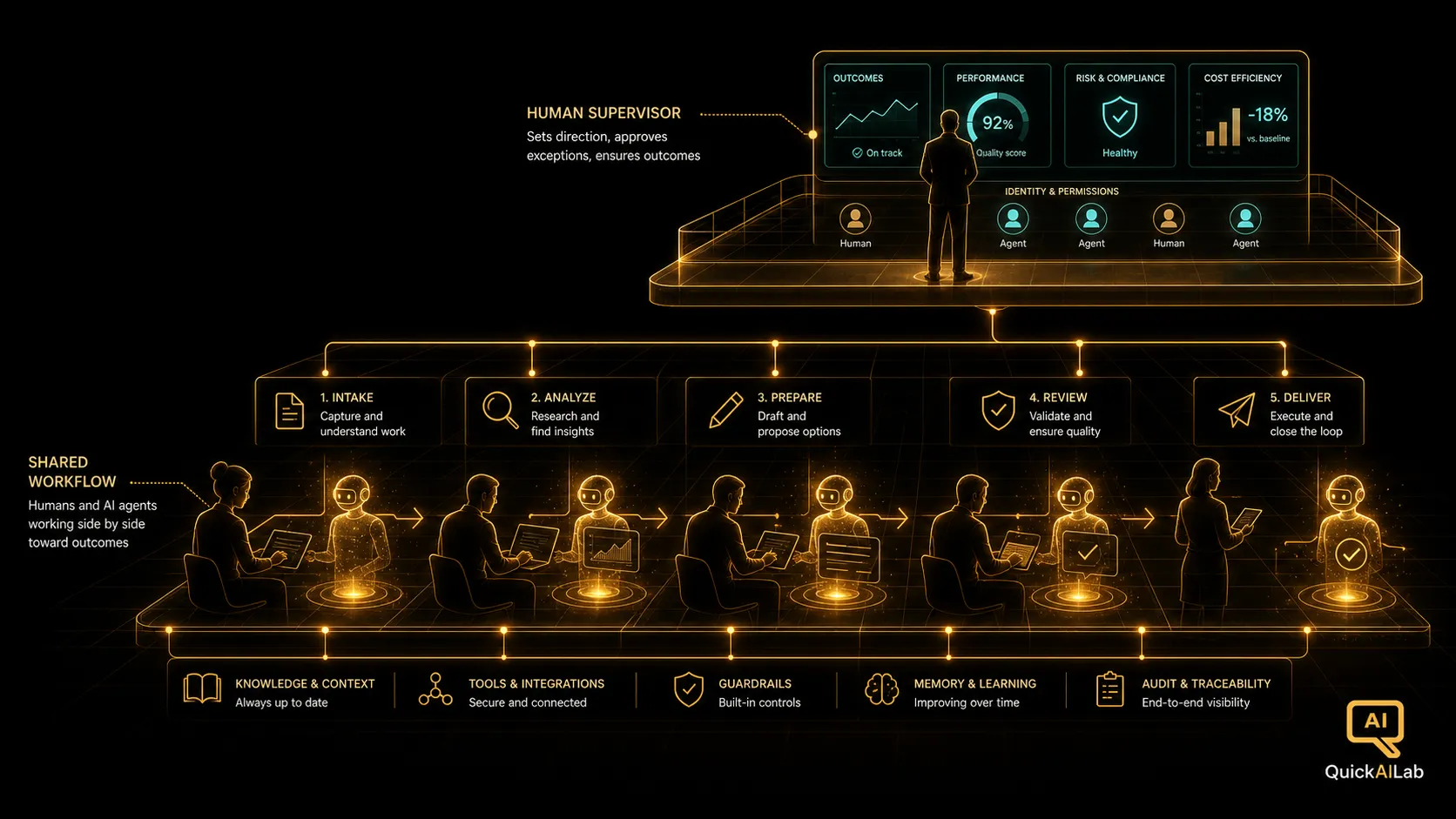
Here is a question that a serious management team in 2026 has to answer with a straight face. If an AI agent, acting inside your systems, executes a wrong action that costs the business money, who owns the mistake? Not conceptually. Operationally. Whose OKR degrades. Whose incident review it appears in. Whose team gets called into the boardroom.
If the answer takes more than ten seconds, your operating model has not yet caught up with the workforce you already have. Because whether or not you have called it this, if agents are executing actions inside your production systems, you are already managing a hybrid workforce. The only question is whether you are managing it deliberately or accidentally.
This article is about doing it deliberately: the roles, the oversight patterns, the autonomy ladder that everyone in this field is now climbing, and the accountability discipline that keeps the whole thing from becoming a governance disaster. It builds directly on the work redesign of the last article, because a redesigned workflow with agents in it is what a hybrid workforce actually looks like at ground level.
The shift the vocabulary has not caught up with
Traditional AI systems made predictions. A fraud model flagged a transaction. A recommendation engine suggested a product. In each case, a human reviewed the output and decided what to do. Agentic AI inverts that relationship. Agents plan, decide, and execute multi-step tasks. They query APIs, modify configurations, process payments, send communications, and trigger downstream workflows. The window for human intervention shrinks from days to seconds. The consequences of failure become immediate: a wrong payment, an unauthorized data access, a misconfigured system.
The management vocabulary most enterprises use, “the AI system supports the analyst,” was written for the prediction era. In the agentic era, it is describing the wrong relationship. Deloitte’s 2026 research is worth quoting for its bluntness: supervising, testing, and improving agent-enabled workflows is not the same as doing the underlying tasks. Roles emphasizing judgment, investigation, and intervention are what the new workforce needs, and helping people maintain the operational context to spot when agents are wrong is now a core management responsibility.
There is a language trap worth flagging up front. Some organizations, and some vendors, have begun referring to agents as “AI workers” or “AI employees.” The framing is seductive and dangerous. It implicitly erodes the accountability structures that governance requires, because employees have rights, protections, and moral status agents do not, and the moment we treat agents linguistically as peers, we start losing the sharpness of the “who is accountable” question. The Berkeley research on agent governance is emphatic: agentic AI should be treated as a tool under human oversight, not as a peer or subordinate. Vocabulary shapes what an operating model permits.
The three oversight postures
The field has settled, roughly, on three distinct oversight postures for AI systems, and knowing which one applies to which system is now foundational management skill.
Human-in-the-loop (HITL). A human approves or authorizes every action before the AI executes it. The system pauses at defined checkpoints and waits. This is the right posture for high-risk, low-reversibility decisions: financial disbursements, legal agreements, actions on sensitive data, anything an incident report would have to explain publicly.
Human-on-the-loop (HOTL). The AI acts autonomously; a human monitors outputs and intervenes if needed. Appropriate for medium-risk scenarios where speed matters and mistakes are reversible. Content moderation, first-draft communications, tier-one support responses.
Human-in-command (HIC). The AI acts within defined authority; humans set policy, boundaries, and review aggregate performance rather than individual actions. Appropriate for high-volume, low-per-action-risk workflows where per-action human review is neither feasible nor meaningful, and the meaningful control is at the policy and audit level.
The mistake to avoid is treating these as a fixed choice per system. In practice, a single agent may operate in all three postures at once depending on the action it is about to take. A customer service agent might handle standard queries in HIC mode, produce responses to sensitive complaints in HOTL mode, and pause for HITL approval before issuing any refund above a threshold. The posture is action-level, not system-level, and building the operating model around that granularity is where mature programs pull ahead.
The autonomy trust ladder
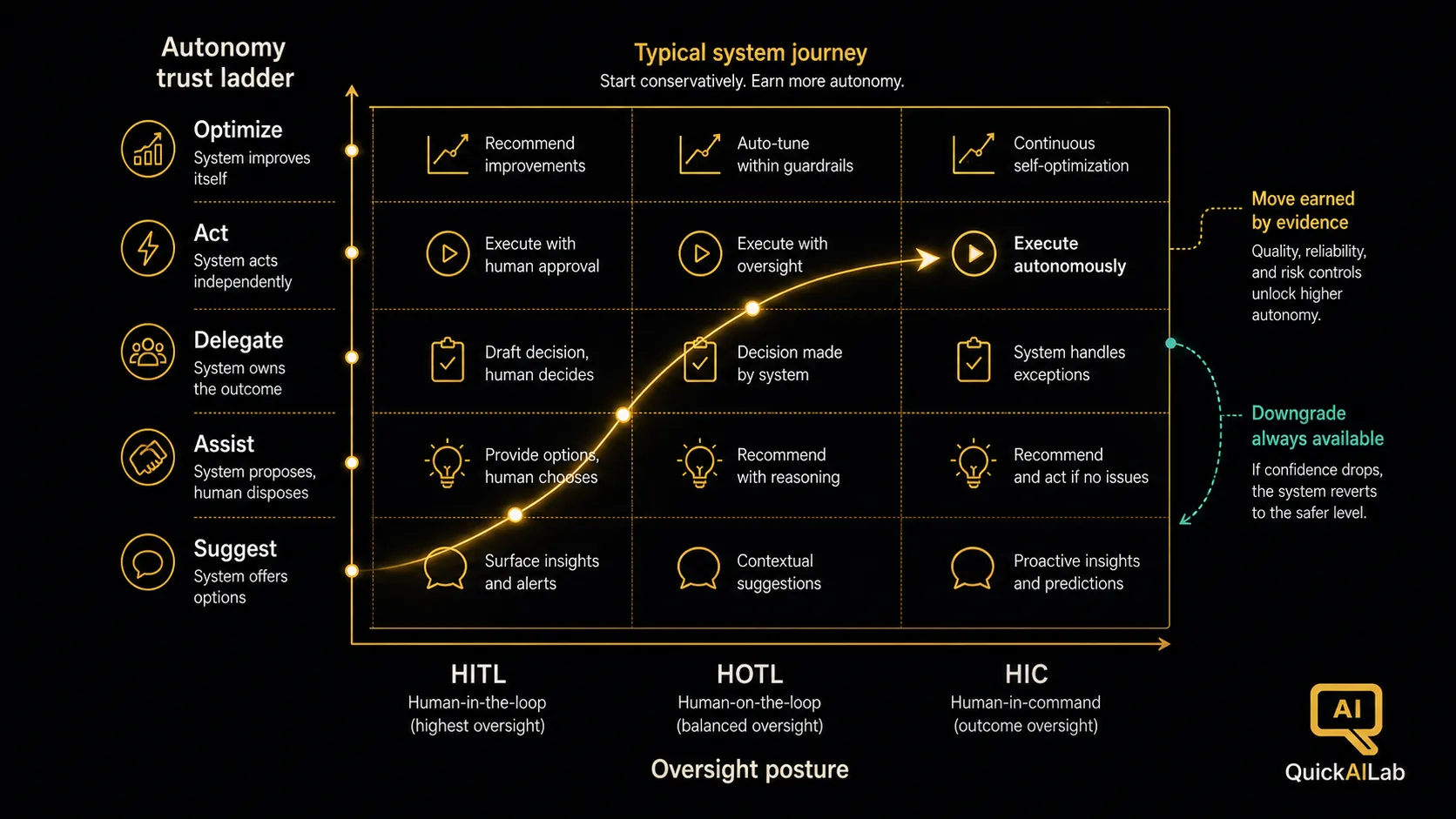
If oversight postures describe where a system sits today, the autonomy trust ladder describes how systems move over time. Deloitte’s 2026 framing, echoed across the field, is that moving from “humans approve everything” to “humans audit” is less about writing a policy and more about earning an operational track record. Organizations equipped with a robust measurement infrastructure climb the ladder faster and more confidently than those still depending on broad human approval requirements.
The ladder has recognizable rungs. Suggest, where the AI proposes and the human always decides. Assist, where the AI acts on narrow low-risk subtasks under close human supervision. Delegate within limits, where the AI executes bounded actions autonomously with humans monitoring aggregate behavior. Act, where the AI executes routinely within its defined authority and humans intervene only on exceptions or aggregate trends. Optimize, where the AI takes ownership of the outcome metric and adjusts its own approach within policy constraints.
Movement up the ladder is earned per capability, per workflow, per risk tier, on the evidence of a measured track record. Reversibility of the action matters: a downgrade to lower autonomy is always available, and mature programs use it routinely when incidents or drift appear. Trust is a resource that can be spent and rebuilt, and the operating model is the system that keeps score.
Figure 1 maps the autonomy trust ladder against the three oversight postures, showing how a system typically starts high on the HITL side, migrates through HOTL as track record accumulates, and reaches HIC only for the actions and workflows where the evidence supports it. Notice that “top of ladder” is not the destination for every system. Some workflows will and should stay in HITL forever, because the risk tier warrants it.
The five accountability structures
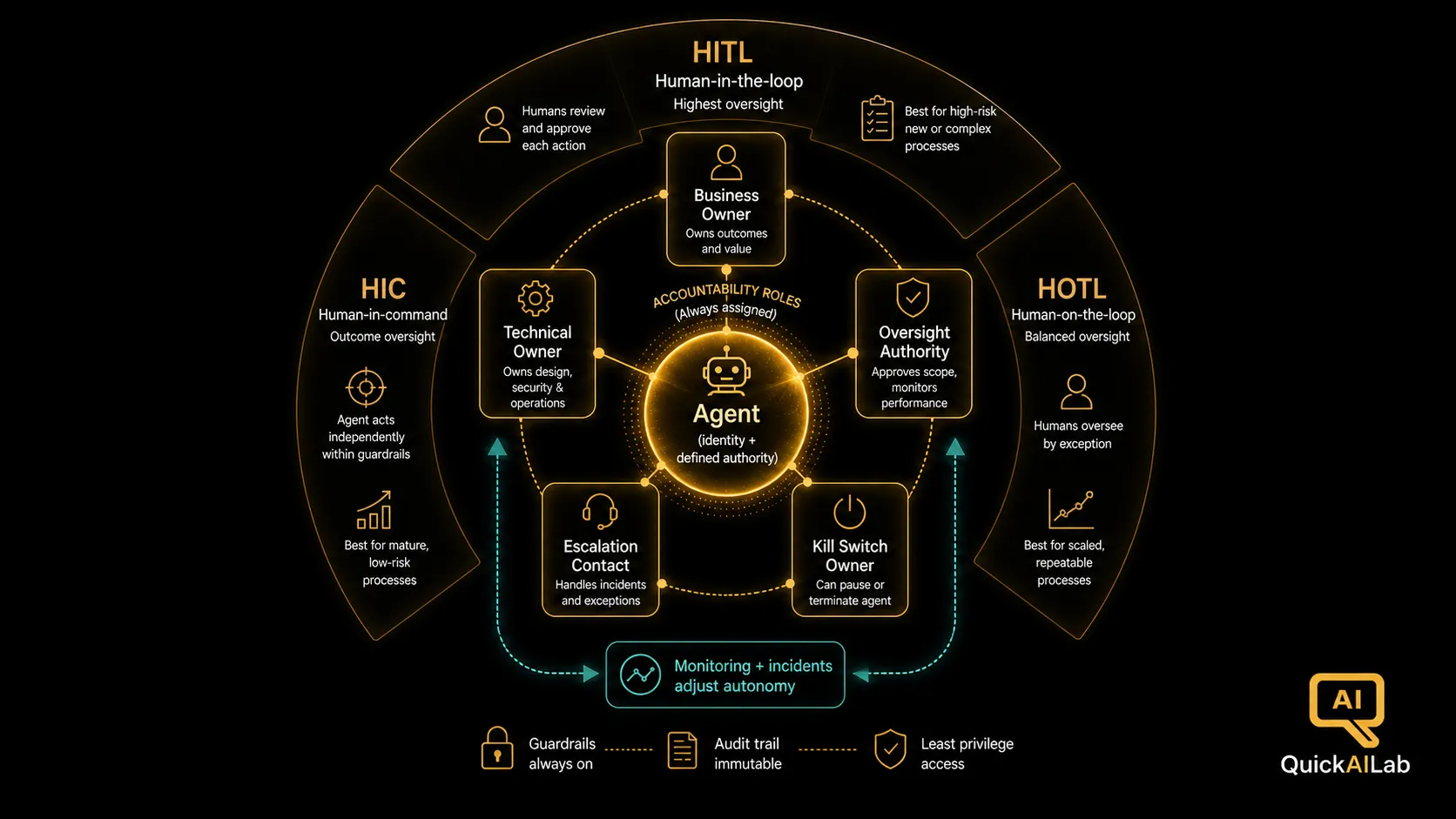
Oversight postures answer “how are humans involved.” Accountability structures answer “who is responsible when it goes wrong.” A hybrid workforce needs five distinct accountability roles, and clarity on who fills each is what separates a governable operating model from a governance failure waiting to happen.
Business owner. The role accountable for the outcomes the agent produces. This is the person whose team the agent is embedded in and whose objectives it exists to serve. When the agent underperforms or misbehaves, the business impact lands here first. Agents without a business owner are orphans.
Technical owner. The role accountable for the agent’s design, configuration, and technical operation. Usually an AI engineer or agent operations specialist. When the agent behaves in an unexpected way, this is where the diagnostic path starts.
Oversight authority. The role or function accountable for reviewing whether the agent’s actions are within policy: responsible AI advisor, risk function, or in some cases the CoE. This is the sign-off that the risk tier assessment matched the actual behavior.
Escalation contact. The human whose approval or attention the agent seeks when it hits an exception it cannot handle alone. Named. Reachable. Trained to make the call.
Kill switch owner. The person with the authority and the practical capability to disable the agent in an incident. In Writer’s 2026 research, 35 percent of executives admitted they could not immediately “pull the plug” on a rogue AI agent. That is the exact gap this role exists to close, and until you can name the person and the mechanism, the honest answer is that you do not have a functioning kill switch.
These five roles overlap in small teams and separate in large ones. Consolidating them all onto one person is workable for a single low-risk pilot; scaling that consolidation to a fleet of production agents is how organizations discover they have quietly built systemic risk.
Identity is the control surface
One implementation reality deserves calling out, because it is where a lot of hybrid workforce programs quietly fail. Traditional identity systems, OAuth and SAML and their kin, were designed for static human users, not for dynamic, autonomous workflows of AI agents. Agents shift from human to non-human identities depending on task, take actions across multiple systems, and often need adaptive access controls that permit some actions and deny others based on context.
Recent studies suggest fewer than 20 percent of organizations have formal processes to offboard and rotate API keys, which is the machine-identity equivalent of never removing a departed employee from the building access list. In an agent workforce, that is not a theoretical risk. Every agent needs an identity, defined authority limits, and centralized governance oversight that can detect and isolate violations quickly. Identity governance is where oversight becomes enforceable in the runtime, rather than being a policy document that nobody consults during an incident.
The practical implication for the operating model: an agent management program that does not include a machine identity governance layer is oversight in name only. The agent’s technical authority to act determines what oversight can possibly catch, because everything else has already happened by the time a human notices.
Managing the humans in the loop
There is a second workforce that this article is really about, and it is the one that tends to get less attention in agent-management discussions: the humans working alongside the agents. Their jobs have changed. Their success looks different. And their management needs to change too.
Three specific management shifts matter. First, the humans in oversight roles need context to make good calls, and context comes from continued exposure to the underlying work. Reviewers who never do the work themselves lose the pattern recognition that lets them spot a subtle failure. Rotating humans between doing and overseeing is an operating discipline, not a preference.
Second, oversight is cognitively demanding in ways that “doing the work” is not. Reviewing thirty agent outputs an hour, most of them fine, produces exactly the automation bias the aviation industry has documented for decades: the human rubber-stamps, catches nothing, and provides the appearance of control without the substance. Meaningful oversight needs sampling strategies, deliberate hard cases, and rotation, not marathons at a screen.
Third, incentives need alignment. If the human overseer is measured on throughput, they will approve. If they are measured on catch rate, they will over-flag. If they are measured on the net quality of the workflow output, including both false approvals and false catches, the incentives align with actual value. Building that measurement is real work, and few organizations have done it yet, but the ones running large agent fleets are learning fast that they must.
Figure 2 assembles the whole picture: agents in production with defined authority and identity, humans in the oversight postures the workflow requires, the five accountability roles wrapped around the system, and the feedback loop from monitoring and incidents that adjusts autonomy up or down as evidence accumulates. It is a workforce diagram, and it looks nothing like the org chart from three years ago.
The subtle skill that decides everything
If I had to pick one competency that separates organizations doing this well from those doing it badly, it is the skill of continuously downgrading autonomy when the evidence calls for it. Everyone can promote an agent up the ladder when things go well. Very few operating models have the reflex, the tooling, and the political cover to downgrade an agent when subtle drift or an edge case appears. And yet the willingness to downgrade is what makes the upgrade decisions trustworthy in the first place. Looking again at Figure 1, notice that “top of ladder” is a resting position for some workflows and a passing-through point for others; the same organization needs to be equally competent at moving in both directions.
That competency lives at the intersection of the agent operations specialist from the roles article, the responsible AI advisor from the governance track, and the business owner who takes the hit when performance dips. The three of them, together, are the management team of the hybrid workforce. Get their working relationship right and the whole model in Figure 2 works. Get it wrong and no amount of platform investment covers for it.
Managing a hybrid workforce is, in the end, the sharpest test of an AI operating model. It exercises every element from earlier in this track: the structures, the roles, the platform, the change management, the redesigned workflows, and now the accountability skeleton that holds the runtime together. What comes next is the operational culture that keeps it all working under pressure. In an environment where deployments happen weekly and behavior can drift silently, culture is the difference between a resilient program and a fragile one. That is the MLOps and LLMOps culture question, and it is where we go next.