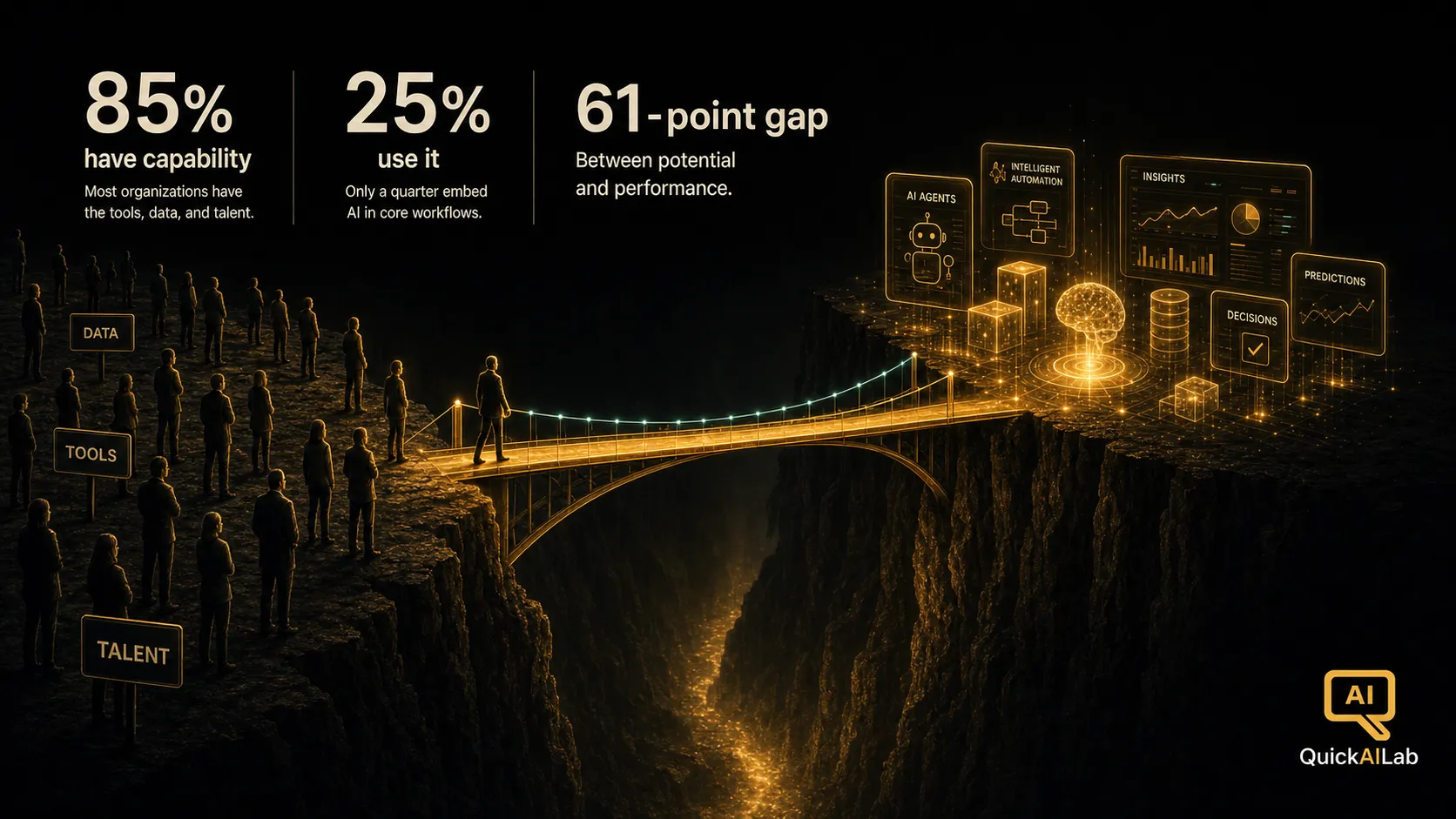
Here is the most expensive number in enterprise AI in 2026, and almost nobody in leadership meetings names it out loud. IBM’s Global CEO Study for this year found that 85 percent of employees have the capability to use AI at work, while only 25 percent actually use it regularly. Sixty-one points of gap. That gap is where the return on your AI investment is quietly disappearing.
The gap has other names. Deloitte calls it the deployment-versus-transformation gap. The World Economic Forum calls it a capability overhang, the growing distance between what AI systems can technically do and how they are actually used in practice. Prosci, whose 2026 study of 1,107 change professionals is the most cited data point in the field, resolves it more bluntly: roughly 38 percent of AI implementation difficulty comes from user proficiency, the human side of learning, prompting, and workflow change, while about 16 percent comes from purely technical issues. Nearly two and a half times as much friction lives on the human side as on the technology side. Yet a review of most AI programs’ budgets reveals almost the exact inverse ratio in spending.
This article is about closing that gap: what causes it, what it costs, and the change management discipline that turns capability into value. It opens the second half of the AI Operating Model track because everything from here on, redesigning work, managing agents, funding, accountability, scaling, sits on top of adoption. Without adoption, the rest is theater.
What the gap is actually made of
Zoom into the adoption gap and it resolves into five distinct causes, each with a distinct fix. Confusing them, treating them all as “training problems” or all as “resistance problems,” is the reason so many programs stall.
Unclear use cases. The most common cause and the least discussed. Employees have been given AI tools but no answer to the “where in my job does this help” question. Generic tool literacy without a role-specific map produces exactly what IBM measured: capability sitting on the shelf. The fix is not more training; it is workflow mapping done with the people who do the work, identifying the two or three moments per week where the tool changes the outcome.
Workflow friction. AI adoption stalls when tools add steps rather than remove them, or when they sit in a separate window from the systems people actually work in. Grant Thornton’s 2026 field work on stuck adoption programs points to this as the second-largest killer: if AI support is not built into the existing templates, ticketing systems, or knowledge bases, employees will not switch context to reach it. The paved road principle from the platform article applies here too, at the level of the user’s screen.
The trust gap. WalkMe’s 2026 survey of 3,750 enterprise workers found that only 9 percent of frontline workers trust AI for complex, business-critical decisions, against 61 percent of executives. The people most exposed to the downside are the most skeptical, and the people authorizing the rollout are the most confident. A rollout designed by executives who trust the technology, for workers who do not, will discover that trust asymmetry the hard way.
The what’s-in-it-for-me question. No adoption program survives contact with the workforce if it cannot answer why the person in front of the screen should change how they work. In an environment where 92 percent of C-suite leaders are actively cultivating “AI elite” employees and 60 percent plan layoffs for non-adopters, the honest translation is that AI proficiency has become a career necessity, not a productivity boost. That is a real answer. Programs that dodge it with vague productivity language get the quiet non-participation they deserve.
Leadership modeling. Only 35 percent of employees say their manager is an AI champion. And the most precise correlation in the Prosci data is the leadership support gap: organizations with smooth AI implementations score executive sponsorship at +1.65 on a minus-two-to-plus-two scale, while struggling ones score minus 1.50. That 3.15-point spread on a four-point scale is not “executive buy-in is nice.” It is the difference between adoption and abandonment, measured.
Figure 1 stacks these five causes into a diagnostic pyramid, from the foundational leadership modeling at the base to the surface-level workflow friction near the top, with the approximate remedy category attached to each layer. Programs skip the base at their peril, because a beautifully designed use case sitting on top of absent leadership modeling collapses.
Reading the signals honestly
Before designing a fix, an operating model needs to read the room. Two signals matter more than any survey.
Shadow AI usage. WalkMe’s field data shows that 78 percent of employees admit to using AI tools their employer never approved. In another 2026 study, 67 percent of executives believe their company has already suffered a data leak or breach because of an employee using an unapproved AI tool, and 35 percent of employees have entered proprietary information into public AI tools. The security instinct is to treat all of that as a violation. The operating model instinct should be to treat it as market research: shadow AI is a signal that the sanctioned path is not competitive. Every unauthorized tool in your telemetry is a product gap in your platform.
Sabotage and disengagement. The uncomfortable finding from Writer’s 2026 enterprise research: 29 percent of employees, and 44 percent of Gen Z, admit to actively sabotaging their company’s AI strategy. Fifty-four percent of C-suite executives report that adopting AI is tearing their company apart. These are not people who need better training. They are people who have concluded, correctly or not, that the AI program is being done to them rather than with them. That diagnosis calls for a different response.
The World Economic Forum’s 2026 archetype work is useful here. Rather than binary “adopter or resister,” they identify five distinct workforce archetypes: enthusiasts, curious, cautious, sceptics, and opposed. Each responds to different interventions. Sceptics need proof of utility; the cautious need visible guardrails; the opposed need honest engagement with the underlying fear of displacement. A one-size-fits-all rollout gets four of the five wrong.
The playbook that works
Two years of scaled AI rollouts have converged the field on a recognizable playbook. It is neither novel nor complicated. It is simply what the winners actually do.
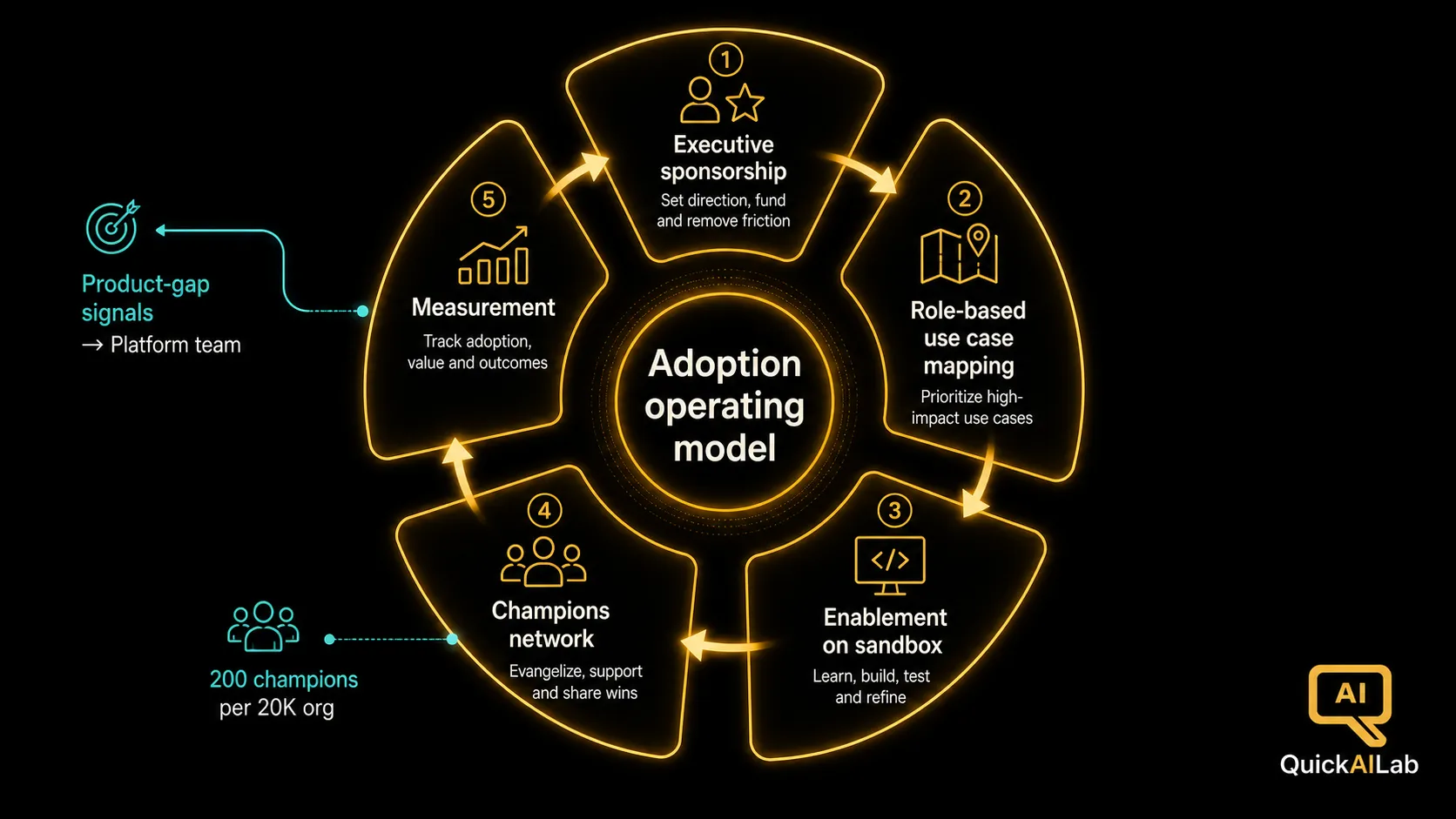
Executive sponsorship, expressed as behavior. Not a memo. Executives who visibly use the tools, share their own prompts, admit their own learning curve, and reference AI-produced work in their own meetings. The Prosci data on the leadership support gap is the most compressible finding in the whole field: sponsorship measured in behavior predicts outcome. Sponsorship measured in emails predicts nothing.
Role-based use case mapping, done with the people. Send champions and enablement leads to sit with actual practitioners for a day and map where the tool moves the needle for their specific work. Two anchor use cases per role, verified with the practitioner as real, is worth ten generic tutorials. This is where the AI product manager and the domain expert from the team article earn their keep.
Answer the WIIFM honestly. For each role affected, articulate what changes, what does not, what is expected, and what the person gains: time back on tedious work, capability they did not have, career adjacency into AI-adjacent roles. Where the honest answer is that the role will contract, do not pretend otherwise. Change management works because it is trusted; trust survives one clumsy communication a lot better than it survives one artful lie.
Meet people in their existing tools. Wire AI into the workflows people already use, not into a separate portal that requires a context switch. If your CRM does not surface the AI assist, expect adoption to plateau at the enthusiasts.
A champions network that is real. Named, time-allocated, visibly senior enough to matter. Champions do three jobs: model behavior in their teams, surface product gaps back to the platform team, and translate for the WEF archetypes their peers cluster into. A network of 200 champions across a 20,000-person organization moves what memos never can.
Address the layoff question directly. In a market where 60 percent of executives plan layoffs for non-adopters and 64 percent of employees fear losing their jobs over AI transition failures, silence on this topic is heard as confirmation. Programs that pair honest acknowledgment of disruption with a real, funded upskilling path get materially better adoption. Programs that offer platitudes get quiet resistance.
Measure what actually predicts value. Licenses provisioned and training completed are deployment metrics; they predict nothing. Repeat usage tied to the priority use cases, cycle-time reduction on those use cases, quality of AI-assisted work, and manager-observed workflow change are what matters. And crucially, employee experience: fatigue and frustration are leading indicators of quiet drop-off.
Figure 2 assembles these into the adoption operating model: a continuous loop from sponsorship and use case mapping through enablement, champions, and measurement, feeding product-gap signals back into the platform team from the earlier article. It is called change management, but the shape is really a product cycle for behavior change.
What this costs, and what it returns
Gallagher’s 2026 research finds that organizations measuring AI ROI expect an average of 28 months to realize meaningful returns. That is a boardroom fact. And here is the corollary that boardrooms less often notice: the change management spend that converts capability into that ROI is chronically underfunded relative to the technology spend that produced the capability in the first place. A rule of thumb from field practice is that mature programs invest roughly one dollar in enablement and change for every three to four dollars in tools and platforms. Programs that invest one-in-twenty produce the 25 percent usage rate IBM measured. The economics are not complicated. They are just uncomfortable.
The upside of doing this well shows up in the same research. Only 29 percent of organizations report significant ROI from generative AI, but the individual productivity gains among adopters are real: AI super-users deliver up to five times the productivity of peers. The gap between “individual wins” and “organizational returns” is precisely the adoption gap: many people getting better at their work, one at a time, in the absence of structural change that captures the value. Close the adoption gap, and those individual wins aggregate into the P&L. Leave it open, and the productivity flows to individual careers instead of enterprise outcomes.
The tie-back to the operating model
Every mechanism in the previous eight articles depends on adoption. The platform provides paved roads no one drives on. The Center of Excellence enables teams that do not engage. The training programs graduate people who then quietly return to their old workflows. Adoption is the multiplier on every other investment, and when it is zero, the product is zero. The pyramid in Figure 1 makes the sequencing point explicit: skipping the base layers of leadership and WIIFM to work on the visible surface layers is precisely how programs produce dashboards of activity with no change in outcomes.
The five archetypes from the World Economic Forum, the trust asymmetry between executives and workers, the leadership support gap from Prosci, and the workflow friction data from Grant Thornton all say the same thing in different vocabularies. Capability without adoption is inventory that depreciates. What Figure 2 sketches is not a communications plan; it is the operating discipline that turns AI from a line item on the technology budget into a change in how work gets done.
There is a subtler point buried in the numbers. When 48 percent of organizations have introduced AI without redesigning workflows or roles at all, the reason adoption stalls is often that there is nothing new to adopt into. Employees have been handed powerful tools and asked to keep doing yesterday’s job with them. The result is exactly the 25 percent usage figure: people trying the tool, finding no obvious slot for it in a workflow designed for pre-AI patterns, and returning to what worked. Adoption cannot be forced into a workflow that was not built to receive it.
Which raises the question this article deliberately does not fully answer: what would work look like if we redesigned it around AI as a participant, rather than bolting AI onto work designed for humans alone? That is the question the next article takes on. Redesigning work around AI is the missing step between deploying tools and getting transformation, and it is where the biggest returns of the AI era actually live.