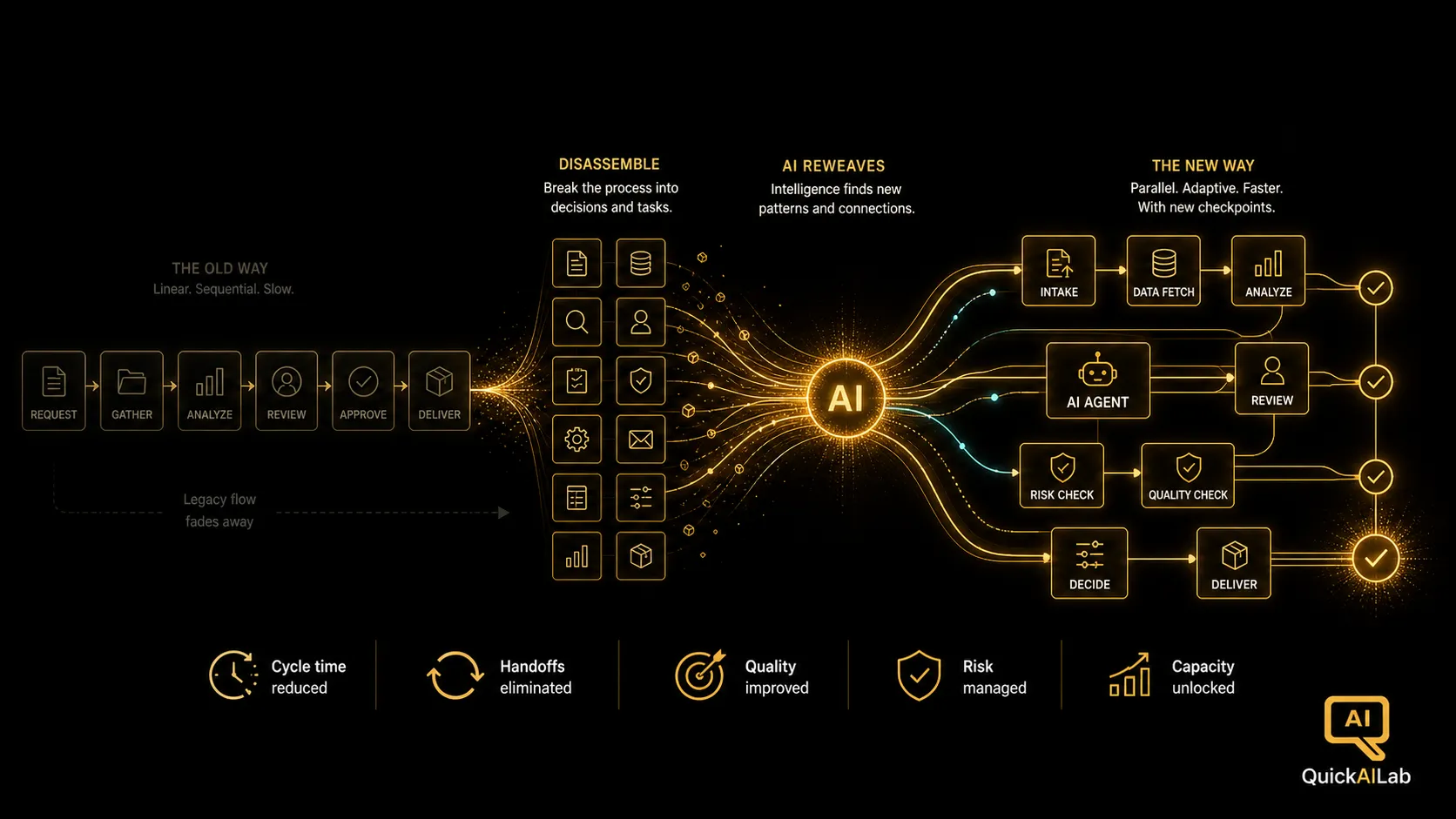
Deloitte’s State of AI in the Enterprise 2026 asked leaders a specific question: has your organization redesigned jobs to fit AI? Eighty-four percent said no. Not “we are working on it.” Not “for some roles.” No. Automation expectations across those same organizations are high, but the work itself is being asked to receive AI without changing shape. The tools arrived. The job descriptions, the process maps, the handoffs, the review points, the definitions of “done,” all of them, stayed the same.
This is the missing middle in almost every stalled AI program. Between the technology deployment on the left and the transformation outcomes on the right, there is a step that leaders describe in slide decks and rarely actually do: redesigning work around AI as a participant. Skip that step, and no amount of tooling closes the adoption gap the previous article measured. Do it well, and modest technology can deliver outsized returns, because the work is now shaped to convert AI capability into value.
Why bolting AI onto old workflows fails
Consider the mundane case that plays out in every large enterprise. A claims team gets a generative AI tool that can draft initial claim assessments. Nobody redesigns the claims workflow, so the tool sits at the front of a process that still assumes an assessor writes the draft. Assessors dutifully use the tool, watch it produce a draft, and then, because the review checkpoints downstream were designed to catch human errors from a human draft, apply a level of scrutiny that would have caught most human errors and also catches most of the AI’s. Net cycle time savings: modest. Net workflow change: none. Net insight into whether the AI is actually good: zero, because the downstream review compensates for every failure mode.
Now scale that pattern across every process where AI has been introduced without redesign, and the industry’s disappointment with AI ROI has a much simpler explanation than the usual “the technology is not there yet.” The technology is there. The workflow around it is designed for a workforce that does not exist anymore.
Gallup’s April 2026 data confirms the shape of the problem from the employee side. Twenty-seven percent of employees in AI-adopting organizations report disruptive workplace change in the past year, compared with 17 percent in non-adopting ones. But the gap between reported individual productivity gains and firm-level productivity gains remains stubbornly wide. The disruption is real; the value capture is not, because the disruption is happening to workflows that were not redesigned to convert it.
What “redesigning work” actually means
Let me be specific about what work redesign is not, because the phrase invites vagueness. It is not a training program. It is not a change communication. It is not a new tool rollout. It is a deliberate, granular reshaping of who does what, in what order, with what handoffs, to what standard.
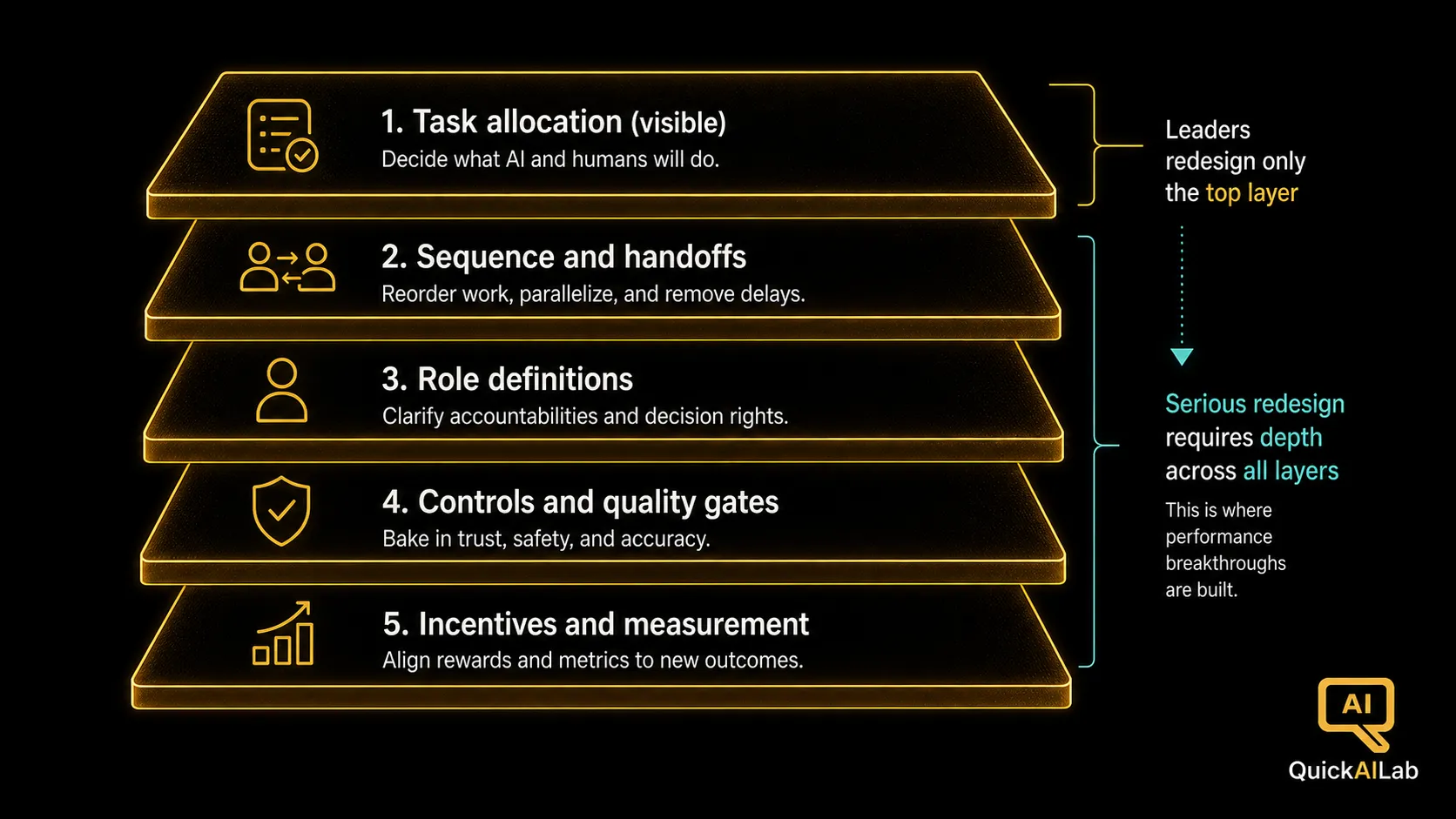
Redesigning work around AI touches five layers of the workflow, and all of them have to move together.
The task allocation. Which steps stay with humans, which move to AI, which become hybrid. This is the visible layer, and the one leaders think redesign is entirely about. Doing it well requires the AI product manager’s judgment about what accuracy is acceptable, and the domain expert’s judgment about what “acceptable” means in this specific context.
The sequence and handoffs. When AI moves upstream, downstream steps often need to change. Reviews that were designed to catch human errors need to be redesigned to catch AI errors, which fail differently. Sequential steps that AI can now do in parallel need to be re-sequenced. Handoffs between roles need to be redrawn.
The role definitions. The person who used to write the draft now edits, evaluates, and improves it, which is a different job. Job descriptions, competency frameworks, and performance metrics that were built around the old task mix are quickly obsolete, and leaving them obsolete produces the pattern from the new-roles article: people doing new work under old titles, getting evaluated against yesterday’s standards.
The controls and quality gates. AI systems fail differently than humans do. Redesigned workflows include AI-specific evaluation points, sampling regimes for machine-produced work, and escalation paths for the edge cases the AI reliably struggles with. Regulators expect this discipline; supervisors increasingly ask about it.
The incentives and measurement. If the workflow now produces the same output with less effort, the question of what people spend the freed capacity on becomes the entire ROI question. Redesign that does not think through the reinvestment of freed capacity captures cost savings once and leaves compounding value on the table.
Figure 1 shows these five layers as a stack. The visible one, task allocation, is on top; the ones that leaders most often skip, roles, controls, and incentives, sit underneath. Programs that redesign only the top layer produce cosmetic transformation. Programs that redesign the whole stack produce the compound returns we spend the rest of this track chasing.
Where to start: the right unit of redesign
The instinct is to start with functions or departments. That is too big. The right unit is the workflow: a bounded end-to-end process with an identifiable input, output, owner, and cycle time. Claims triage. Contract review. Marketing brief to launched campaign. Incident ticket to resolution. Sales research to first outreach. These are unit-sized problems where redesign is tractable, measurable, and revisitable.
Three criteria pick the workflow to start with. First, cycle time volume: many small cycles let you measure change quickly. Second, AI leverage: at least one meaningful step where AI capability is genuinely differentiated. Third, engaged domain experts: no redesign survives contact with the actual work without the people who do it.
Once the workflow is chosen, the redesign method is straightforward, though not easy. Map the current state honestly, all of it, including the informal loops nobody documented. Identify where AI participates: what it does alone, what it does with a human, what it never touches. Redraw the sequence with those roles in mind. Rewrite the role definitions for the humans involved. Redesign the controls and quality gates for a mixed workforce. And crucially, decide what the freed human capacity gets redirected to: quality, throughput, complexity, or reduced headcount, and be honest about which one.
Grant Thornton’s 2026 field research on adoption that sticks converges on a specific check: does the redesigned workflow’s language match how employees describe the work? If the flow chart uses vocabulary the practitioners do not, the redesign is imported. If it uses their vocabulary, it was co-designed, and the odds of adoption climb sharply.
The task-versus-role distinction
Here is a subtle mistake worth naming, because it wastes enormous amounts of leadership energy. Most tasks in most jobs are automatable in principle. Very few jobs are. Roles are bundles of tasks plus judgment plus relationships plus context that hold together for reasons the org chart does not capture. Deloitte’s 2026 work on this is emphatic: automating tasks designed for human workers without rethinking how work should be done misses the point, because the value in most roles is not in the tasks themselves but in the pattern of judgment they collectively enable.
A useful reframe: rather than asking “which tasks in this role can AI do,” ask “if AI is a permanent participant, what should this role become.” Sometimes the answer is a role with the same title and radically different content. Sometimes it is a role that splits into two: an execution stream automated and supervised, and an oversight-and-edge-case stream that becomes more senior. Sometimes it is a role that dissolves entirely, its judgment reallocated to a different point in the workflow. All three answers are valid; treating “automate every task inside the existing role box” as the only answer produces the pattern PwC’s 2026 barometer measured, where entry-level roles have started demanding traditionally senior skills because the old apprenticeship tasks vanished.
The workflow as evidence
There is a governance dimension to workflow redesign that comes into sharper focus every quarter. When regulators ask how AI is being used in a process, a documented redesigned workflow is now the strongest possible evidence. It shows the risk assessment that led to the task allocation. It shows where humans oversee and where AI operates alone. It shows how quality is monitored. And it shows what the escalation path is when the AI is wrong. The Governance track’s continuous assurance expectations map almost perfectly onto the workflow layer, because that is where controls live in operation, not in policy.
The inverse also holds. When a workflow has not been redesigned, the answer to “how do you govern this AI system in this process” is usually an uncomfortable pause followed by pointing at the tool’s own documentation. Regulators, boards, and eventually incident reviewers find that answer unsatisfying.
Rebuilding measurement around the redesigned work
The measurement question deserves its own moment, because it is where redesign programs most commonly leak value. When work is redesigned, the metrics attached to it usually need to be redesigned too. Cycle time, quality, and throughput often improve at the level of the individual step and get invisible at the level of the whole workflow, because the old measurement instruments were designed to sample the old workflow at the old handoffs. Instrument the new handoffs. Sample the new quality gates. And, critically, measure the reinvestment of freed capacity, because that is where the compound returns show up or fail to.
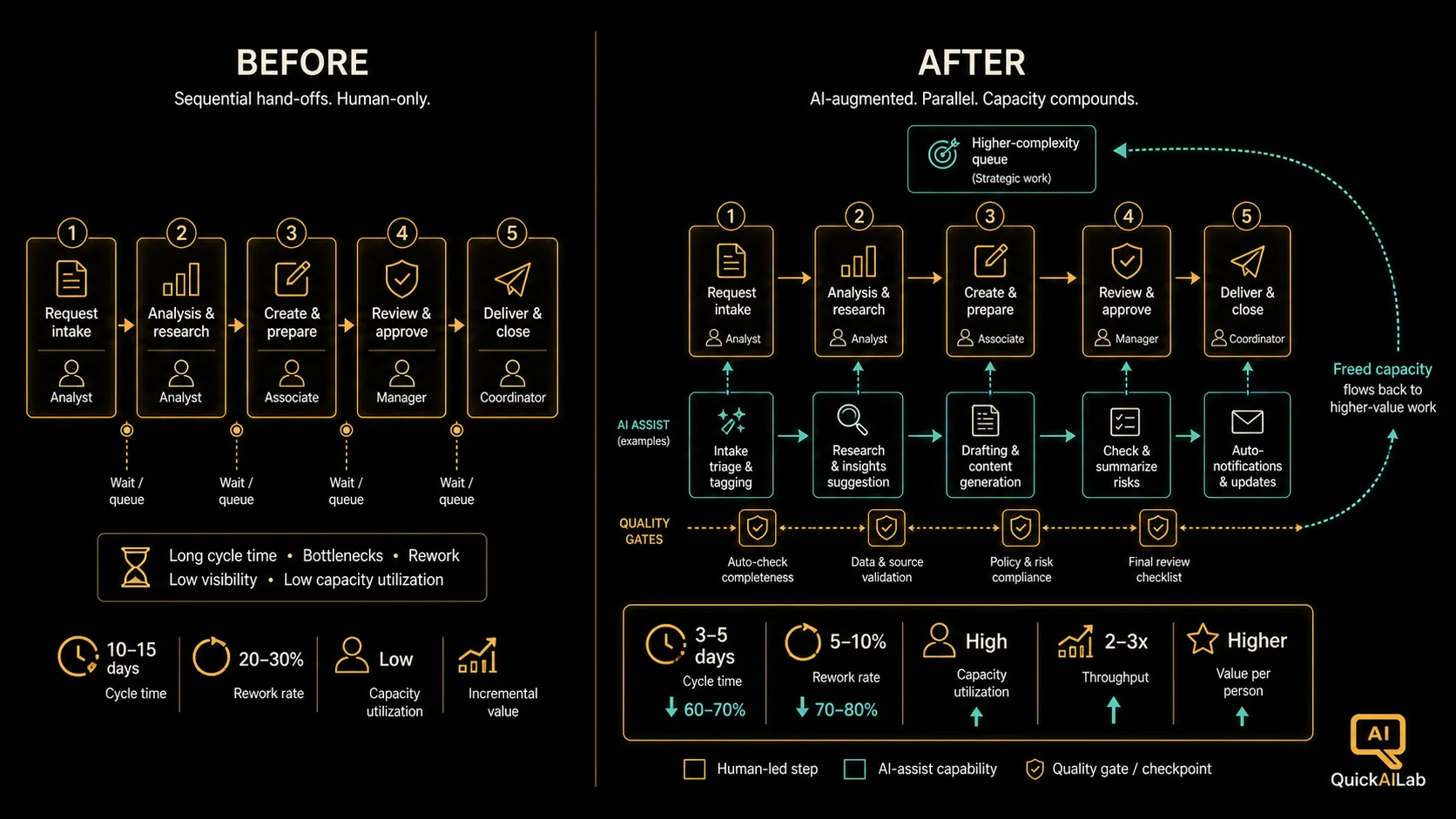
Figure 2 traces the before-and-after of a redesigned workflow, showing task allocation, handoffs, and measurement points shifting together. The specific example is drawn from a customer service context, but the shape generalizes: fewer sequential human steps, more parallel AI-assisted ones, redesigned control points on the AI-produced work, and a reinvestment loop that sends freed human time toward higher-complexity cases the AI does not handle.
Redesign as a repeat game
One closing point that matters more than any single workflow. Work redesign around AI is not a one-time project; it is a capability the organization needs to develop and keep. The models improve every quarter, agents extend what is automatable, and the useful task allocation shifts underneath the workflow like tectonics. Organizations that redesigned once in 2024 and moved on are already living inside stale workflows. The ones building genuine advantage are running redesign as a rolling program, revisiting workflows on a cadence, and treating the redesign function itself as a durable capability inside the operating model.
This is where the CoE, the platform team, and the business units all meet. The CoE and platform team provide the tools, patterns, and evaluation infrastructure that make redesign fast; the business units provide the domain expertise and the ownership of the outcome. As Figure 1 suggests, the five layers of the redesign stack cannot be redesigned by any of these functions alone; the deep layers require the business, and the shallow layers require the CoE. When the two work together, you get the pattern the 16 percent of organizations who redesigned at scale reported: real workflow change, real adoption, and a productivity signal that stops being individual and starts being enterprise-level. The before-and-after comparison in Figure 2 also implies something about pacing: the redesigned workflow is not a bigger workflow, it is a differently shaped one, and the redesign investment pays off precisely because the shape stops changing every quarter once the pattern is right.
The next question, once work is redesigned and humans are working alongside AI in the flow, is how to manage the resulting hybrid workforce. Because in most redesigned workflows in 2026, AI is not just a tool anymore; it is a participant. That changes what management, oversight, and accountability mean, and it is the subject of the next article.