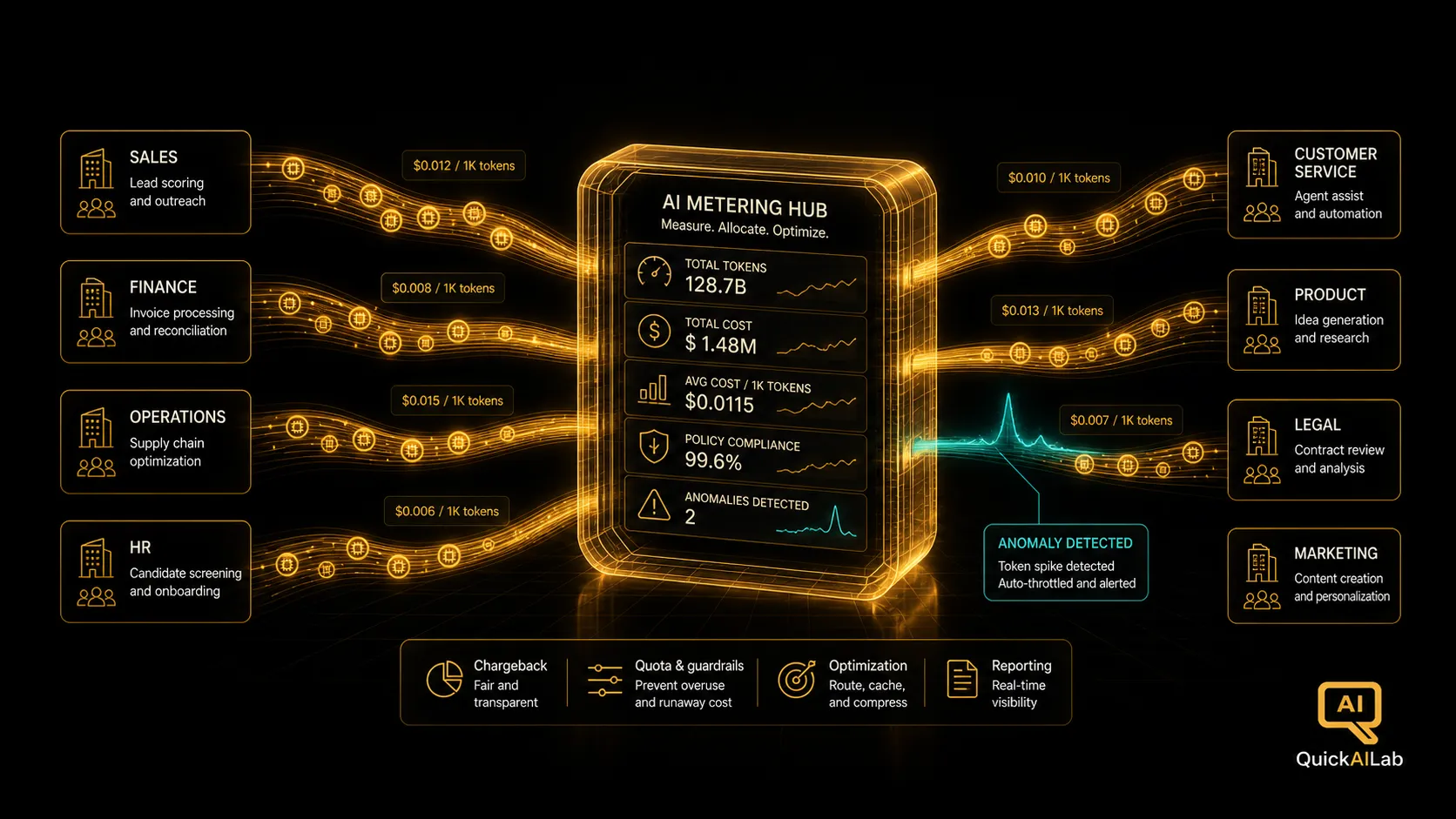
At FinOps X 2026, one chart did most of the arguing for the week: enterprise token consumption climbing from single-digit trillions to tens of trillions in under a year. Against that backdrop, the FinOps Foundation formally expanded its mission from “cloud value” to “technology value,” and by end of conference had announced a new Tokenomics Foundation under the Linux Foundation umbrella, backed by Accenture, Booking.com, Google Cloud, IBM, JPMorgan Chase, Microsoft, Oracle, Salesforce, SAP, ServiceNow and others. The State of FinOps 2026 report captured the shift in numbers: 98 percent of respondents now manage AI spend, up from 63 percent in 2025 and 31 percent in 2024. GPU spend is now the number one FinOps concern for AI-first organizations, surpassing general cloud costs for the first time.
The industry, in other words, has just decided out loud that AI cost is a boardroom-level discipline, not an engineering line item. And the practitioners in the trenches have been telling us why. Organizations that forecast their 2026 AI spend late last year, conservative estimates through aggressive ones, had, by June 2026, already burned through three times that entire annual budget. The mechanisms that worked for cloud do not translate cleanly. All-you-can-eat subscription plans modeled on SaaS seat licenses are being replaced by metered usage as providers face their own capacity constraints. Anthropic’s April 2026 enterprise pricing transition was the visible front edge of a broader move across the industry.
Funding, in other words, is no longer a spreadsheet exercise done once a year. It is an operating model decision that shapes behavior, allocates scarce resources, and decides whether AI value shows up in the P&L or just on the invoice. This article is the funding chapter of the operating model, and given the topic’s rate of change, it earns a longer treatment than most.
Why AI spend behaves differently
Traditional software procurement priced predictability: a seat license, a server, a support contract. AI spend has three properties that break that model, and every failure mode discussed below traces back to one of them.
It is metered at the atomic level. The token is the unit of AI cost, and unlike cores or storage bytes, tokens are consumed non-uniformly across workloads. The same feature can cost ten times more depending on prompt length, context window, model tier, and whether caching hits. Finance functions accustomed to seats and CPU hours are being handed an invoice denominated in a unit they have never budgeted before.
Consumption is elastic and demand-driven. Cloud compute usage tends to reflect the size of the workload; AI usage tends to reflect the enthusiasm of the users. A single successful adoption push, or a single well-optimized agent that starts iterating aggressively to solve a problem, can multiply consumption in a way that flat monthly forecasts cannot absorb.
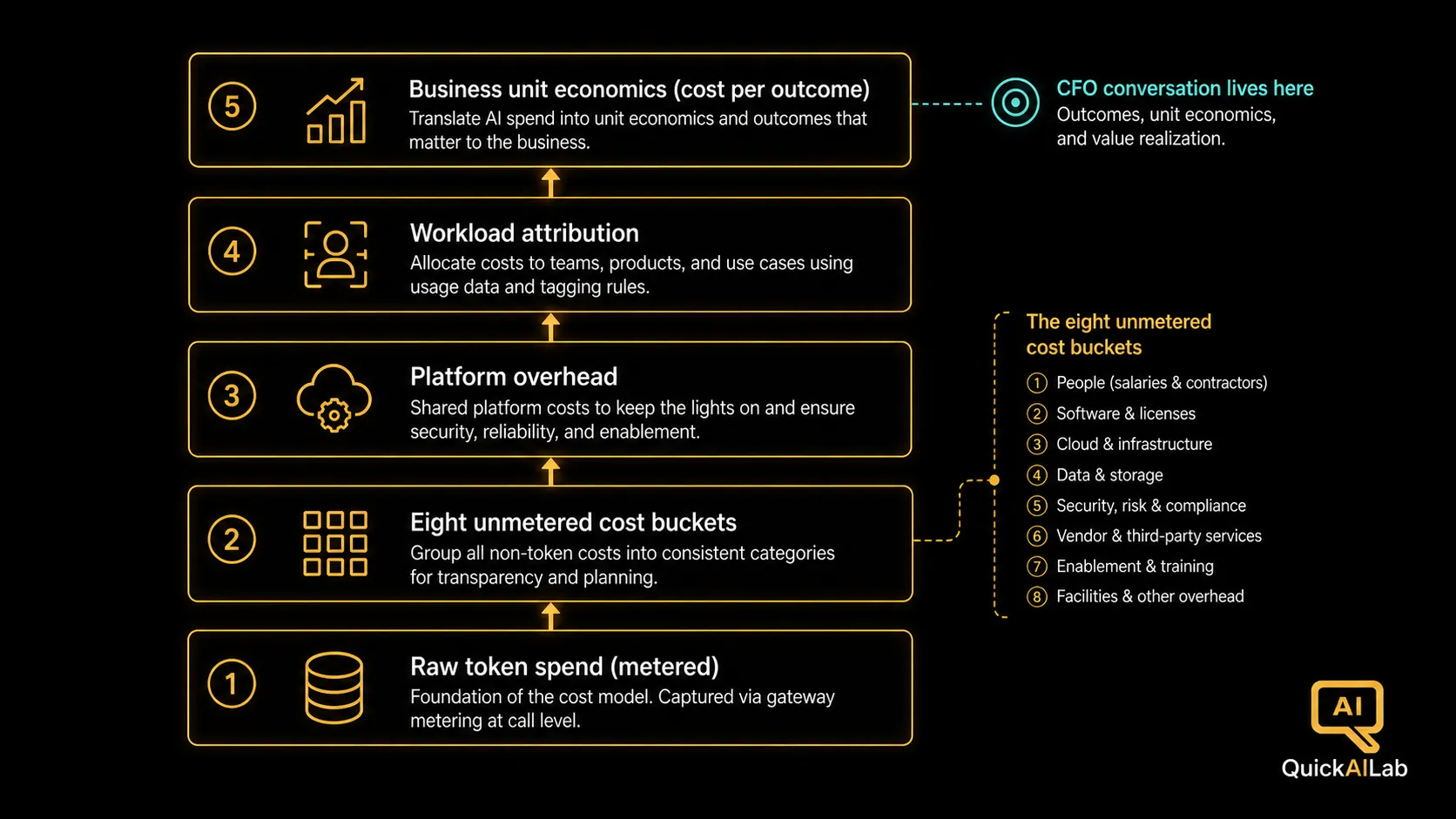
The invoice is not the whole cost. The metered token bill is one of nine cost buckets that FinOps X 2026 identified. The other eight, retrieval and data infrastructure, orchestration, inference infrastructure including KV cache the invoice never shows, evaluation harness compute, observability, sovereign compliance, human oversight, and platform overhead, all sit unmetered next to it. Enterprises that anchor budgets on the API invoice alone are budgeting for roughly a quarter of what they will actually pay.
The result is that the 2026 practitioner community, the same one that spent the last decade mastering reserved instances, tagging, and cloud showback, is starting close to zero on AI. Not because the discipline is different at the core, it is not, but because the surface area has moved and the vocabulary has changed. FinOps for AI is FinOps applied honestly to a new unit of consumption.
The three funding archetypes
Before touching the mechanics of tokens and tagging, the operating model owes a decision at a higher level: how are AI initiatives funded across the enterprise. Three archetypes cover most enterprises in 2026.
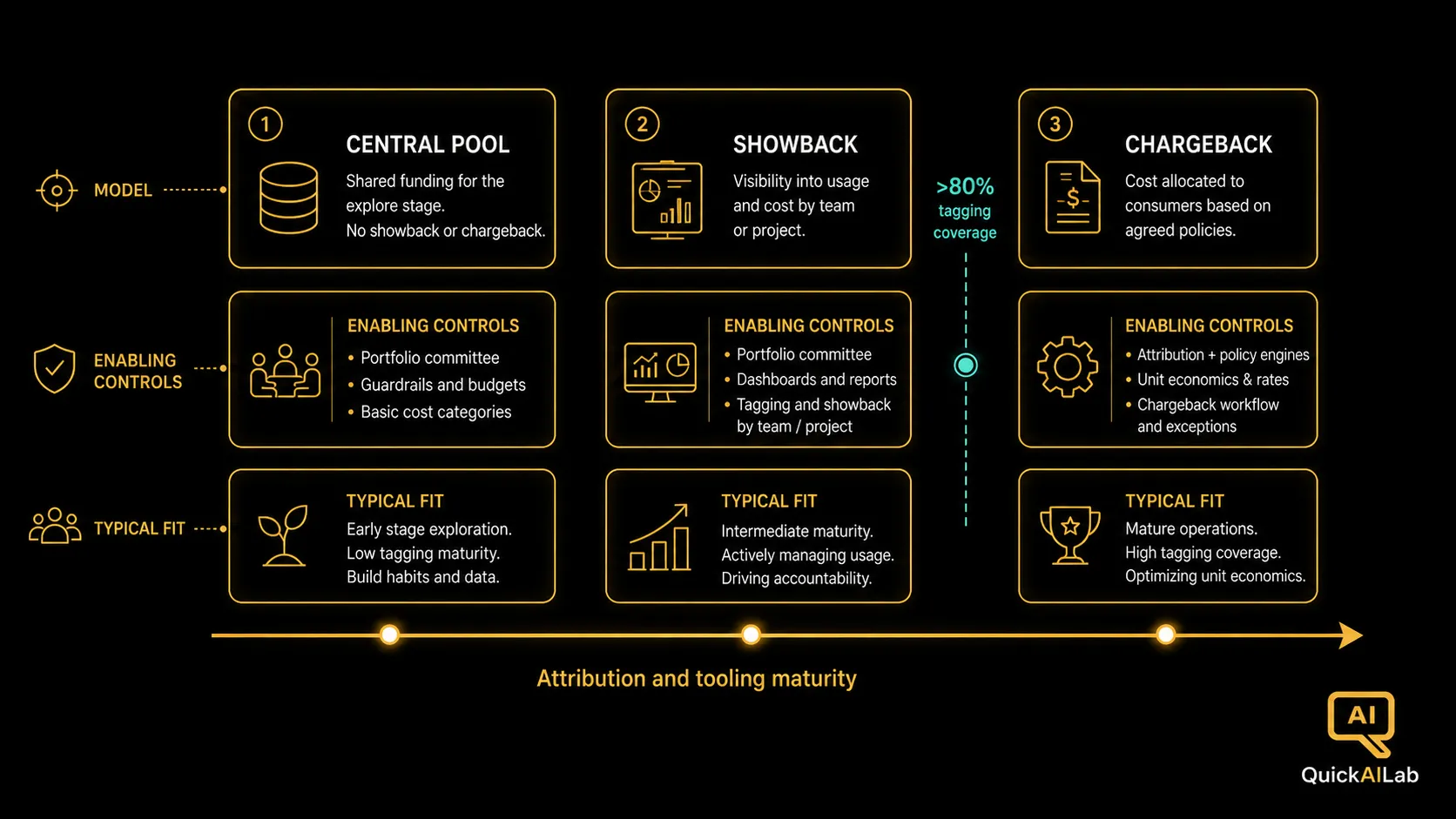
Central pool. A single enterprise budget funds AI activity across the organization, allocated by the CoE or a steering committee. Advantages: it lets leadership steer investment toward the highest-value opportunities and prevents rich business units from monopolizing capacity. Disadvantages: it creates a queue, misaligns spending with the value produced, and quietly disincentivizes optimization because the cost is not felt where it is generated. Best fit for early-stage programs where portfolio steering matters more than local optimization.
Business unit budget with showback. Each business unit funds its own AI initiatives; the central team provides visibility into token and infrastructure consumption without invoicing. Advantages: units own their outcomes and their spending; central visibility keeps the enterprise view alive; nobody has to argue about attribution accuracy because nothing is being invoiced. Best fit for the intermediate stage where discipline is emerging but the tooling to invoice precisely is not yet in place.
Chargeback. Business units are invoiced for their actual AI consumption, attributed at whatever granularity the tooling can support (team, product, use case, sometimes per-inference). Advantages: direct accountability, the strongest possible signal for optimization, and clean unit economics conversations. Disadvantages: attribution overhead, disputes about shared infrastructure allocation, and the risk that units under-invest in AI to avoid the invoice.
The State of FinOps data is clear about the direction of travel. Mature enterprises are moving from showback to chargeback as their attribution tooling improves. But the transition is not automatic and not always warranted; showback done well is often better than chargeback done sloppily. The practitioner rule of thumb worth honoring: showback for four to six weeks to find the tagging gaps, then move to chargeback once coverage is above roughly 80 percent.
Figure 1 arranges the three archetypes across the maturity path and shows the enabling controls each one requires: portfolio committee for central pool, transparent showback dashboards for showback, and precise attribution plus policy engines for chargeback.
The visibility problem: attribution at the token level
Chargeback and even honest showback both depend on knowing which team consumed which tokens for which purpose. The bad news is that model providers do not natively support the tagging structures FinOps teams rely on. An OpenAI or Anthropic invoice will show spend by API key or project, not by business unit, cost center, application, or team. Bridging that gap requires a deliberate instrumentation strategy, and the operating model has to fund the instrumentation, or the discipline it enables will not exist.
Three foundational moves establish visibility.
API key governance. Each key should map to a single team, application, or use case. Key provisioning should require a named owner, a designated cost center, and an approved use case. This alone provides rough allocation data without any additional tooling, and it is the ceiling of what the provider will give you natively. Organizations that skip this step spend years arguing about attribution after the fact.
A model gateway. The platform team’s model gateway from the earlier article is the FinOps team’s best friend. Every call routes through it, every call carries attribution metadata, and the resulting log is the single source of truth for what was consumed by whom. Without a gateway, attribution is reconstruction; with one, it is a query.
A tagging schema. The five-dimension schema that GPU FinOps practice has settled on, team, project, experiment or use case, cost center, environment, works for tokens as well. Applied consistently from the workload down to the calls it makes, it produces the granularity finance actually needs.
Once visibility exists, the interesting work begins: optimization.
Optimization moves that matter
Not every optimization move is worth its overhead. The ones that consistently produce results in 2026 practice:
Model right-sizing. Not every workload needs the frontier model. Routing simple queries to smaller, cheaper models, and reserving the flagship model for cases where accuracy differences justify the cost, is often the single largest lever. The savings are real; the design cost is figuring out which queries can safely be routed down.
Prompt and context discipline. Context windows are cost multipliers. Prompts that pack unnecessary history, retrieved documents that were not needed, or verbose system instructions can double a workload’s cost invisibly. Reviewing prompts as artifacts with a cost dimension, not just a quality dimension, is a mature discipline.
Caching. Prompt caching, KV cache sharing, and retrieval result caching all reduce redundant computation. Providers increasingly meter this favorably; the operating model win is designing workloads to be cache-friendly rather than treating caching as an afterthought.
Batch versus real-time. Batch pricing is often significantly cheaper than real-time inference for the same tokens. Any workload that does not have a hard latency requirement is a candidate for batch.
Commitment strategy. As provider pricing shifts toward seat-fee-plus-pre-committed-token structures, the buyer has to forecast compute demand as they once forecast cloud demand. This is closer to a capacity commitment than a traditional software subscription, and it requires the finance function to develop the same discipline it developed for cloud reservations a decade ago. Under-committing leaves discount on the table; over-committing lights money on fire.
Anomaly detection. Set alerts on per-team, per-workload consumption. AI spend can spike overnight, and by the time the invoice arrives a month later, the damage is done. Real-time anomaly detection is now table-stakes tooling.
The last one deserves emphasis. FinOps X’s early 2026 lesson was that token leaderboards, the internal gamification of AI usage supposed to encourage adoption, backfired spectacularly in some organizations: teams raced to the top without understanding the cost implications. Consumption is easy to grow; controlling the shape of that growth is the discipline.
Speaking the CFO’s language
Every FinOps X practitioner session made the same point about communication: when you walk into the boardroom, translate. A CEO, CFO, or CRO does not think in tokens. They think in unit margins, cost per transaction, cost per customer conversation, cost per line of code shipped. The metric that unlocks the CFO conversation is value per token, not cost per token, and it is expressed in the business’s operating unit, not FinOps units.
That reframe changes everything downstream. Cost per inference becomes an intermediate metric; cost per successful customer resolution, cost per contract reviewed, cost per lead qualified, become the metrics that connect AI spend to business value. When your funding conversation is in the CFO’s units, the ROI conversation writes itself, and the operating model has a defensible answer to “is this working?”
Figure 2 shows the AI cost model as a stack: raw token spend at the bottom, the eight unmetered cost buckets around it, the platform overhead layer that carries them, the workload attribution that maps them to teams and use cases, and the business unit economics layer at the top where “cost per outcome” lives and where the CFO conversation happens. Every layer needs its own owner, its own controls, and its own metrics, and the operating model that funds AI is really a system for keeping this stack coherent.
The J-curve everyone has to hold their nerve on
One last mechanical point, because it decides whether the funding model survives its first big review. AI investment produces a J-curve: costs rise in early phases as platform, tooling, and dual structures ramp up, and productivity gains accelerate later as the model beds in. Boards that expect linear returns lose their nerve exactly when holding it matters most, and the funding conversation becomes an existential one right at the point where the curve is about to turn.
The operating model implication is that the funding archetype has to be explained alongside the J-curve, not separately from it. Central pool early, transitioning to showback as attribution matures, transitioning to chargeback as tooling supports it, all mapped against the productivity ramp, is not a cop-out; it is the honest shape of the transition, and it is exactly the maturity path Figure 1 traces. Presenting it that way pre-empts the “why is spend so high” question at month twelve, because everyone signed up for month twelve when the strategy started.
There is a strategic note to close on. In an environment where enterprise AI consumption is doubling and redoubling, and where provider pricing is tightening rather than easing, the organizations that build FinOps discipline early accumulate compound advantage. Not because they spend less, though they usually do, but because they can allocate their spend with more precision, redirect it faster when priorities change, and defend the total investment with real unit economics. That precision is what the funding chapter of the operating model produces, and the cost stack in Figure 2 is the framing that makes it defensible to a CFO. By 2027 it will be the difference between AI programs that scale and AI programs that hit their credit limit.
Funding decides where the money goes. It does not, by itself, decide who is accountable when the money goes wrong, or when the AI system it funds behaves in a way the business owns the consequences of. That is the decision-rights and accountability question, and it is where we go next.