
Software engineering has a wonderful tradition of naming its failure modes. The god object. The big ball of mud. Cargo-cult programming. The names matter because a named failure is a recognisable failure, and a recognisable failure can be caught at the door instead of discovered in the wreckage.
AI strategy deserves the same tradition, and this closing article is my contribution: the anti-pattern gallery. Fifteen articles of this track have described what to do; this one catalogues the specific, recurring ways organisations do otherwise, each with its telltale signature and its antidote. I have watched every one of these in the wild, some more than once, and a few from uncomfortably close range. None of them announces itself as a mistake. Each one, at the moment of commission, feels like progress, which is exactly what makes a catalogue worth keeping.
Consider this article the track’s immune system. The strategy articles built the organism; this one teaches it to recognise infections.
The selection anti-patterns
Tool-first thinking. The organisation buys a platform, then convenes workshops to find problems worthy of it. The signature: a licence renewal driving the use-case pipeline instead of the other way round, and the phrase “we need to get more value out of our investment in X.” The antidote is the entire front half of this track: outcomes, then use cases, then sourcing, in that order, always. Tools are hired by problems; problems are never hired by tools.
Competitor cosplay. The strategy is a mirror of a rival’s press releases: they launched an agent, so we launch an agent. The signature: use cases justified by external announcements rather than internal economics, and no one able to state the value hypothesis in P&L terms. The antidote is the portfolio discipline: your data, your friction inventory, your scores. Competitors are a legitimate source of candidates and an illegitimate source of priorities, not least because their press releases report their pilots, and you now know what happens to 88% of those.
The moonshot monoculture. The portfolio holds only strategic bets: transformative, eighteen-month, board-thrilling initiatives, and no quick wins. The signature: a year of impressive architecture and no shipped metric. The mirror-image anti-pattern, snack strategy, holds only fill-ins: a portfolio of low-value conveniences that ships constantly and moves nothing a CFO tracks. The antidote to both is the balanced-horizons rule from the portfolio article, enforced at every quarterly review.
The execution anti-patterns
Pilot sprawl. The one I have warned about since the first article, because it is the most common serious failure in enterprise AI. Twenty pilots, no production; innovation-team demos as the programme’s principal output; each pilot individually defensible, collectively a graveyard subscription. The signature is arithmetic: count pilots started versus systems in production with measured impact, and if the ratio exceeds five to one, the pattern has you. The antidote is scarcity plus gates: portfolio slots that must be earned, the three artefacts before any pilot starts, and evidence gates with celebrated kills.
Demo-driven development. Success is measured by steering-committee reactions rather than baselined metrics. The signature: a programme whose milestones are showcases, and a curious absence of the word “baseline” from its reporting. The antidote is the no-demos rule in the monthly metric review: thirty minutes, numbers against baselines, and enthusiasm earns exactly zero points. Demos are a communication tool, and the moment they become an evaluation tool the programme starts optimising for theatre.
The eternal pilot. One system, technically successful, rolled out to a friendly team eighteen months ago, still there. Production in name, pilot in blast radius. The signature: “we’re being careful about scaling,” said for the fourth consecutive quarter, with no written scaling criteria. The antidote is the value gate treated as a real decision with a date: scale, hold with explicit conditions, or kill. Careful is a plan with criteria; indefinite is a decision being avoided.
Foundation worship. The inverted execution failure: a multi-year data-and-platform programme that must complete before meaningful use cases ship. The signature: an AI strategy whose first-year deliverables are entirely infrastructural, and a business sponsor who has stopped attending. The antidote runs through the whole data arc of this track: foundations are built use case by use case, justified by the value each slice unblocks, and a foundation nobody is consuming within two quarters is an opinion with a budget. The 12x readiness differential is real, and it was earned incrementally by every organisation that holds it.
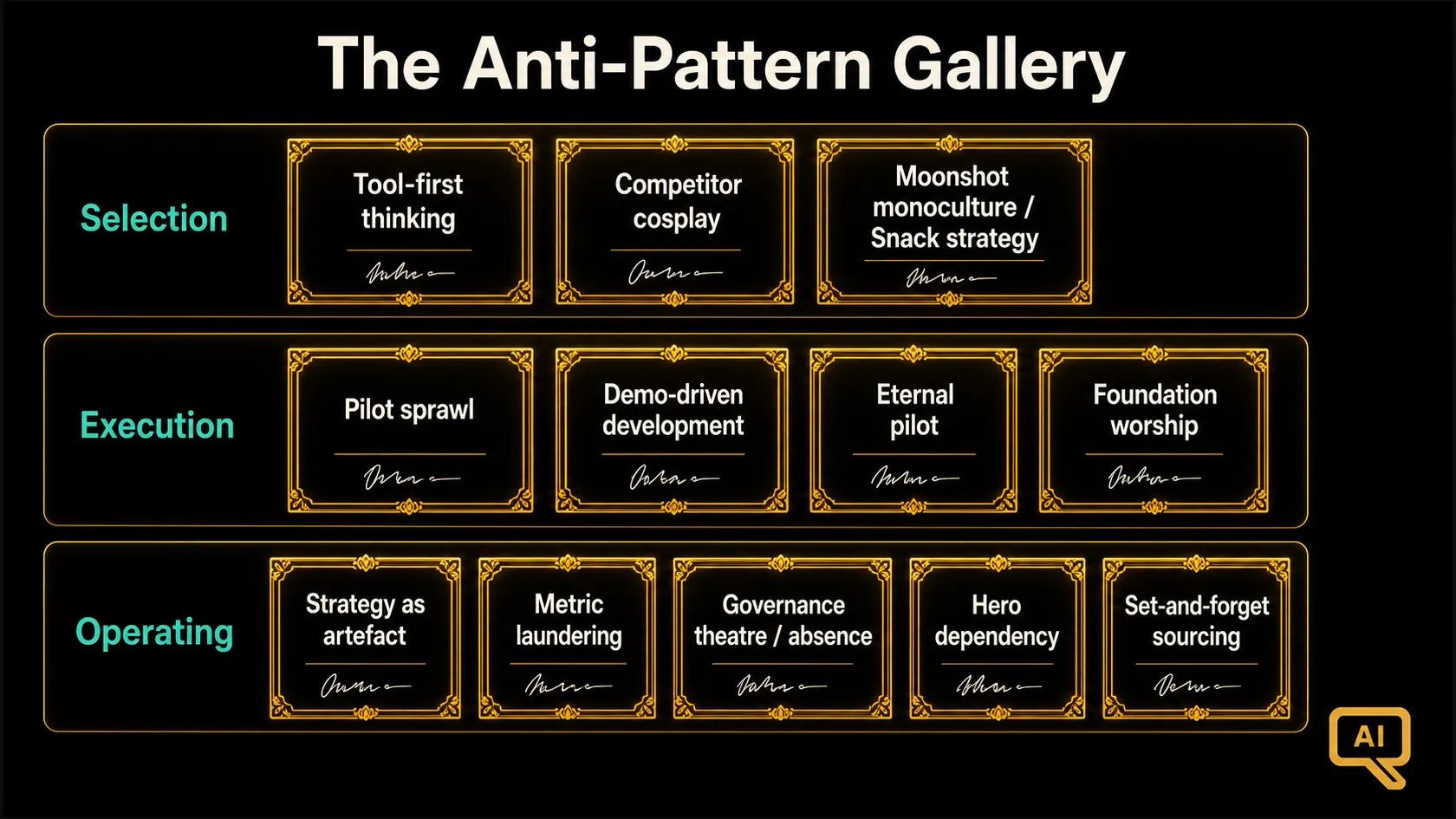
Figure 1 arranges the gallery so far by where each anti-pattern strikes in the strategy lifecycle, because half the diagnostic skill is knowing where to look.
The operating anti-patterns
The final band of Figure 1 covers the failures that arrive after launch, when the strategy is nominally working and quietly decaying.
Strategy as artefact. The strategy was written, approved, admired, and shelved; the organisation continued as before. The signature: a canvas last touched two quarters ago, in a field where the ground moves monthly. The antidote is the operating rhythm from the roadmap article, and one honest test: name a decision made differently last month because of the strategy. If the room goes quiet, the document is a souvenir.
Metric laundering. Productivity anecdotes dressed as business impact: hours saved multiplied by loaded salary, aggregated, and presented as value created. The signature: impressive totals that never reconcile to any P&L line. This one matters more each year as the accountability shift hardens; boards have learned to ask where the hours went. The antidote is the discipline installed in the canvas: at least one metric per use case that lives in a system finance already trusts. (The full treatment of honest AI value measurement is its own track on this site, for good reason.)
Governance theatre and governance absence. Twin failures, one antidote. Theatre: a review board through which everything must pass and nothing passes quickly, converting governance into a queue and driving teams to the shadows. Absence: no guardrails at all until the first incident writes them in a hurry. The signatures, respectively: time-to-approval measured in months, and the phrase “we’ll formalise it once we scale.” The antidote is the risk-tiered design from the governance article, measured on both of its KPIs: incident rate and time-to-approval. A governance function tracking only one of those numbers has picked a failure mode.
The hero dependency. The programme works because of one extraordinary person: the engineer who knows every pipeline, the product lead who holds every context. The signature: a bus factor of one, visible in who gets paged and whose calendar gates every decision. The antidote is unglamorous and non-optional: documentation, paired delivery, and the ownership structures from the data-products article, built while the hero is still there rather than after they resign.
Set-and-forget sourcing. Model and vendor decisions made once and never revisited, in a market where open weights closed a twenty-point gap in two years and API prices have fallen repeatedly. The signature: no revisit dates in any sourcing decision record, and a routing layer that routes everything to the same place it did a year ago. The antidote: the twelve-month revisit rule and the quarterly evaluation pass, both cheap, both standing between you and a strategy that quietly became expensive nostalgia.
Running the immune system
A catalogue only protects an organisation that consults it, so the final recommendation of this track is a ritual: the anti-pattern review, twice a year, one hour. The format is deliberately simple, and Figure 2 lays it out as a self-audit flow.
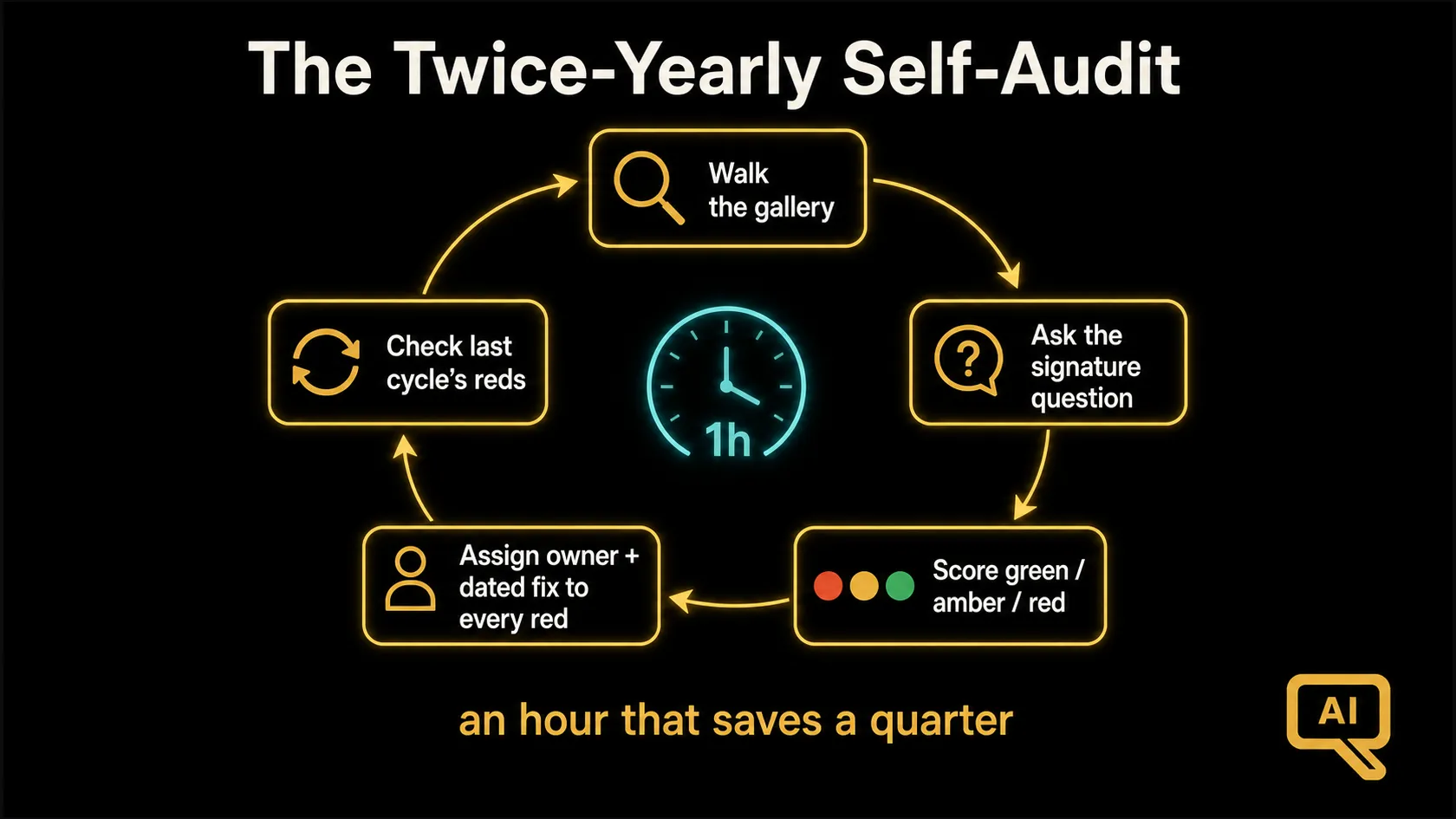
Walk the gallery in Figure 2 pattern by pattern, and for each one ask only the signature question: what is our pilots-to-production ratio; when was the canvas last touched; can we name a decision the strategy changed; who gets paged. Score each signature green, amber, or red on evidence in the room, assign every red a named owner and a dated remediation, and close by checking last cycle’s reds. The whole exercise costs an hour and routinely saves a quarter, because every anti-pattern in this gallery is cheap to correct early and expensive to correct late, and the entire difference is detection.
And with that, the track is complete. Sixteen articles ago I claimed that most documents titled “AI Strategy” are wish lists with a logo. You now have everything needed to write the other kind: a canvas that forces choices, a maturity mirror that tells the truth, a data foundation built value-first, a portfolio with scarcity and gates, a sourcing posture that survives model releases, an agent playbook with a trust ladder, a pipeline that beats the 88%, a calendar that compounds, and an immune system against the failures that stalk all of it. The market will keep generating hype on schedule. Your advantage, from here, is that you no longer need it to.