
Let’s start with a confession: most documents titled “AI Strategy” are not strategies but wish lists with a logo. They usually follow the same pattern: a page of breathless market statistics, a list of tools someone saw at a conference, a slide that says “become AI-first,” and no answer to the question that matter: Which business outcomes will AI change, by how much, and in what order?
That question got much harder to dodge in 2026, because budgets shifted from experimentation to accountability. The exploratory phase, where every pilot was defensible because “we’re learning,” is over. Boards now expect each AI dollar to connect to revenue growth, margin improvement, or a measurable risk reduction. Survey after survey confirms the shift: enterprise buyers have stopped accepting “productivity gains” as the headline metric and started demanding direct P&L impact. If your strategy cannot survive that conversation, it is not a strategy yet.
This article is the anchor for the whole Data and AI Strategy track. My goal is to give you a way of thinking about AI strategy that will still be useful when the model names change, because they will. The tools are temporary. The strategic logic is not.
What an AI strategy actually is
Let me define terms, because sloppy definitions produce sloppy plans.
An AI strategy is a set of explicit choices about where AI will create value for your organisation, what foundations you need to capture that value, and what you will deliberately not do. Three parts: value, foundations, exclusions. Miss any one of them and you have something weaker.
A strategy that names value but not foundations produces the classic 2024-era failure: exciting pilots that die the moment they touch real data, real security reviews, and real workflows. The numbers here are sobering. The most cited statistic in enterprise AI right now is that roughly 88% of agent pilots never reach production, and when researchers dig into why, the causes are almost never model quality. They are unclear success criteria, insufficient data access, and nobody owning the outcome. Those are strategy failures, not technology failures.
A strategy that names foundations but not value produces the opposite failure: a beautifully governed data platform that nobody uses, funded for two years and then quietly defunded. I have seen both movies. Neither has a happy ending.
And a strategy without exclusions is not a strategy at all. If everything is a priority, nothing is. The organisations winning with AI in 2026 are not doing more AI than everyone else. They are doing less, in fewer places, with more force behind each initiative.
Why 2026 changes the playbook
Three shifts define the current moment, and your strategy needs a position on all of them.
First, the accountability shift. Direct financial impact has roughly doubled as the primary way enterprises measure AI success, while productivity gains have collapsed as the leading metric. This changes how you select use cases. “Saves each analyst four hours a week” is now a losing pitch unless you can show where those hours go: into more revenue, lower cost, or faster cycle time that customers will pay for.
Second, the agentic shift. AI agents, systems that take actions rather than just generate text, moved from demo to production in 2026. Around 31% of enterprises now run at least one agent in production, with banking and insurance approaching half. Gartner expects 40% of enterprise applications to embed task-specific agents by year end, up from under 5% in 2025. Whether or not you deploy agents this year, your strategy must decide when and where you will, because your competitors are deciding right now. I cover this decision in depth later in the track.
Third, the data readiness shift. The bottleneck is no longer model capability. It is whether your data can support AI at all. Analysis across more than 20,000 organisations found that companies with proper data infrastructure and governance pushed roughly 12 times more AI projects into production than those without. Twelve times. That single number should reshape your investment sequence, and it is why this track spends five full articles on data before we ever discuss vendors or roadmaps.
Figure 1 puts these three shifts together as the strategic context every 2026 plan operates inside.
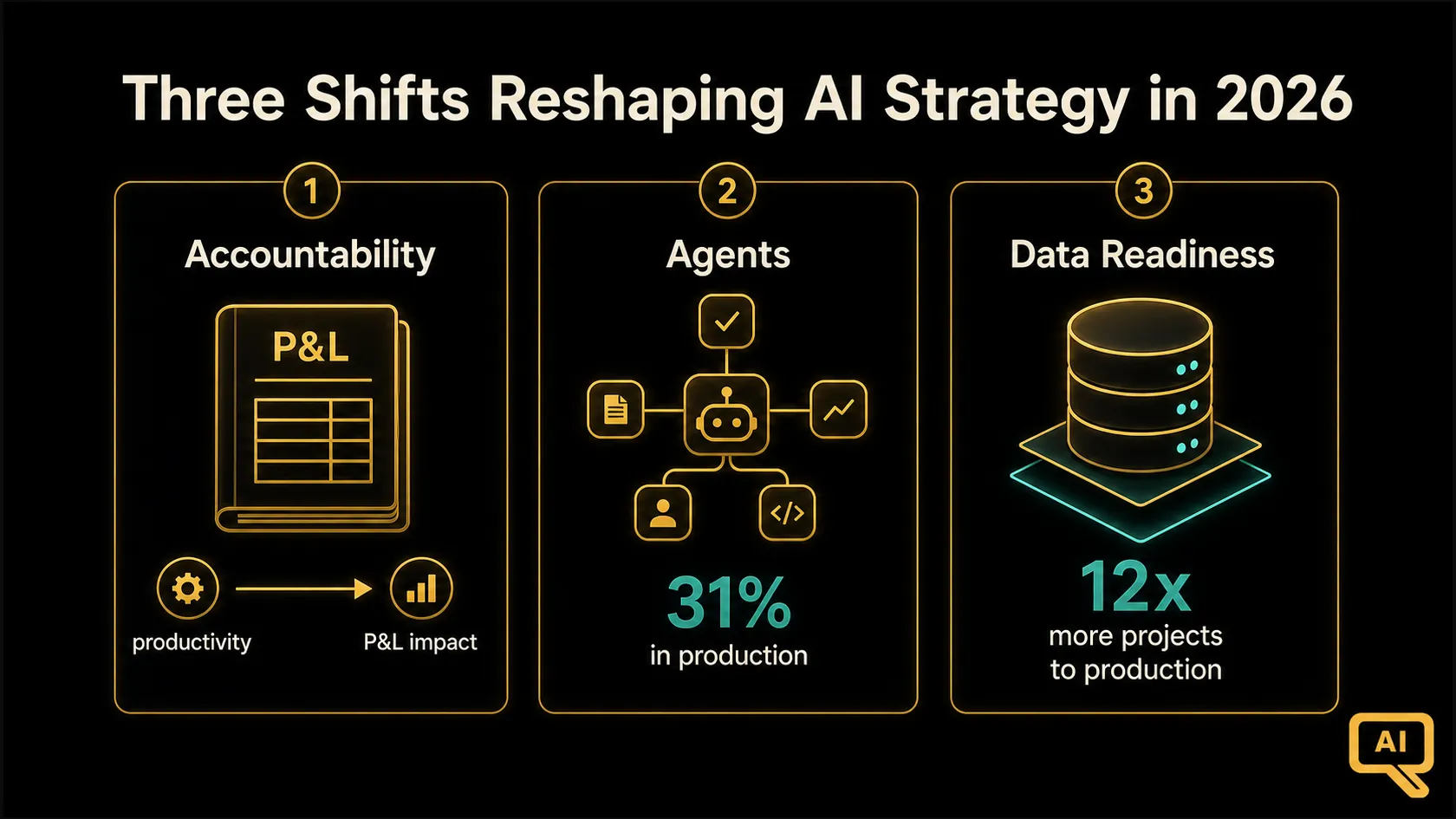
What I like about the framing in Figure 1 is that it explains why so many 2024-vintage strategies now feel stale. They were written for a world where experimentation was the goal, chatbots were the ceiling, and data debt could be deferred. All three assumptions broke.
The five questions your strategy must answer
Strip away the templates and consulting language, and an AI strategy answers five questions. I will give you the short version here; most of them get their own article in this track.
1. Where will AI create value for us specifically? Not “in our industry.” For your organisation, with your customers, your cost structure, your bottlenecks. The honest way to answer this is a use-case portfolio scored on value and feasibility, which I walk through in the prioritisation article. The dishonest way is to copy a competitor’s press release.
2. Is our data ready to support that value? For most organisations the true answer is “partially, in patches,” and pretending otherwise is the number one cause of AI failure. Data readiness is not a compliance checkbox. It is the difference between the 12x cohort and everyone else.
3. What will we build, buy, or adapt? The sourcing question runs across a whole spectrum now: SaaS features, platform tools, open-weight models you fine-tune, and fully custom systems. Each point on that spectrum carries different cost, control, and lock-in profiles. It deserves a deliberate answer, not an accumulation of accidental decisions.
4. How will we govern it? Governance is not the innovation police. Done well, it is what lets you move fast without breaking things that matter: customer trust, regulatory standing, brand. Organisations where senior leadership actively shapes AI governance capture significantly more value than those that delegate it to technical teams. I built an entire companion track on this, and the strategy article on data governance connects the two.
5. In what order, and who owns each step? Sequencing is where strategies become roadmaps. Quick wins fund patience for the harder structural work. Ownership is what separates initiatives that survive contact with reality from the 88% that do not.
From answers to roadmap
Answering the five questions produces raw material. Turning it into a roadmap requires one more discipline: honest sequencing.
Here is the sequencing logic I recommend, and Figure 2 lays it out as a flow you can adapt.
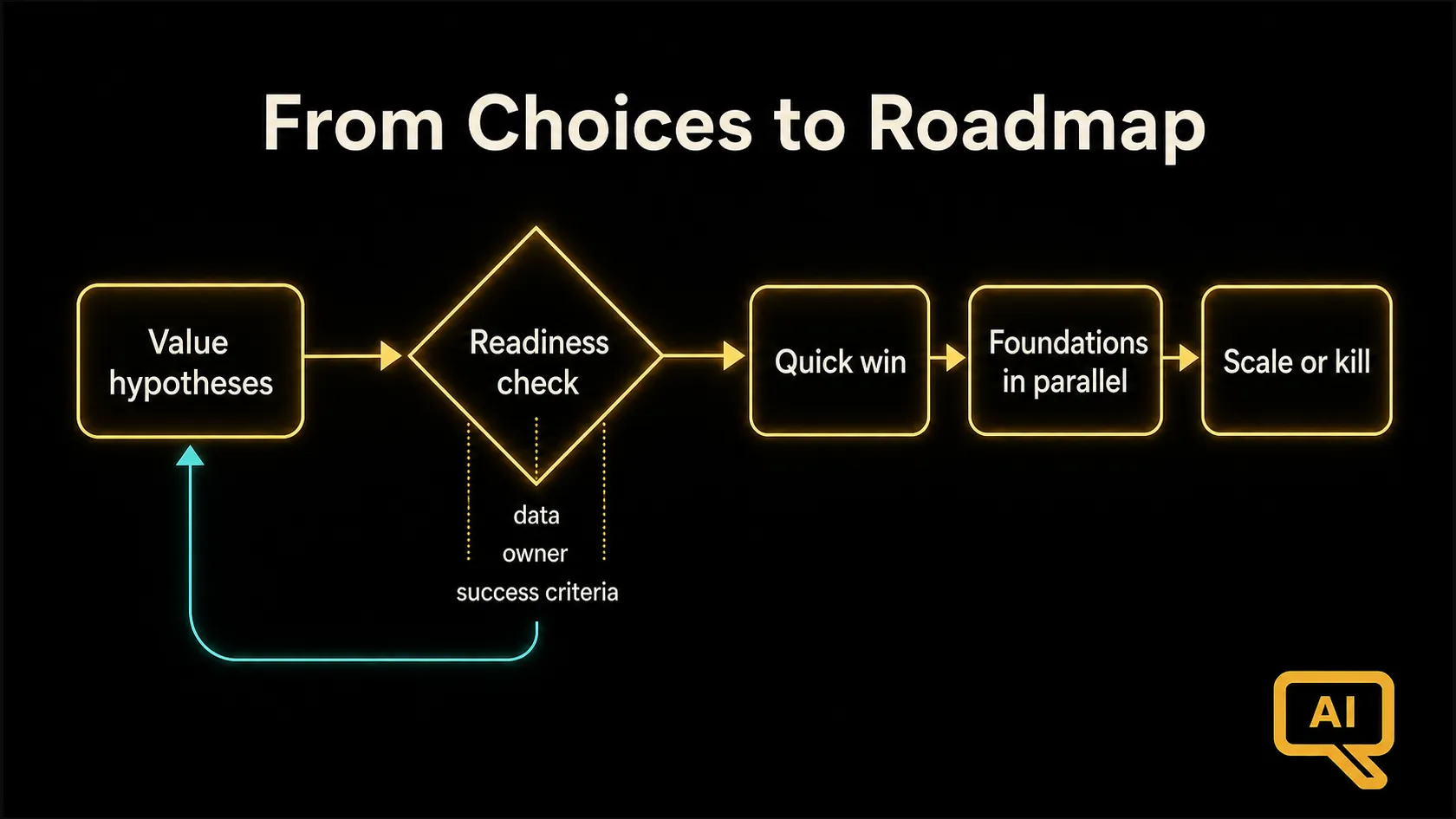
Start with two or three value hypotheses, each tied to a P&L line or a named risk. For each, run a readiness check: is the data accessible, accurate, and permitted for this use? Is there an owner with budget authority? Are success criteria written down before the pilot starts, not after? The deployments that fail at the 12-month mark almost never lose on model quality; analysis attributes the failures overwhelmingly to unclear success criteria, missing data access, and evaluation gaps. Every one of those is preventable at the planning stage, which is exactly what the readiness gate in Figure 2 exists to catch.
Then phase the work. Phase one is a quick win: something visible, measurable, and deliverable inside a quarter, chosen partly for its political value. Phase two runs the structural work in parallel: the data foundation, the governance guardrails, the platform decisions. Phase three scales what worked and kills what did not, without sentimentality. The 12-month roadmap article later in this track turns this into a month-by-month plan.
The mistakes I want you to avoid
Let me close the anchor article by naming the failure patterns you will be tempted toward, because forewarned is forearmed.
Tool-first thinking. Buying a platform and then looking for problems it might solve. This is how organisations end up with five overlapping AI subscriptions and no measurable outcome. Strategy chooses problems first.
Pilot sprawl. Twenty pilots, no production systems. Pilots feel like progress because they generate demos. Production is where value lives, and production requires the unglamorous work: data plumbing, evaluation, ownership, change management.
Strategy as a document. A strategy that gets written, approved, and shelved is theatre. Real strategies are revisited quarterly, because this field moves quarterly. Your strategy needs a review cadence built in from day one.
Ignoring the workforce. AI strategies that treat people as an afterthought meet quiet, effective resistance. The organisations scaling successfully treat capability building and role redesign as first-class workstreams, not training videos bolted on at the end.
Deferring data. The most expensive mistake of all. Every quarter you defer data readiness, you pay for it with failed pilots and eroded credibility. The 12x production gap is the receipt.
Where we go from here
This track is built to walk you through each of the five questions in depth. The next article gives you the AI Strategy Canvas, a one-page tool that forces the five answers onto a single sheet your leadership team can argue about productively. Then we get honest about maturity, spend serious time on data (readiness, governance, foundations, unstructured data, and ownership), work through the portfolio and sourcing decisions, and finish with the agentic question, the roadmap, and the anti-patterns that kill good strategies.
The market will keep generating hype. Your job is to convert a small, carefully chosen slice of it into a roadmap your CFO believes. That is what the rest of this track is for.