
This is the article where I ask business leaders not to skip the architecture conversation. I know the temptation. Words like “lakehouse” and “semantic layer” sound like something the CTO should worry about while you focus on strategy. But here is the uncomfortable truth I keep returning to in this track: your AI strategy is constrained by your data architecture, whether you understand that architecture or not. Leaders who cannot follow this conversation end up approving whatever they are shown, and some of what gets shown is expensive nostalgia.
So this is data architecture for decision-makers: enough to ask sharp questions, spot the failure patterns, and understand why the industry spent 2026 rebuilding data platforms around a new customer. Because that is the real story. For twenty years, data platforms were built to serve humans reading dashboards. Now they are being rebuilt to serve AI systems, and especially agents, that consume data in a fundamentally different way. Analysts summarising the new agent-oriented data architectures put the problem in five words: without this layer, agents are “fast but blind.”
How we got here, briefly
A compressed history, because the vocabulary makes sense once you see the sequence.
Warehouses came first: structured, governed, reliable, and rigid. Wonderful for financial reporting, painful for anything that did not fit rows and columns, and historically expensive to scale.
Lakes were the reaction: throw everything in cheap object storage (documents, logs, images, tables) and figure out structure later. Flexible and affordable, but “later” often never came, and many lakes decayed into swamps: vast, undocumented, untrusted.
Lakehouses are the synthesis that won: lake economics with warehouse discipline. One platform holding structured and unstructured data, with transactions, governance, and quality enforcement layered on top through open table formats. Most serious platform vendors converged on this pattern, which matters for you in one specific way: the lakehouse can hold your documents and your tables in one governed place, and as the next article will argue, your unstructured data is about to matter enormously.
For a leadership audience, the punchline is this: the storage wars are largely over, and the interesting action has moved up the stack, to the layer that gives data meaning.
The semantic layer: where meaning lives
Here is a question that sounds trivial and is not: what is “revenue”? Gross or net? Recognised when booked or when paid? Including intercompany? Every organisation has a dozen definitions in circulation, embedded in different dashboards, spreadsheets, and heads. Humans navigate this ambiguity with context and corridor conversations. AI systems cannot.
A semantic layer is the fix: a governed, machine-readable definition of your business concepts (metrics, entities, relationships) that sits between raw data and everything that consumes it. Revenue is defined once, with its logic, and every consumer (dashboard, analyst, model, or agent) gets the same answer.
Semantic layers existed before AI; BI teams have argued about them for a decade. What changed in 2026 is that they went from nice-to-have to load-bearing, because of agents. When you ask an agent “how did Q2 revenue in the Sydney region compare to plan,” the agent must resolve “revenue,” “Sydney region,” and “plan” into precise queries. Without a semantic layer, it guesses, and a fluent, confident guess about your financials is worse than no answer. The industry’s response has been visible all year: major cloud platforms shipping knowledge catalogs and semantic services explicitly designed for grounding agents in enterprise-wide context. The analysts’ verdict on why: the real AI bottleneck is not compute or model capability, it is this connective tissue.
Figure 1 shows the modern stack as I recommend leaders picture it: storage at the bottom, the semantic and governance layers in the middle, and the consumers (humans, models, agents) on top.
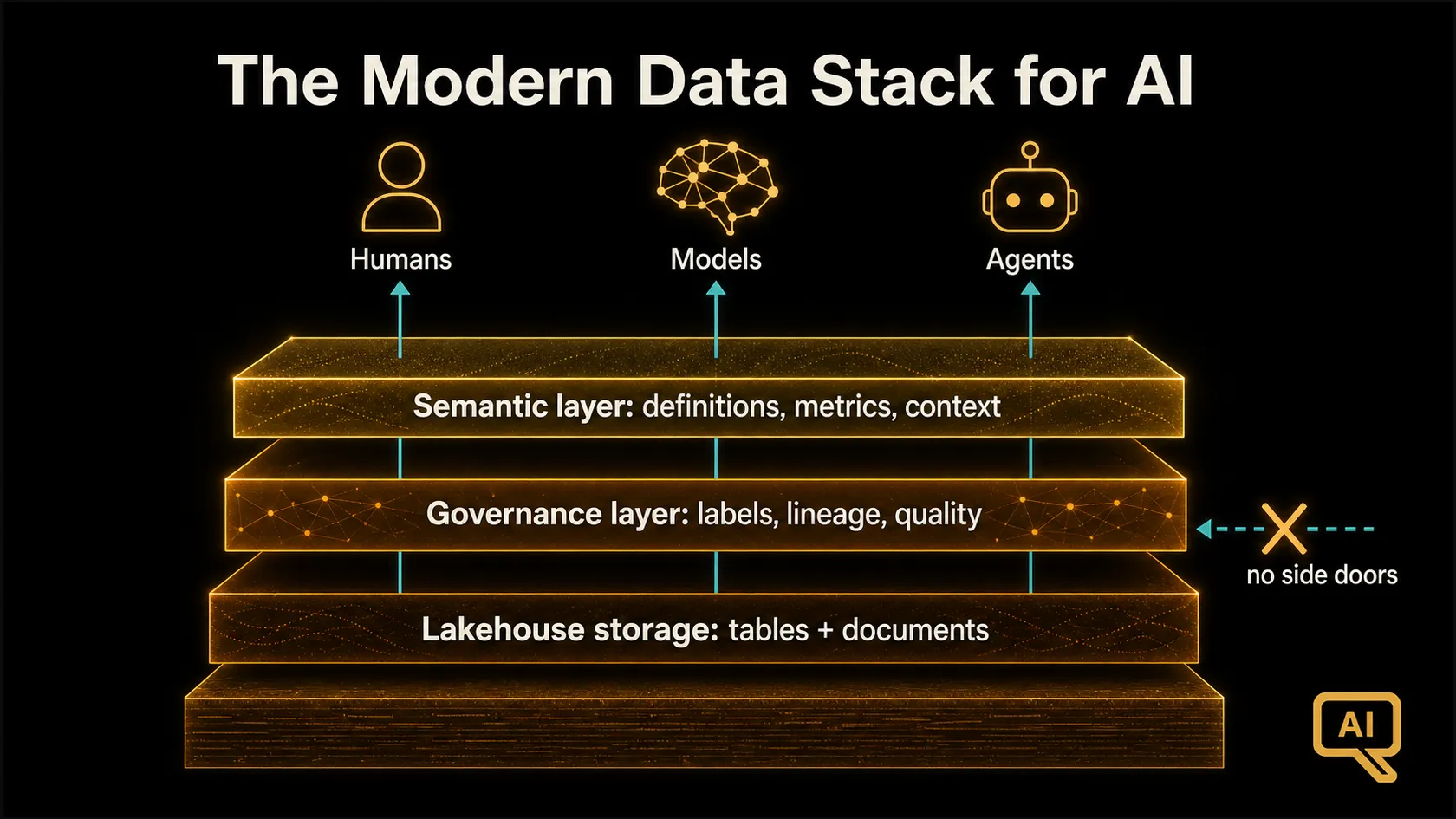
The design principle embedded in Figure 1 deserves stating plainly: every consumer goes through the semantic and governance layers, including AI. The moment an agent gets a side door to raw tables, you have two sources of truth and zero control. The layers are not overhead between AI and data; they are what make AI answers mean anything.
What “agent-ready” adds
Agents impose requirements beyond what dashboards ever demanded, and this is where 2026 architecture genuinely differs from 2023 architecture. Four additions matter.
Live, governed access paths. Dashboards tolerate overnight batch. An agent rebooking a customer or checking stock mid-conversation needs current data through APIs, with the governance labels from the previous article enforced at the access point. The permitted-purposes classification does real work here: it is what lets the platform automatically answer “may this agent read this table?”
Context, not just data. An agent benefits not only from the revenue number but from what revenue means, how it relates to bookings, and which table is authoritative. This is the semantic layer consumed as machine-readable context, and it is why the knowledge-catalog pattern took off: it packages meaning for a consumer that reads documentation at machine speed.
Retrieval infrastructure for unstructured data. Agents grounded in your documents need those documents indexed, embedded, permission-filtered, and fresh. This machinery (covered properly in my RAG track) is now a standard component of the data platform, not a bolt-on, and the permission-filtering part is where most home-grown implementations quietly fail.
Action logging. When agents write as well as read, every action becomes data you must capture: what the agent did, based on what inputs, under whose authority. This is the lineage pillar extended to actions, and when something goes wrong, it is the difference between an investigation and a shrug.
If you remember one framing, make it the one enterprises keep converging on: an effective agentic enterprise needs agents, data, automation, and infrastructure working as one integrated system. The data layer is not a supporting act to the agent strategy. It is half of it.
Failure patterns to watch for
Architecture reviews are where leaders can add the most value with the least technical depth, because the failure patterns are recognisable from the business side. Four to watch for.
The side-door pattern. Teams under deadline pressure wire their AI project directly to source systems, bypassing the governed platform “just for the pilot.” The pilot works, becomes production, and now you have shadow architecture: ungoverned, unmonitored, and load-bearing. The question to ask in any AI review: does this system go through our semantic and governance layers, and if not, when will it?
The two-platform pattern. The AI team builds its own data stack parallel to the analytics stack, usually because collaboration was slower than construction. Now definitions drift between the two, and the agent answers differently from the dashboard. One platform, one semantic layer, all consumers. Exceptions need justifying in writing.
The perfection pattern. The opposite failure: a multi-year platform rebuild that must finish before any AI value ships. The 12x production statistic gets misread as “build everything first.” Wrong lesson. The winners built incrementally, use case by use case, exactly as the readiness article prescribed: make the tables green for this workflow, ship, repeat. Platforms are grown, not erected.
The freshness illusion. Everything works in the demo because the demo data was loaded yesterday. Production decays because nobody owns the pipelines. Ask what monitoring exists for the feeds this AI system depends on, and who gets paged when they drift.
Sequencing the foundation build
Which brings us to the practical question: in what order do you build this? Figure 2 gives the sequence I recommend, and it is deliberately value-led rather than architecture-led.
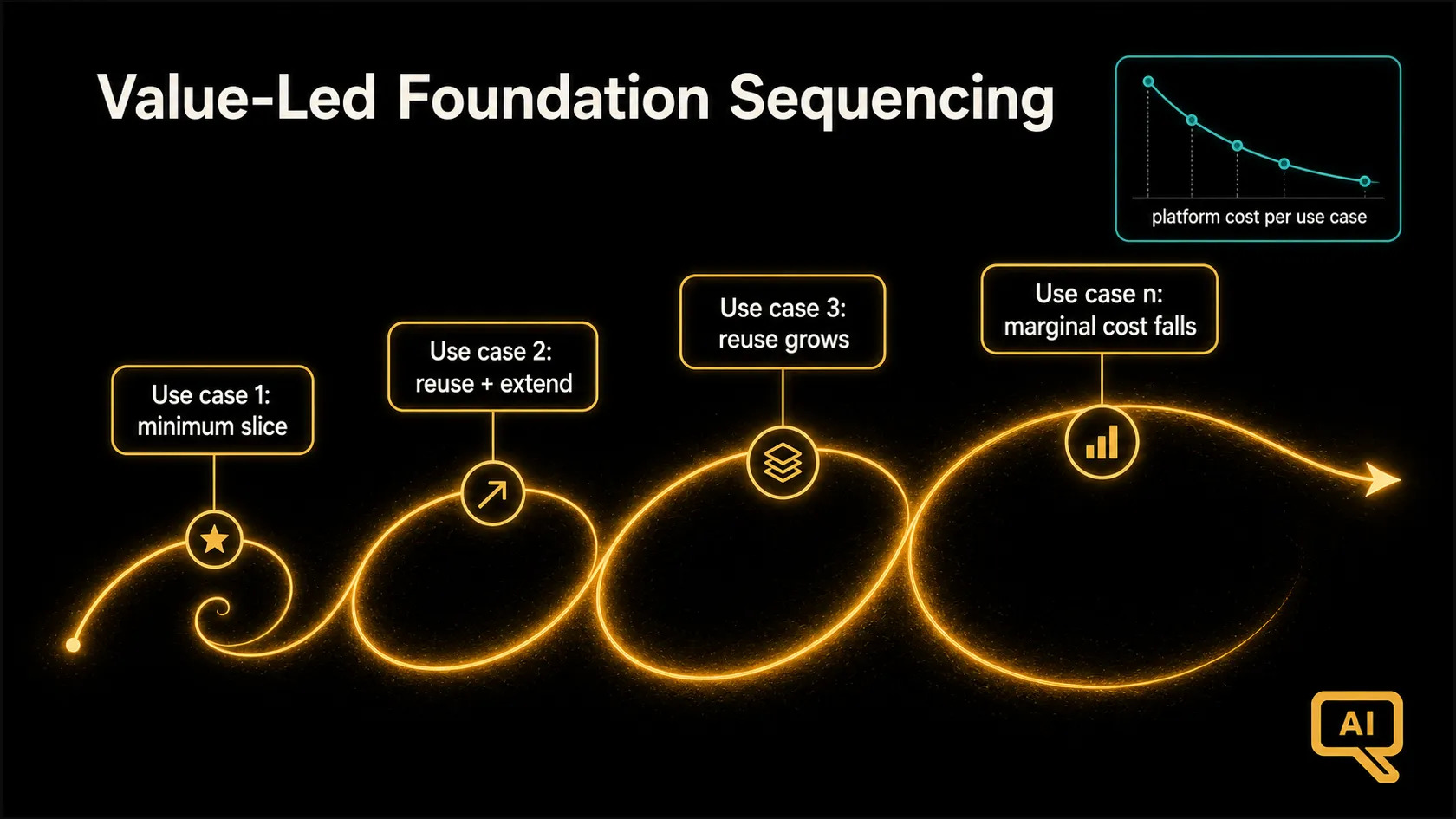
The logic of Figure 2 runs like this. Take your top use case from the canvas. Build or extend the minimum platform slice it needs: the governed tables, the semantic definitions it touches, the access path, the monitoring. Ship it, measure it, and bank the value. Then take use case two, which reuses much of slice one and adds its own increment. Within four or five iterations you will find the marginal platform cost per use case falling steeply, which is the compounding that Stage 4 maturity describes. The platform emerges from the strategy, funded by the value it unblocks, instead of preceding the strategy as an act of faith.
Two investments justify going slightly ahead of immediate need, because they are painful to retrofit: the semantic layer for your core business concepts (start with the twenty metrics your executive pack already uses) and the governance labels from the previous article. Both are cheap early and expensive late.
The questions to ask your team
I promised architecture literacy for decision-makers, so here is the pocket version: six questions that surface most problems.
Where is our single governed platform, and what runs outside it? What is our semantic layer, and how many of our core metrics does it define today? Can an agent get live, permission-checked access to the systems our top use cases need? How is our unstructured data indexed and permission-filtered for retrieval? What monitoring tells us when data feeding production AI goes stale? And for any new AI initiative: does it go through the layers, or around them?
None of those requires you to configure anything. All of them require answers, and the quality of the answers will tell you more about your AI readiness than any vendor briefing.
Next in the track: the half of your data estate this article kept gesturing at. Documents, emails, transcripts, contracts: the unstructured data that most strategies ignore and that RAG and agents have suddenly made your most undervalued asset.