
Every technology cycle has a defining strategic question, the one that separates the organisations that positioned early from those that explained later. For 2026, that question is agents: AI systems that do not just generate answers but take actions, across multiple steps, with a degree of autonomy. Whether, where, and how fast to deploy them is the decision this year’s strategy documents will be judged by.
The adoption numbers explain the urgency. Roughly 31% of enterprises now run at least one agent in production, with banking and insurance approaching half, and agentic AI has become the fastest-growing technology priority in enterprise surveys, up more than 31% year on year. Gartner projects 40% of enterprise applications will embed task-specific agents by the end of 2026, from under 5% in 2025. And yet the countervailing number is just as loud: 88% of agent pilots never reach production, and the post-mortems blame scoping, ownership, and data access, almost never the models.
Both numbers are true, and together they define the strategic task: move deliberately into agents, in the places and sequence where they can actually survive. This article is that playbook. (The engineering of agents lives in my Agentic AI track; this is the strategy layer above it.)
What actually changes when AI acts
Strategically, an agent is not a better chatbot. The difference is categorical, and three of its consequences drive everything else in this article.
Errors become actions. A generative system’s mistake is a wrong sentence a human can catch. An agent’s mistake is a wrong refund, a wrong order, a wrong email to a customer. The cost-of-error distribution changes shape entirely, which is why agent strategy is inseparable from the governance tiering built earlier in this track, and why “human in the loop” stops being a philosophy and becomes an architecture decision made per action type.
Data requirements go live. Agents consume context mid-task: current inventory, this customer’s actual history, today’s prices. The whole data arc of this track (readiness, governance labels, live governed access paths, curated corpora) is precisely the infrastructure agents require, and the enterprises reporting stalled agent programmes name data confidentiality, context limits, and verification gaps as their chief blockers. An agent on unready data is not just blind; it is blind with permissions. Without a grounded data layer, as the industry line goes, agents are fast but blind.
Work gets redesigned, not just assisted. A copilot fits inside an existing job. An agent absorbs a slice of the job, which means process redesign, role evolution, and the change-management work that AI strategies chronically defer. The organisations scaling agents successfully treat workflow redesign as the project, with the agent as a component.
The delegation-versus-augmentation choice
The most useful strategic lens for agent decisions is a single axis: augmentation versus delegation. Augmentation keeps the human in the driver’s seat, with the agent preparing, drafting, and recommending: it does the work, the human does the deciding. Delegation hands the agent a bounded slice of work end to end, with humans supervising by exception.
Figure 1 maps common agent patterns along this axis, together with the readiness each position demands.
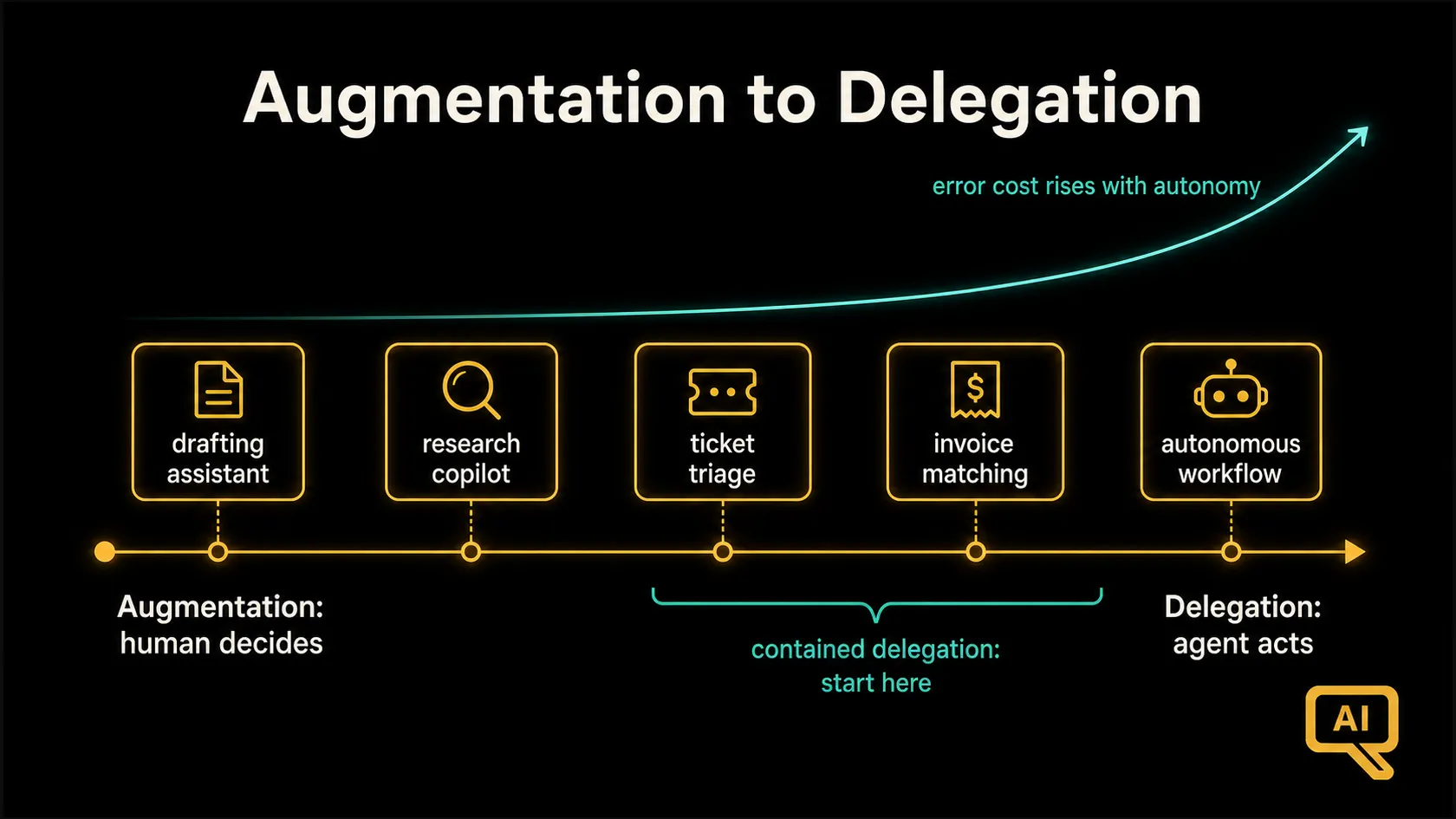
The strategic error is treating the right edge of Figure 1 as the goal and the left edge as a compromise. That is backwards. Position on the axis should be set per use case by two variables: cost of error and quality of your verification. High error cost with weak verification means augmentation, full stop, regardless of what the technology could do. Delegation is earned, per workflow, by demonstrated reliability against your evaluation suite plus containment that limits the blast radius when (not if) the agent errs. The successful production deployments of 2026 cluster exactly this way: delegation in high-volume, low-blast-radius, easily-verified workflows (invoice matching, ticket triage, meeting follow-ups, claims document assembly), augmentation everywhere the stakes rise.
This also settles the “where to start” question with unusual clarity. Your first agents should be contained delegation: workflows where volume is high (so value is measurable), each action is individually small (so errors are cheap), outcomes are verifiable (so trust can be built on evidence), and the data is already green on your readiness assessment. The finance-operations cluster (invoice and expense matching, reconciliation exceptions) and the service cluster (triage, drafting, follow-up tracking) keep producing the fastest honest paybacks for exactly these reasons.
The trust ladder
The second strategic instrument is sequencing autonomy over time, and the pattern that works is a trust ladder: every agent starts with training wheels and earns altitude on evidence.
Rung one: shadow mode. The agent does the work but nothing ships; humans do the real work in parallel, and you measure agreement. Cheap, safe, and brutally informative: shadow-mode data is what tells you whether the 88% statistic is about to include you.
Rung two: propose-and-approve. The agent acts, a human approves each action before it lands. Value begins flowing (the human is now reviewing rather than doing) while every error is caught at the gate. Most production agents in regulated industries live here, deliberately and appropriately.
Rung three: act-with-exceptions. The agent acts autonomously within defined bounds (amount limits, confidence thresholds, category restrictions) and routes everything else to humans. The bounds are policy, versioned and audited, not vibes.
Rung four: supervised autonomy. Full delegation of the workflow with monitoring, sampling, and kill switches. Reserved for workflows with long rung-three track records.
Promotion between rungs is an evidence decision made against your evaluation suite, and demotion must be equally available: an agent whose error rate drifts gets moved down the ladder automatically, without a meeting, because the policy already decided. Organisations that operationalise this (the same evaluation infrastructure that delivered the 6x production differential) are the ones compounding safely, and the ladder itself becomes an asset: the second agent inherits the rungs, the monitoring, and the promotion criteria, and climbs faster for it.
The strategy, assembled
Figure 2 pulls the pieces into the agentic strategy on a page: portfolio selection, the axis placement, the trust ladder, and the enabling investments underneath.
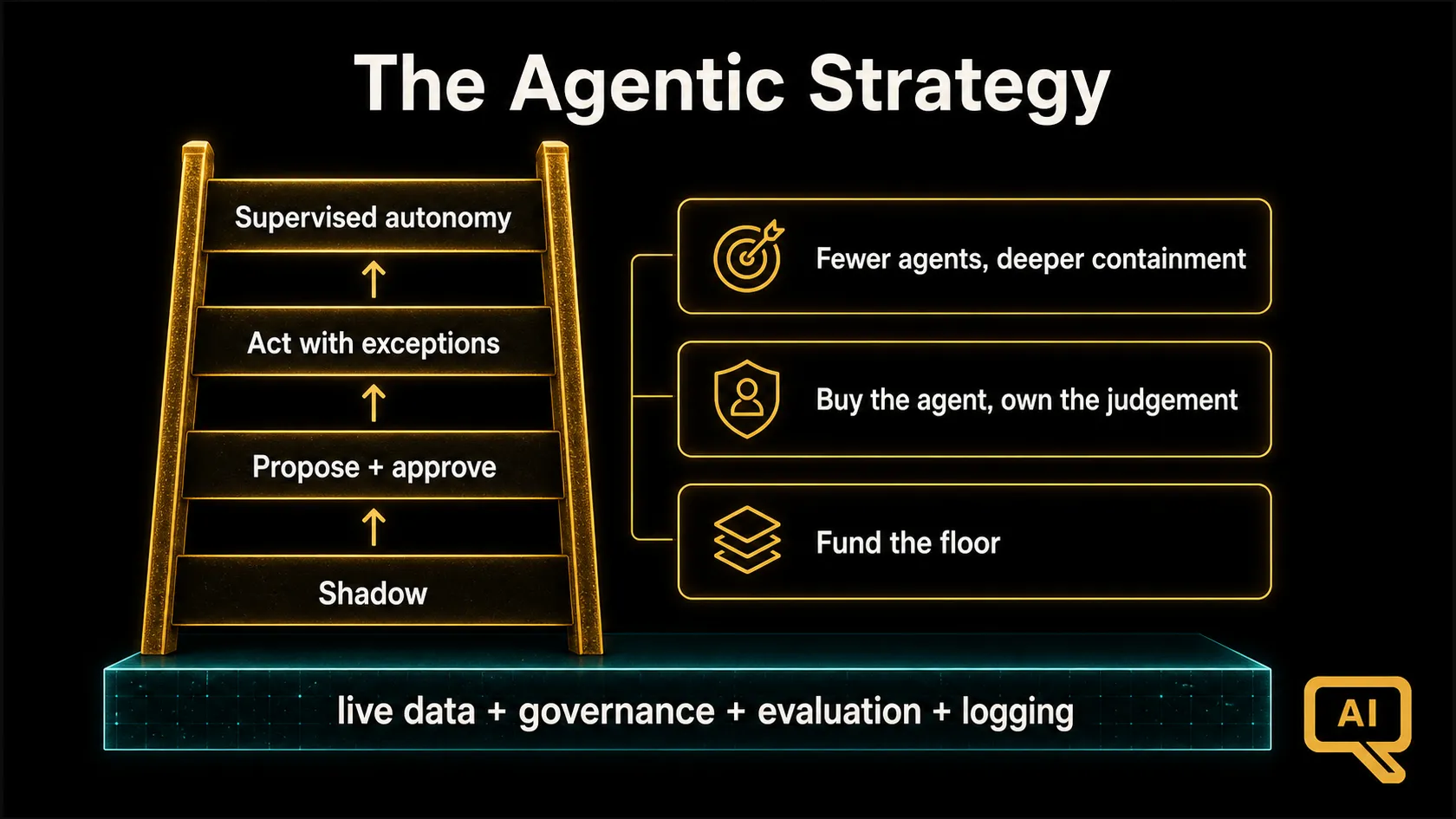
Three portfolio-level rules complete Figure 2, and each one is a lesson someone else paid for.
Fewer agents, deeper containment. The failure pattern of 2026 is agent sprawl: a dozen pilots, each shallow, none owned, collectively ungovernable. The success pattern is two or three agents, each with a named owner (portfolio rules apply, no owner no slot), a defined blast radius, and a metric a CFO recognises. Depth compounds; sprawl just spends.
Buy the agent, own the judgement. Vendors now sell agents for every function, and the sourcing spectrum from earlier in the track applies unchanged, with one addition: whatever you buy, the evaluation suite, the trust-ladder policy, and the action logs must be yours. Delegating work to a vendor’s agent is fine; delegating the decision about how much to trust it is not. The update-day question from the vendor article matters double for agents, because a silently swapped model behind an acting system is a silently changed employee.
Fund the floor, not just the flash. Every dollar of agent ambition implies dollars of enabling investment: the live data access paths, the permission-aware retrieval, the action logging, the evaluation harness. Boards approving agent initiatives should see both numbers together. The 12x data-readiness differential and the 88% pilot mortality are the same fact viewed from opposite ends, and the difference between the cohorts is that one funded the floor.
The honest timeline
A closing calibration, because agent enthusiasm needs a clock. A realistic first-year arc for an organisation at Stage 3 maturity: one quarter to select the contained-delegation use cases and stand up evaluation and logging; one quarter of shadow mode and propose-and-approve on the first agent, measuring relentlessly; then graduated autonomy and the second agent, reusing the rails. Value lands from the second quarter (propose-and-approve is already labour reallocation) and compounds from there. Faster arcs exist; most of them end as statistics. And the payback evidence favours the patient path anyway: the production agents delivering measurable returns this year are overwhelmingly the boring, bounded, well-instrumented ones, while the ambitious autonomous showcases populate the conference circuit and the post-mortems in roughly equal measure.
The pattern in that timeline (prove, then scale, with evidence at every gate) is really the general answer to the question the whole industry keeps asking: why do so few pilots survive contact with production, and what do the survivors do differently? Agents merely raise the stakes. The next article takes the question head-on: pilot-to-production as a discipline, and the specific gates that turn the 88% statistic into someone else’s problem.