
Every organisation that runs an AI ideation workshop ends up with the same artefact: a long, exciting, completely unusable list. Forty use cases, maybe sixty, ranging from “summarise meeting notes” to “autonomous supply chain,” all captured on virtual sticky notes, all technically possible, all somebody’s favourite. The workshop ends with applause. Then the list sits there, because a list is not a decision.
Prioritisation is the act that converts the list into a strategy, and it is harder than it looks, for a specific reason: the loudest advocates are rarely attached to the highest-value cases, and the highest-value cases are rarely the most feasible ones. Without a scoring discipline, the portfolio gets decided by enthusiasm, seniority, or whoever saw the best demo last week. The industry results of enthusiasm-led selection are well documented by now: only about a quarter of AI initiatives deliver their expected ROI, and the post-mortems keep finding the same thing, that the failures were selected badly before they were executed badly.
This article gives you the scoring discipline: how to build the longlist honestly, score it on value and feasibility, and turn the scores into a sequenced portfolio your leadership team will actually fund.
Building the longlist properly
Before scoring comes sourcing, and two common mistakes happen here.
The first is sourcing only from the top. Executive-generated use cases skew toward the strategic and vague (“transform customer experience”). The people who know where the friction lives (the claims handlers, the analysts re-keying data, the support agents answering the same question forty times a day) rarely get asked. Run the sourcing in both directions: strategic themes from leadership, friction inventory from the front line. The friction inventory is where the fast payback hides, and 2026’s workhorse deployments (invoice matching, document extraction, ticket triage) all came from that layer.
The second mistake is sourcing only from within. Your competitors’ deployments, vendor case studies in your sector, and the use-case patterns from my tutorials track are all legitimate feedstock. You are not obliged to be original; you are obliged to be effective.
Aim for thirty to sixty candidates, each captured in a consistent one-line format: who benefits, what changes, roughly how much. “Claims triage assistant: handlers get a first-pass severity and routing recommendation, targeting 30% handling-time reduction.” That format forces every idea to name a beneficiary and a movement, which quietly kills the vaguest entries before scoring even starts.
The two axes that matter
The scoring model I recommend is deliberately simple: value on one axis, feasibility on the other. Complexity in scoring models is a trap; I have seen nine-factor weighted matrices that produced numbers nobody trusted and arguments nobody resolved. Two axes, scored coarsely, argued honestly, beats false precision every time.
Value is expected business impact, scored 1 to 5, anchored in the language of your strategy canvas Box 1 outcomes. The 2026 discipline applies here with full force: value means a P&L line or a named risk, not a productivity anecdote. A use case scoring 5 moves a number the CFO already tracks, by an amount worth tracking. A use case scoring 1 makes somebody’s afternoon nicer. When estimating, triangulate: volume of the affected activity, cost or revenue per unit, plausible improvement percentage. Rough is fine; unanchored is not.
Feasibility is the probability of reaching production within two or three quarters, scored 1 to 5, and this is where the earlier articles in this track pay off directly. Feasibility is dominated by four factors: data readiness (the six-dimension score from the readiness article), integration complexity (how many systems, how live the access), risk tier (which governance lane it travels), and organisational readiness (is there a willing owner and an affected team that wants this). Notice what is not on the list: model capability. In 2026 the models can usually do it; the question is whether your organisation can.
Figure 1 shows the resulting matrix and the four zones it produces.
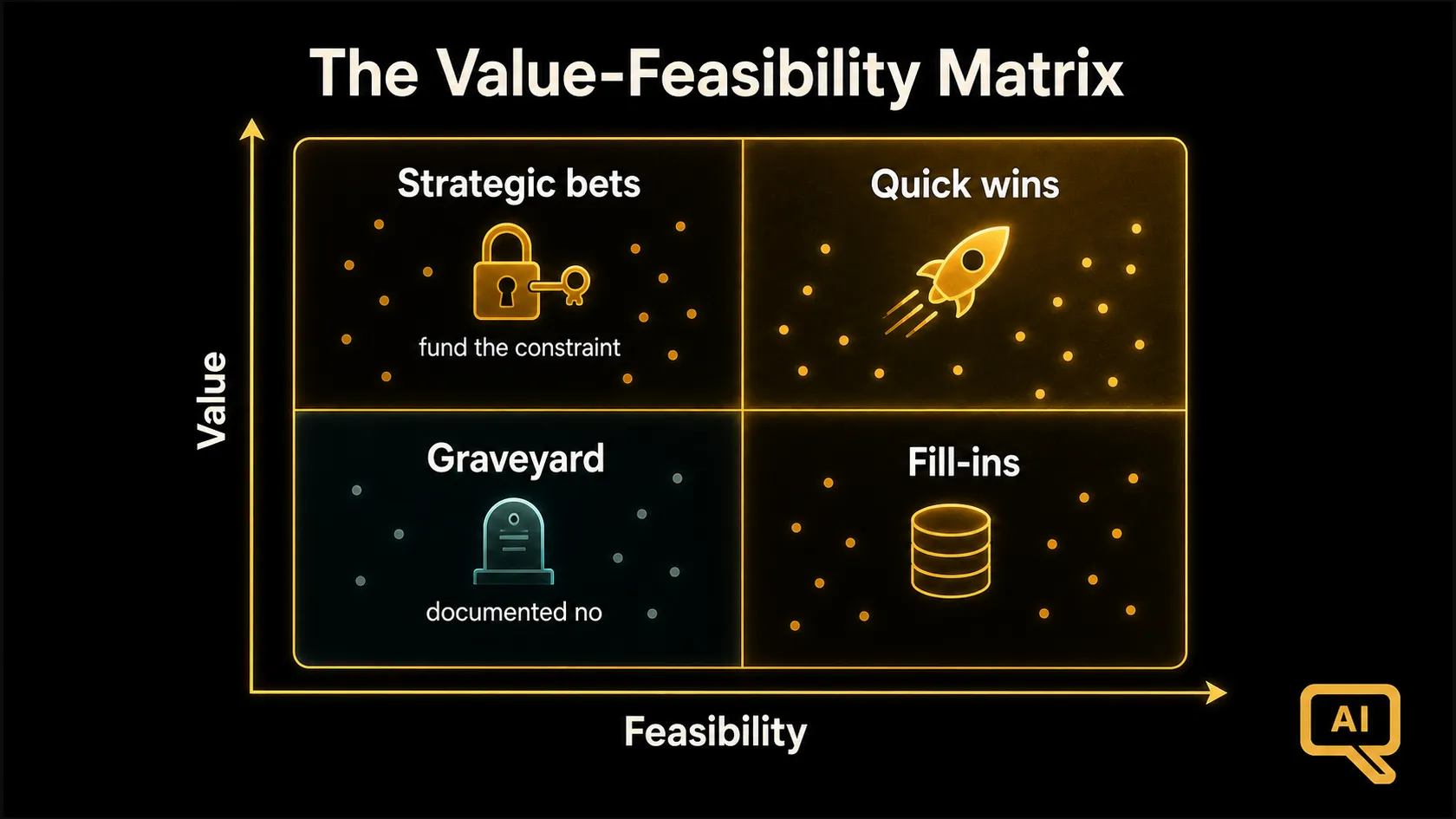
The zones in Figure 1 each get a different treatment. Quick wins (high value, high feasibility) are your phase one: fund immediately, deliver within a quarter, and spend the credibility they generate. Strategic bets (high value, low feasibility) are the interesting zone: do not fund the use case yet, fund the constraint. If the blocker is data readiness, the readiness fix goes on the roadmap with the use case as its justification, exactly the value-per-fix logic from the data articles. Fill-ins (low value, high feasibility) are tempting because they are easy, and they are how pilot sprawl happens: cap them ruthlessly, allowing one or two only where they build capability you need for a strategic bet. The graveyard (low value, low feasibility) gets written down and explicitly declined, which matters more than it sounds: a documented “no” prevents the idea resurfacing every quarter wearing a new costume.
Running the scoring session
Scores made by one person are opinions; scores made in the right room are commitments. Some mechanics that make the session work.
Score value and feasibility in different rooms. Business leaders inflate feasibility (“how hard can it be”) and technologists inflate or deflate value depending on how interesting the problem is. Value gets scored by the P&L owners; feasibility by the delivery and data leads, using the readiness assessments as evidence, not vibes. The matrix positions emerge from the combination, and disagreements between the rooms are findings, not problems.
Anchor with reference cases. Before scoring anything, agree what a 5 and a 1 look like on each axis, using two or three real examples. Without anchors, everyone’s 3 means something different and the matrix is noise.
Timebox per use case. Five minutes each. The goal is coarse, honest placement, not perfect estimation. Anything genuinely contentious gets parked for a deeper look; if more than five items get parked, your anchors were wrong.
Record the why. One sentence per score. Next quarter, when you re-score, the sentences tell you what changed and whether your feasibility judgements are calibrated. Portfolios that skip this step relearn the same lessons annually.
From matrix to sequence
A scored matrix is still not a plan; sequencing is where portfolio thinking earns its name. Three sequencing rules do most of the work, and Figure 2 shows them applied to a worked portfolio.
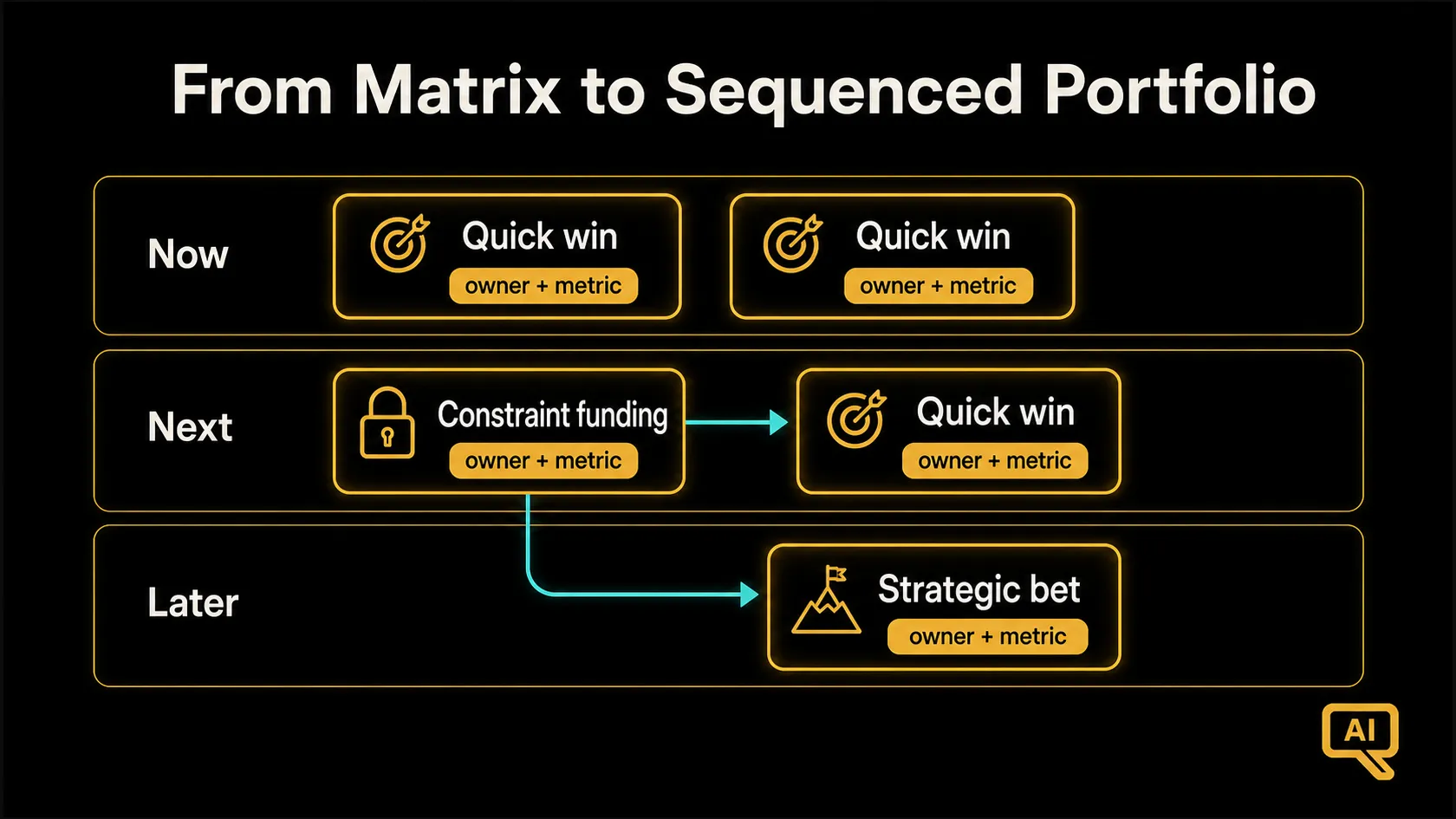
Rule one: balance the horizons. A healthy portfolio at any moment holds two or three quick wins in delivery, one or two constraint-funding programmes (the data and platform work that unlocks the strategic bets), and one strategic bet in design. All quick wins and you plateau in six months with nothing big behind them; all bets and you produce nothing visible for a year, which is how programmes lose their funding. The blend in Figure 2 is the shape to copy.
Rule two: sequence for shared foundations. Two use cases that need the same data product or the same platform slice should travel together or consecutively, because the second one inherits the first one’s plumbing. This is the compounding logic from the architecture article expressed as portfolio order, and it is the difference between a portfolio and a pile of projects. When choosing between two similar-scoring quick wins, the tiebreaker is always: which one builds the foundation the bets will need?
Rule three: attach every item to an owner and a metric before it enters the roadmap. The canvas linkage rules apply at portfolio scale. No owner, no slot. No baseline metric, no slot. This rule is annoying precisely in proportion to how necessary it is.
Keeping the portfolio alive
The portfolio is a living instrument, reviewed quarterly alongside the strategy canvas, and the review has teeth or it has nothing. Three questions per active item: did the metric move against baseline, what did we learn that changes any scores, and does this item keep its slot? Killing underperformers is the hardest discipline in the entire strategy system, because every active item has an advocate by now. Do it anyway. The 16% of initiatives that reach enterprise scale are funded by the honest funerals of the ones that did not, and a portfolio that never kills anything is not a portfolio, it is a museum.
Re-score the graveyard and the strategic bets too, because feasibility moves fast in this field. A use case that was blocked on model capability eighteen months ago may be trivial now; one blocked on your data may have been unblocked by a fix shipped for a different use case. Some of the best items in mature portfolios are resurrections.
The portfolio you now have answers the “what” and the “when” of your strategy. The next three articles answer the “how sourced”: build versus buy versus fine-tune, the open-weights decision, and how to evaluate the vendors who will inevitably come calling once word gets out that you have a funded roadmap.