
For years, data governance had a reputation problem. It was the department of “no”: committees, catalogues nobody updated, policies nobody read. Plenty of organisations concluded, quietly, that governance was optional overhead, and for a while the consequences were survivable. A messy warehouse produced messy dashboards, people grumbled, life went on.
AI ended that era. When your data feeds models that talk to customers, agents that take actions, and systems that make decisions at scale, data governance stops being hygiene and becomes load-bearing infrastructure. The consequences of ungoverned data are no longer ugly dashboards. They are a model that leaks personal information into a chat window, an agent that acts on a table it should never have seen, and a regulator asking questions you cannot answer.
The pressure is arriving from both directions at once. From below, AI systems consume data at a scale and speed that exposes every governance gap you have. From above, regulation now reaches directly into your data practices: the EU AI Act’s data governance obligations for high-risk systems, privacy regimes tightening globally, and sector supervisors (including APRA and ASIC here in Australia) asking pointed questions about the data underneath AI-driven decisions. Meanwhile only around 8% of organisations globally report having a comprehensive AI governance framework, while 88% are actively using AI. That gap is the story of 2026, and data governance sits at the centre of it.
This article covers what changes about data governance when AI enters the picture, and how to build governance that enables rather than obstructs.
What AI changes about data governance
Traditional data governance was designed for a world where data flowed into reports and humans made the decisions. Five things break when AI joins the pipeline.
Purpose gets slippery. Classical governance asks “who can access this data?” AI forces a harder question: “for what purposes may this data be used?” A customer service transcript collected to resolve a complaint is one thing when a human reads it, another when it trains a model, another again when it is retrieved into a prompt, and something else entirely when an agent uses it to take an action. Purpose-based rules, not just access-based rules, become the unit of governance.
Lineage becomes evidence. When a model produces a harmful output, the first question is “what data produced this behaviour?” If you cannot trace what trained the model, what was retrieved into its context, and where those sources came from, you cannot answer. Lineage used to be an engineering nicety. Under the EU AI Act’s documentation requirements for high-risk systems, and under any serious incident investigation, it is evidence.
Quality failures amplify. A wrong number in a dashboard misleads the people who read it. The same wrong number retrieved by a customer-facing system misleads every customer who asks, in fluent, confident prose, at scale. AI is a quality amplifier in both directions, which is why the readiness dimensions from the previous article need governance teeth behind them.
New data categories appear. Prompts, model outputs, embeddings, retrieval indexes, agent action logs. Each is data, each carries risk (prompts routinely contain personal and commercial information), and most governance frameworks predate all of them. If your data classification scheme has no answer for “what sensitivity tier is a vector index built from customer emails,” it has a gap.
Third parties multiply. Every model API, every AI-enabled SaaS feature, every plugin is a data flow to someone else’s infrastructure. Shadow AI makes it worse: employees pasting confidential material into consumer tools creates ungoverned flows nobody approved. The statistics are uncomfortable: 13% of organisations already report breaches of AI models or applications, and 97% of those breached lacked proper AI access controls.
The four pillars, rebuilt for AI
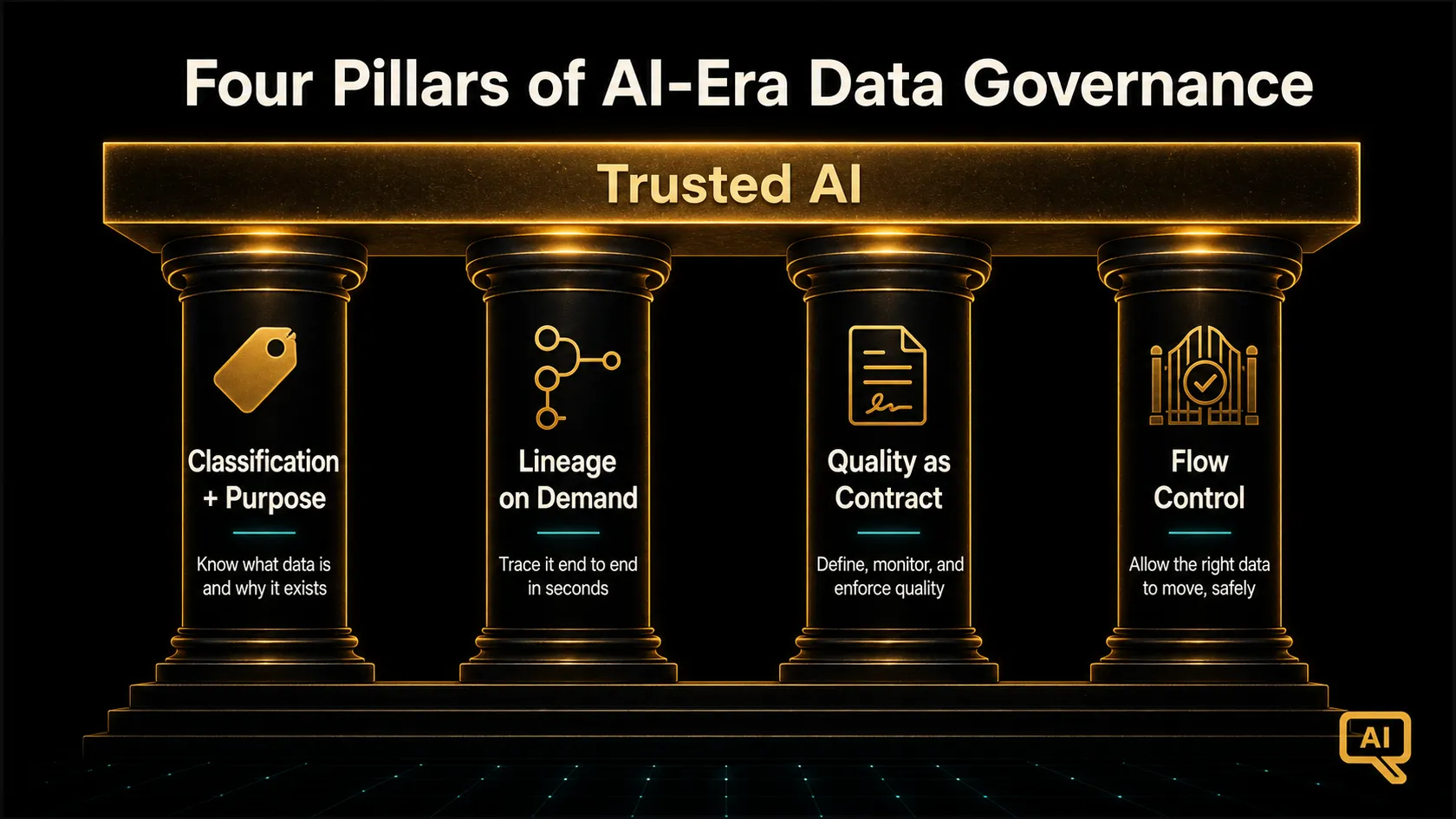
I organise AI-era data governance around four pillars. Figure 1 shows them together, and none is optional.
Pillar one: classification with purpose
Extend your data classification so every significant dataset carries two labels: sensitivity (public, internal, confidential, restricted) and permitted AI purposes (may train models: yes/no/with-approval; may be retrieved into prompts; may ground agent actions; may leave the organisation via third-party APIs). This sounds heavy. In practice, a small matrix applied to your top hundred datasets covers the majority of real AI activity, and the labels do enormous work downstream: platform teams can enforce them automatically, and project teams can self-serve the answer to “can we use this data?” instead of queueing for a committee.
Pillar two: lineage you can produce on demand
The standard to aim for: for any AI system in production, you can produce, within a day, an account of what data trained or fine-tuned it, what sources its retrieval draws from, and what data its actions touch. Modern platforms make much of this automatic if you demand it at architecture time; retrofitting it later is miserable. Lineage pays for itself the first time an incident, an audit, or a “why did the model say that” escalation arrives.
Pillar three: quality as an enforced contract
Move quality from aspiration to contract. Datasets feeding production AI get explicit quality requirements (the freshness, completeness, and accuracy thresholds the use case needs), automated checks in the pipeline, and an owner who is paged when checks fail. The mechanism matters less than the principle: quality for AI-feeding data is monitored like uptime, because for an AI system it is uptime. Model behaviour degrades when its data does, silently, and instrumentation is the only early warning you get.
Pillar four: flow control at the boundaries
Govern where data meets AI systems, especially third-party ones. An approved-tools register with data-handling terms reviewed (does the vendor train on your inputs? where is it processed?). Technical controls that make the approved path the easy path: enterprise AI gateways, DLP on the obvious exfiltration routes, sanctioned tools good enough that shadow AI loses its appeal. Prohibition without provision fails every time; people use unsanctioned tools when the sanctioned ones are worse.
Governance that enables: the operating model
Everything in Figure 1 can be implemented as bureaucracy or as infrastructure, and the difference determines whether your governance accelerates AI or strangles it. Three design principles separate the two.
Tier by risk, ruthlessly. Not every AI use case deserves the same scrutiny. An internal meeting summariser and a credit-decisioning system should travel completely different governance paths. Define two or three tiers with escalating requirements, and make the low-risk path genuinely fast: self-service classification lookup, automated checks, no committee. Save the human review for the tier that can hurt people. Risk-tiering is the single highest-leverage governance design decision, and it is precisely how the major regulatory frameworks think, so aligning with it does double duty.
Embed rules in platforms, not documents. A policy that says “restricted data must not be sent to unapproved APIs” is a wish. A platform where the restricted-data connector simply will not attach to an unapproved endpoint is governance. Every rule you can push into infrastructure is a rule nobody has to remember, and the marginal cost of complying drops to zero. This is the deep reason governance and platform strategy must be designed together, not sequentially.
Measure enablement, not just control. Track time-to-approval for AI use cases, and treat it as a governance KPI alongside incident counts. Governance teams optimising only for risk drift toward infinite caution; giving them a speed metric keeps the function honest about its purpose, which is safe velocity, not velocity prevention.
Figure 2 shows the tiered flow in action: how a use case moves from idea to production under this model, with the fast lane and the scrutiny lane clearly separated.
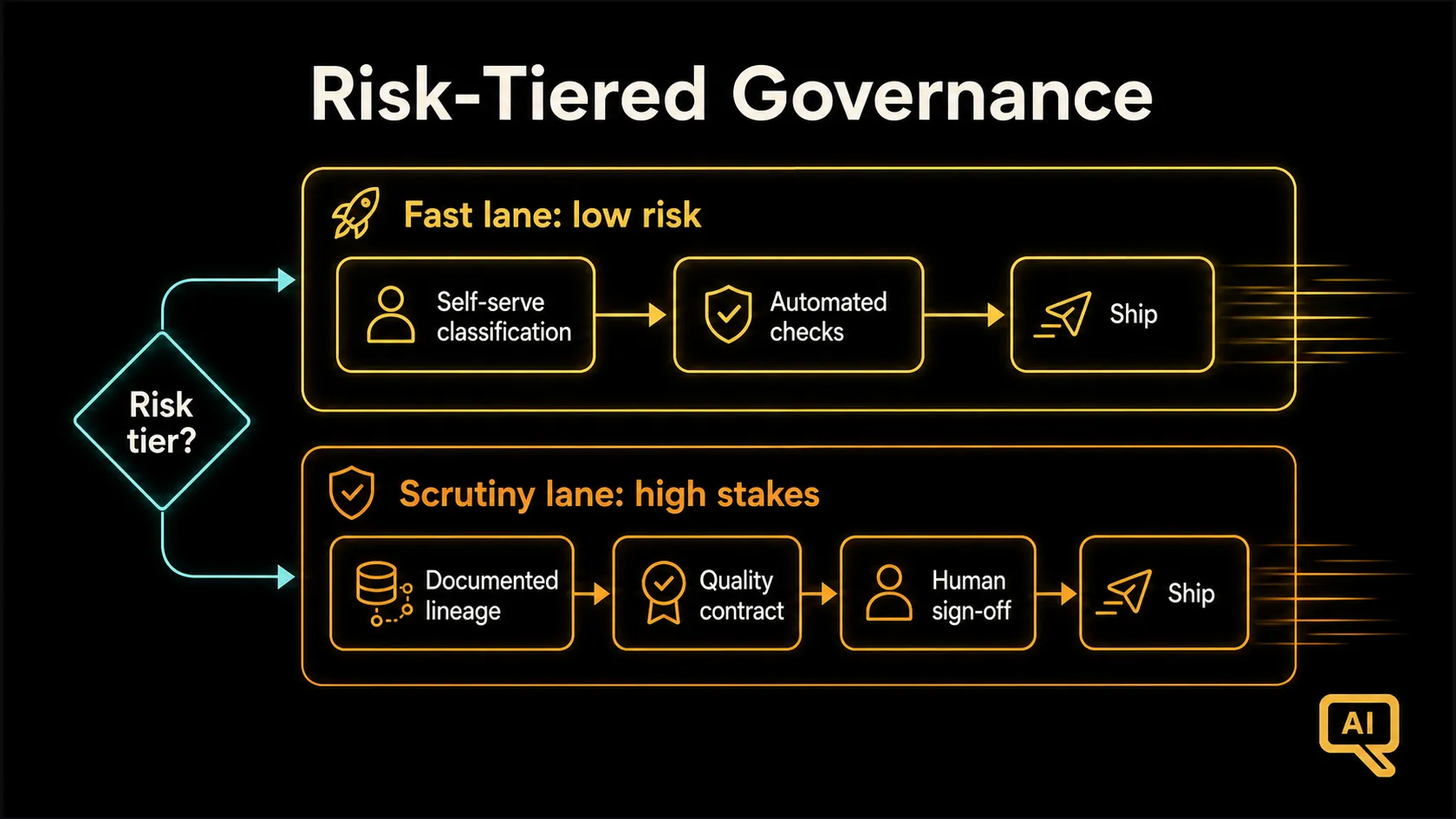
What I want you to notice in Figure 2 is the asymmetry. The majority of use cases take the fast lane and never meet a committee, because classification, purpose labels, and platform controls answer their questions automatically. The scrutiny lane is reserved for systems affecting customers’ money, health, rights, or safety, and there the process is deliberately thorough: documented lineage, quality contracts, human sign-off. Organisations where senior leadership actively shapes this design capture measurably more value than those that delegate governance entirely to technical teams, because the tiering decisions are business judgements, not technical ones.
Where to start on Monday
If your data governance is currently thin, resist the urge to launch a two-year programme. Sequence it against your AI portfolio, exactly as with readiness.
First month: classify the datasets your top five use cases touch, with purpose labels. Stand up the approved-tools register. Second month: wire automated quality checks into the pipelines feeding anything in production, and name owners. Third month: implement the tiered approval flow, and publish the fast-lane criteria so teams know the deal: stay in tier one, move at full speed.
That ninety-day version is not complete governance, but it is real governance, scoped to where AI actually touches your data today. It also generates the artefact that regulators, boards, and customers increasingly ask for: evidence that you know what data your AI uses and that somebody is accountable for it.
The next two articles go deeper into the foundations underneath these rules: the modern data architecture that makes governed, AI-ready data practical (lakehouses, semantic layers, and agent-ready context), and then the asset most strategies still ignore entirely: your unstructured data.