
Strategy without a calendar is commentary. Everything this track has built (the canvas, the maturity assessment, the data arc, the scored portfolio, the sourcing posture, the agent playbook, the production pipeline) converges here, into the question every executive team eventually asks in exactly these words: so what do we actually do first?
This article is the answer: a twelve-month roadmap pattern that sequences quick wins against foundations, keeps value landing every quarter, and leaves you at month twelve with something rarer than a portfolio of projects: an operating capability that compounds. I will give you the pattern quarter by quarter, the logic underneath it, and the honest adjustments for organisations starting from different maturity stages.
One framing note before the calendar. A twelve-month AI roadmap is not a twelve-month plan in the waterfall sense; the field moves too fast for that. It is a sequencing commitment: what starts when, what gates what, and what must be true by each quarter’s end. The contents of later quarters are expected to be revised by the learning of earlier ones, through the quarterly canvas review this track has already installed. Plan the sequence firmly and the details loosely.
The shape of the year
The pattern that works is two tracks running in parallel from day one, meeting deliberately in the middle of the year.
The value track delivers visible wins early: two or three quick-win use cases from the top-left of your portfolio matrix, chosen for speed, measurability, and (per the portfolio article’s tiebreaker) for the foundations they force into existence. Its job is proof and political oxygen: every quarter without visible value is a quarter your programme’s funding gets softer.
The foundation track builds the compounding assets: the first data products, the governance fast lane, the evaluation harness, the platform slice, the model routing layer. Its job is to make the second half of the year, and every year after, cheaper and faster than the first. Underfund it and you plateau at month nine, the classic pilot-sprawl trajectory; overfund it at the value track’s expense and you build beautifully toward a budget cut.
The two tracks are not independent: the deep design move of the whole roadmap is that the value track’s use cases are selected partly to justify and shape the foundation track’s builds. The data products you stand up in Q1 are exactly the ones your Q1 and Q2 use cases need; the governance lane gets built by shipping something through it. Foundations built against real use cases come out correctly shaped; foundations built in the abstract come out shaped like opinions.
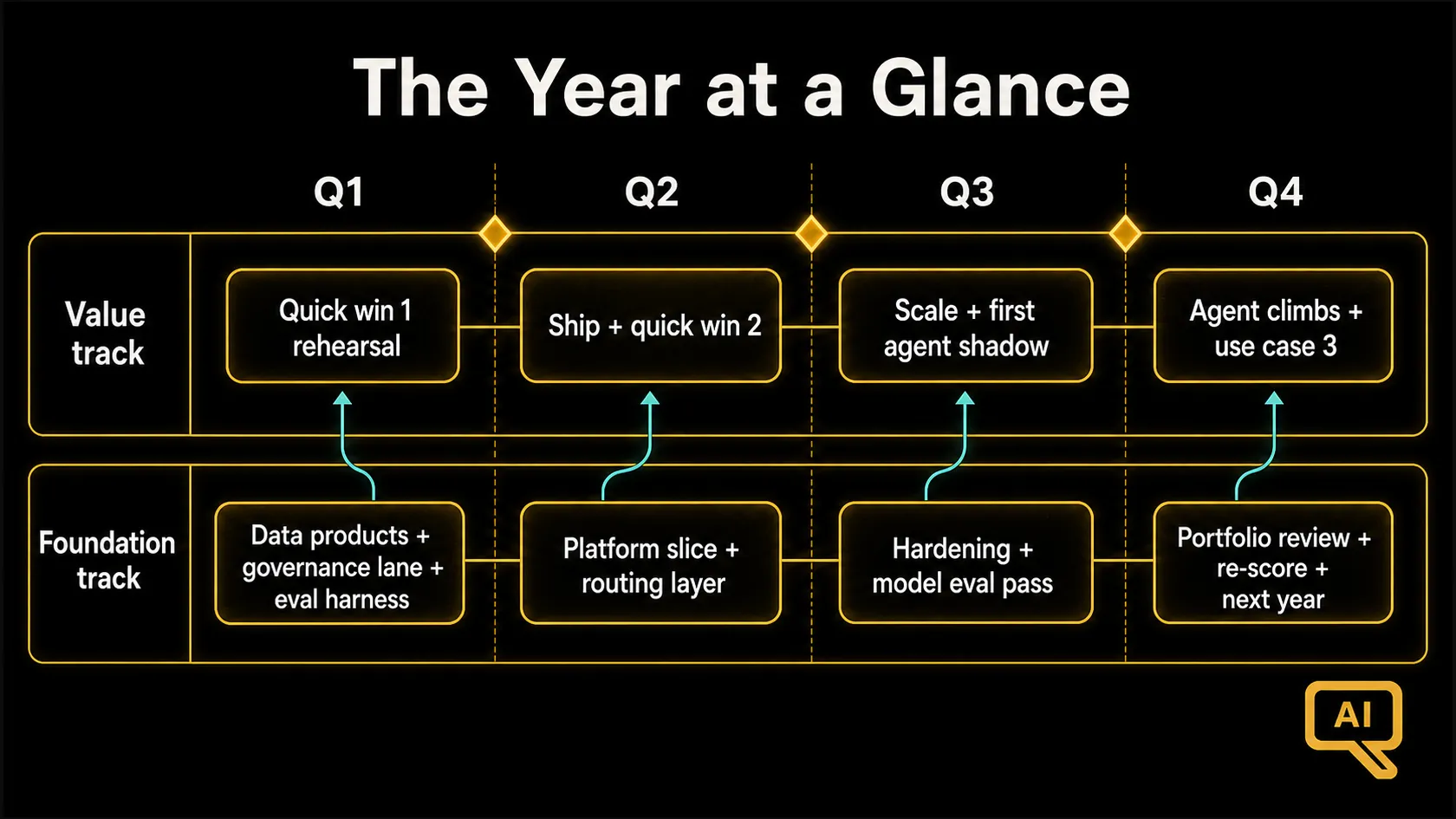
Figure 1 shows the full year at a glance, both tracks, with the dependencies drawn.
Quarter by quarter
With the two-track shape of Figure 1 in mind, here is the year in detail.
Q1: Prove and plumb. The value track launches the first quick win as a production rehearsal (never a demonstration pilot), full three artefacts attached: written criteria, evaluation suite, named owner. Aim for something with an eight-to-ten-week path to the evidence gate: document extraction, triage assistance, and internal knowledge assistants are the reliable openers. The foundation track, in the same weeks: productise the two or three datasets that use case needs (owners, contracts, monitoring), stand up the minimal governance flow with its published fast-lane criteria, and build the first version of the evaluation harness, which every subsequent quarter will lean on. Q1 exit criteria: one use case through the evidence gate with its metric moved, first data products live, governance lane operating.
Q2: Ship and systematise. The first use case crosses the readiness gate and enters controlled rollout; the second quick win starts its rehearsal, reusing the Q1 rails and immediately testing whether they are actually reusable. Foundation track: extend the platform slice (the semantic layer for your core metrics deserves its start here), stand up the model routing layer in basic form, and begin the readiness fixes for one strategic bet from the portfolio, the constraint-funding logic in action. Q2 exit: first system in production with users, second at evidence gate, routing layer carrying real traffic.
Q3: Scale and stretch. First use case passes the value gate and scales; by now its numbers are your programme’s currency, so instrument and narrate them properly. The stretch move: the first contained-delegation agent starts its shadow-mode rehearsal, exactly per the trust ladder, feasible now because Q1 and Q2 built precisely what agents require: live data products, action-capable governance, the evaluation harness. Foundation track: harden what scaling exposes (monitoring depth, cost management, the operational runbooks) and run the first quarterly model-portfolio evaluation pass. Q3 exit: one system at scale with published metrics, agent in shadow or propose-and-approve mode, third use case in pipeline.
Q4: Compound and commit. The agent climbs the trust ladder on evidence; the third use case ships measurably faster than the first did, and that acceleration, more than any single metric, is the number that proves the strategy: falling marginal cost per use case is Stage 4 maturity announcing itself. The foundation track’s Q4 job is institutional: the portfolio review with real kill decisions, the annual refresh of the strategy canvas, re-scoring maturity to measure the year’s actual movement, and the next twelve months sequenced from evidence rather than hope. Q4 exit: three-plus systems in production, one agent earning autonomy, next year’s roadmap funded on this year’s numbers.
Calibrating to your starting point
The pattern above assumes an organisation entering at Stage 2 to 3 maturity with data in the usual partial state. Honest adjustments for other starting points:
Starting at Stage 1 to 2 with rough data: stretch the pattern, do not skip it. Q1 becomes readiness assessment and the first data products with a deliberately modest quick win (an internal assistant on a curated corpus travels light); the agent milestone moves to the following year. The trap at this maturity is impatience: promising Q3-pattern outcomes on Q1-pattern foundations, which is precisely the cheque-writing the maturity article warned against.
Starting at Stage 3-plus with prior production systems: compress the front, not the gates. Quick wins can run two at a time from Q1 and the agent rehearsal can start in Q2, but the three artefacts and the three gates remain non-negotiable at any maturity, because the 88% includes plenty of sophisticated organisations that decided the gates were for other people.
Starting after a failed programme: begin with the funeral. A one-page honest post-mortem of what died and why (usually gaps this track has now named), then the standard pattern with extra weight on early, visible, modest wins: credibility rebuilds on the same evidence it was lost without.
Governing the year
Figure 2 shows the roadmap’s operating rhythm: the cadences and rituals that keep a twelve-month sequence honest through four quarters of surprises.
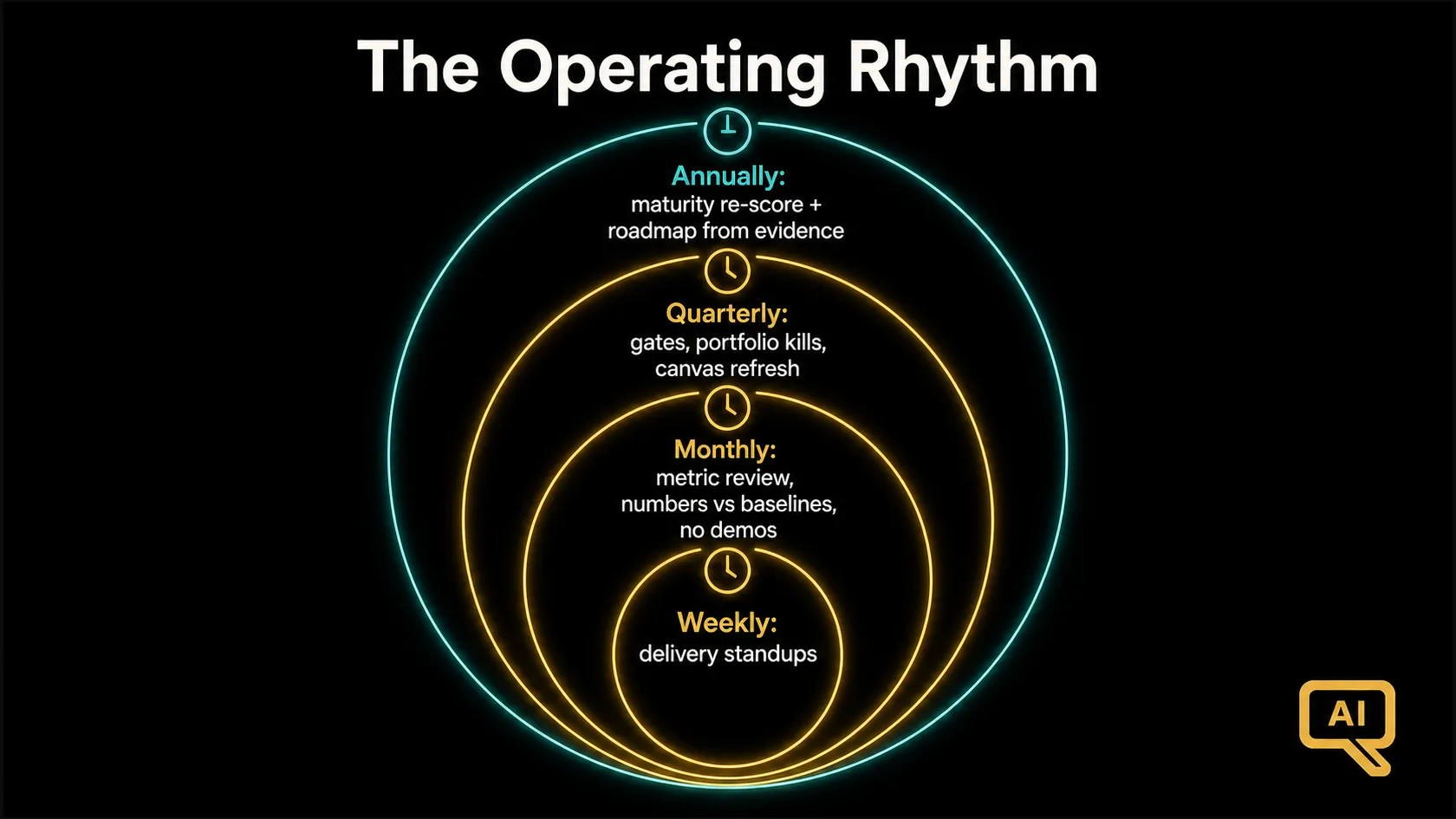
The rhythm in Figure 2 runs on three loops. Weekly: delivery standups per initiative, owner-run, unremarkable by design. Monthly: the metric review, where each active initiative shows its number against baseline to the sponsoring executives, thirty minutes, no demos allowed, a rule that sounds petty and single-handedly prevents success theatre from colonising the programme. Quarterly: the gates from the production pipeline, the portfolio re-score with its kill decisions, and the canvas refresh absorbing whatever the world did that quarter (a model release that moves a sourcing decision, a regulation that moves a governance lane, a competitor move that re-scores a bet).
Budgeting deserves a final word, because roadmaps die of funding models more often than of engineering. Fund the two tracks as a programme with quarterly gates, not as twelve separate project business cases: the foundation track in particular cannot justify itself one project at a time (that is precisely the fragmentation this track’s data articles fought), but justifies itself easily at programme level through the acceleration curve. The deal to strike with your CFO is explicit: value lands every quarter from Q1, the compounding shows by Q4, and the gates give real kill authority in exchange for the programme-level commitment. In my experience that is a deal good CFOs take, because it is the deal they wish every technology programme offered.
The roadmap is the strategy made operational, and by month twelve you will know, with numbers, whether it is working. That knowledge is itself the deepest deliverable of the year: an organisation that has run four honest quarterly gates, killed at least one initiative on evidence, and watched its cost-per-use-case fall has learned to operate AI, which no amount of strategy writing can teach. What remains is insurance: the final article walks the anti-pattern gallery, the recurring ways good AI strategies go wrong, so you can recognise each one in the wild before it costs you a quarter.