
In the AI Primer, we met a key caveat about language models: they can be confidently, fluently wrong. They invent facts, make up quotes, and cite sources that don’t exist, all with total assurance. We called this hallucination, and we traced its root cause: the model is built to produce plausible-sounding text, not necessarily true text.
Now let’s do something practical about it. You can’t eliminate hallucination with wording alone, but you can reduce it, and make it easier to catch when it happens, through a handful of prompting techniques.
Why prompting can help at all
Here’s the key insight. A big reason models make things up is that, left to their own devices, they feel a kind of pressure to always produce an answer. Ask an obscure question and the model doesn’t have an instinct to stop and say “I’m not sure”. It just generates the most plausible-looking continuation, which is often a confident-sounding fabrication.
Prompting helps because much of that pressure comes from how you ask. By wording your request thoughtfully, you can give the model permission to admit uncertainty, anchor it to real facts, and make any fabrication easier to spot. You’re not changing how the model fundamentally works. You’re removing the conditions that push it toward inventing. Figure 1 lays out the main techniques.
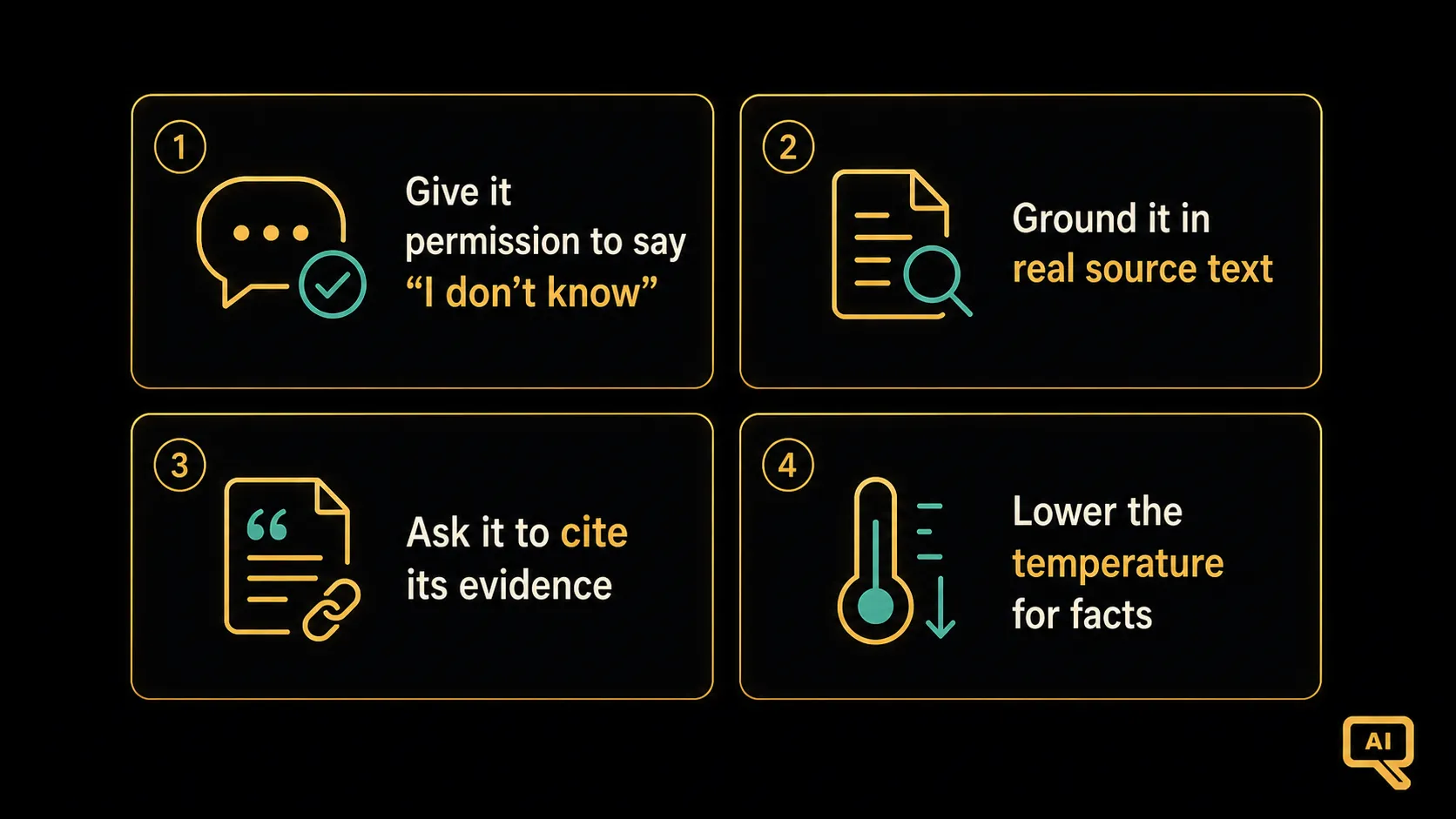 Figure 1: Four practical, prompt-level defences: give the model permission to say “I don’t know,” ground it in real source text, ask it to cite its evidence, and lower the temperature for factual work.
Technique 1: Give it an out
This is the simplest and one of the most effective. Explicitly tell the model that “I don’t know” is an acceptable answer:
“…If you’re not certain, or the answer isn’t in the information provided, say so rather than guessing.”
That single sentence helps. It relieves the pressure to always produce an answer, and gives the model an approved alternative to invention. Many hallucinations happen simply because the model was never told it was allowed to be unsure. Tell it, and it will more readily admit the limits of its knowledge.
Technique 2: Ground it in real information
The strongest defence: don’t rely on the model’s fuzzy memory. Hand it the actual facts and tell it to answer only from those.
“Answer the question using only the information in the text below. If the answer isn’t there, say ‘That’s not covered in the provided text.’”
“…” (your source material here)
When the model is reading from real source text you’ve provided rather than recalling from memory, its answers become more trustworthy, because there’s a real reference right in front of it. This is the idea behind retrieval (RAG), which fetches relevant documents and puts them in the prompt for this reason, a technique that gets its own full track. But you can use the principle manually any time: if you have the source, give it to the model and pin it to that source.
Technique 3: Ask for evidence
Asking the model to show where its answer comes from does two useful things: it nudges the model toward claims it can actually support, and it makes any fabrication far easier for you to catch.
“For each claim, note which part of the provided text it comes from.”
When a model has to point to its evidence, a made-up claim stands out because there’s no real source to point to. Even just asking it to explain its reasoning can surface shaky ground you’d otherwise have missed.
Technique 4: Lower the temperature for facts
Remember the creativity dial from the AI Primer? For factual work, a low temperature keeps the model on the safe, high-probability path and reduces its tendency to wander into invention. Creativity is wonderful for brainstorming and terrible for facts. If your tool lets you set it, turn the temperature down for anything where accuracy matters.
Putting it together: before and after
Let me show you the difference these make. Here’s a prompt that quietly invites hallucination:
“Tell me about the health benefits of the moramba berry.”
If “moramba berry” isn’t something the model knows (or doesn’t exist at all), this phrasing pressures it to produce a confident-sounding answer anyway, and it may invent a list of benefits. Now here’s a hallucination-resistant version:
“Do you have reliable information about the ‘moramba berry’? If you’re not sure it exists or don’t have solid information, say so plainly rather than guessing. Only describe benefits you’re actually confident about.”
Figure 2 shows this contrast.
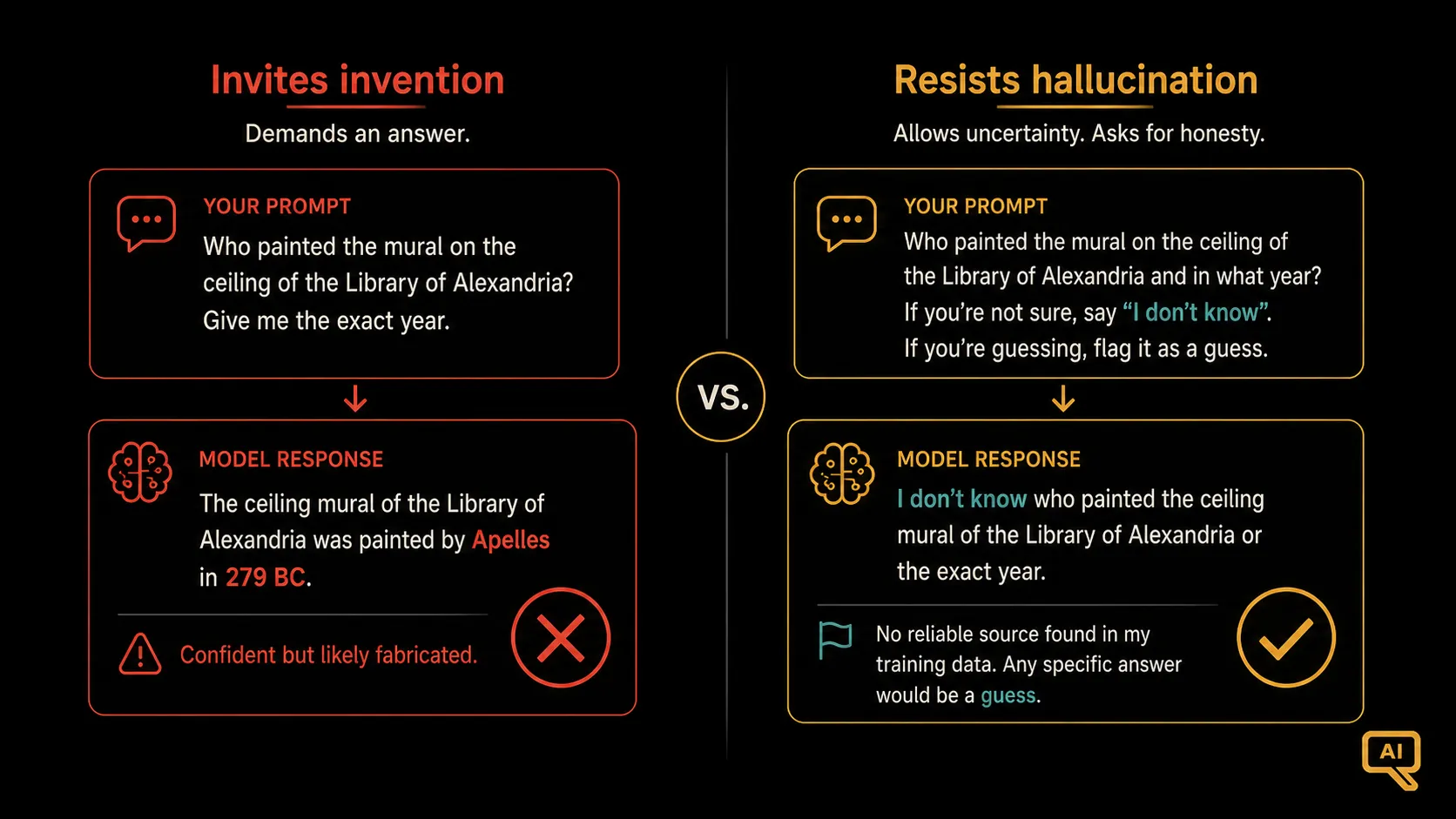 Figure 2: The first prompt pressures the model to produce an answer no matter what, inviting invention. The second gives it permission to admit uncertainty and asks it to flag guesses, so it’s more likely to say “I’m not sure” than to fabricate.
The second prompt gives the model a way out, and it will often take it, telling you it isn’t sure rather than confidently making something up. Same question, very different safety.
The honest limit
I want to be straight with you, because false confidence is exactly what we’re trying to avoid: these techniques reduce hallucination, they don’t eliminate it. As we saw in the Primer, hallucination comes from the fundamental way these models work, and no wording fully patches that. A model can still confidently assert something false even with a careful prompt.
So the golden rule remains: for anything that matters, such as a fact, a figure, a quote, a citation, or a decision, verify it against a reliable source. Treat the model’s output as a confident draft, not settled truth. These prompting techniques stack the odds in your favour and make problems easier to spot, but your own judgement is still the final safeguard.
We’ve now covered getting more reliable output from a single prompt. But some tasks are simply too big for one prompt to handle well, and forcing them into one is its own source of errors. Next, we look at how to break large jobs into a chain of smaller, more reliable steps.
Next in the series: Prompt Chaining & Task Decomposition: breaking big jobs into smaller, more reliable steps.