
You’ve probably noticed it already. You ask an AI assistant something, get a bland or slightly-off answer, rephrase your question, and suddenly the response is far better. Same tool, same underlying knowledge, but the way you asked changed the result.
That’s not luck, and it’s not you imagining things. It’s the idea behind prompt engineering: the skill of writing your request so the model gives you what you want. It sounds fancy, but at its core it’s ordinary: clear communication. This short series will teach it step by step. Let’s start with what it is and, more importantly, why it works at all.
Prompt engineering, plainly
A prompt is simply whatever you type to the model: your question, your instruction, your request. Prompt engineering is the practice of crafting that input well, so the output is useful.
Let me clear up a myth right away, because it trips people up. Prompt engineering is not about discovering secret words that unlock hidden powers. There’s no cheat code. It’s about being clear, specific, and well-organised in what you ask, the same things that get you a good result when you brief a capable colleague. If you can write a clear request to a person, you can learn to write a clear prompt to a model. That’s the whole skill.
Why the wording matters so much
Here’s the part worth understanding, because once it clicks, prompt engineering stops feeling like guesswork. Remember from the AI Primer how a language model works: it reads everything you give it and predicts what should come next, one piece at a time, based on the patterns it learned. It isn’t reading your mind or divining your true intent. It’s continuing from the exact words you provided.
So your prompt isn’t a magic spell; it’s the context the model builds its answer from. Change the words, and you change the context, which changes what the model predicts is a good continuation. A vague prompt gives the model very little to go on, so it produces something vague and generic: a safe, average answer. A rich, specific prompt gives it a lot to work with, so it produces something specific and on-target. You’re not tricking the model; you’re steering it, by giving it a better starting point.
The mental model I find most useful: imagine you’re briefing a fast, very literal new assistant, one who knows a lot but takes you exactly at your word and mostly can’t stop to ask what you meant. If your instruction is vague, they’ll fill the gaps with their best average guess. If your instruction is clear and complete, they’ll do better. Prompt engineering is just learning to write a good brief for that assistant.
See it in action
Let me make this concrete. Watch what specificity does. Here’s a vague prompt:
“Write about dogs.”
The model has almost nothing to go on, so it produces something generic: a bland, encyclopedic paragraph that could appear anywhere and serves no one in particular.
Now here’s a specific one:
“Write a friendly 100-word introduction for a blog aimed at first-time puppy owners. Cover the three most important things to buy before bringing a puppy home. Warm, encouraging tone.”
Suddenly the model knows the audience (first-time puppy owners), the purpose (a blog intro), the length (100 words), the content (three pre-arrival essentials), and the tone (warm, encouraging). The result is better because you gave it more to work with. Figure 1 shows this contrast.
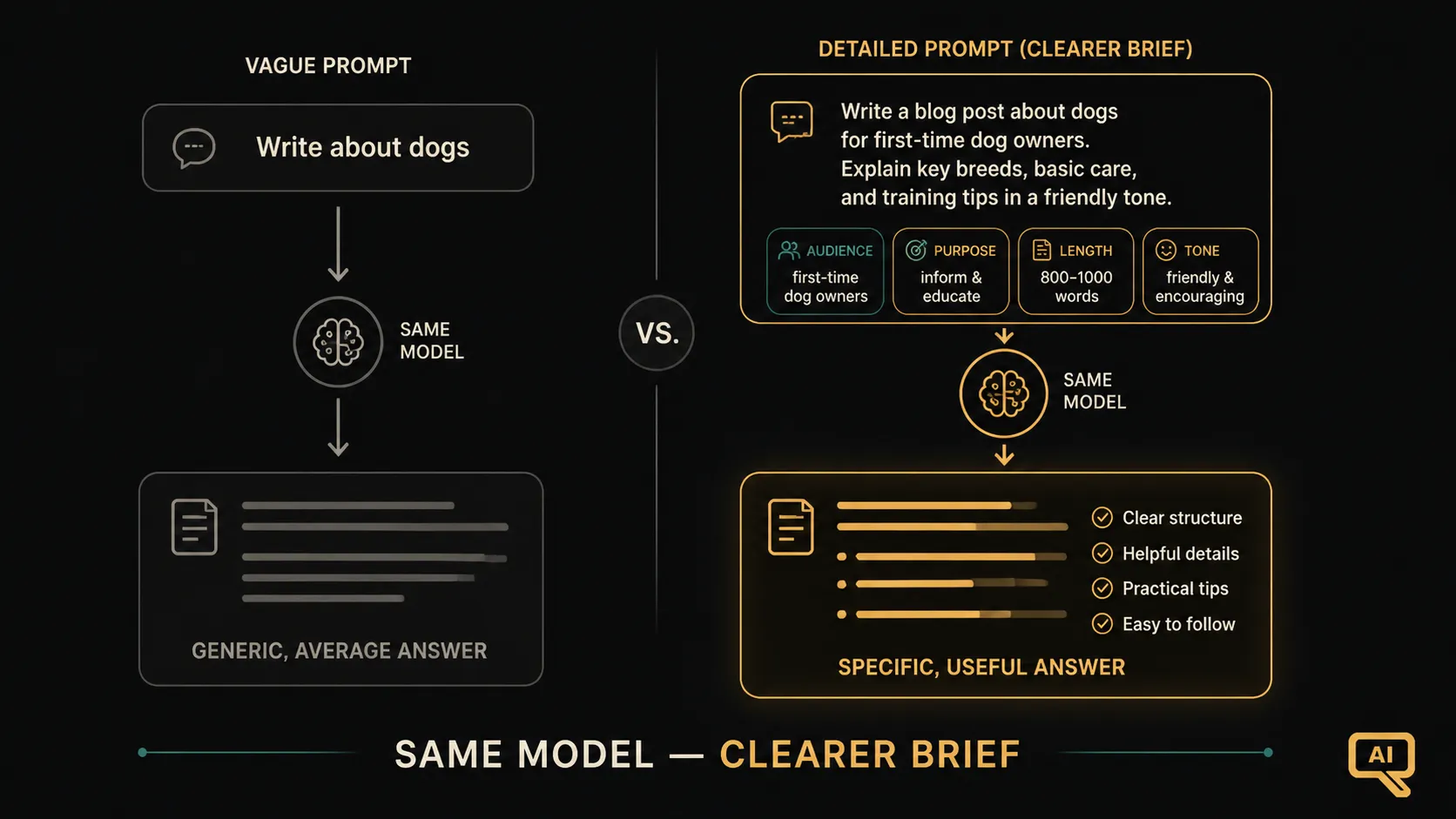 Figure 1: The same topic, two prompts. A vague request leaves the model to produce a generic, average answer. A specific request, with audience, purpose, length, content, and tone, steers it toward something useful.
Nothing about the model changed between those two prompts. Only the quality of the brief changed. That’s the entire lever prompt engineering gives you.
The reframe that makes you good at this
If you take one thing from this article, let it be this: prompt engineering is clear communication, not trickery. Every technique you’ll learn in this series, giving the model a role, showing it examples, asking it to reason step by step, specifying the format, is really just a specific way of being clearer about what you want. None of it is arcane. It’s all in service of the same goal: leaving the model less to guess and more to work with.
That reframe matters because it tells you how to improve. When a response disappoints you, the useful question is rarely “what magic phrase am I missing?” It’s usually “what did I leave vague, assume, or forget to say?” Answer that, add it to your prompt, and the output improves. Prompt engineering is mostly the habit of asking that question well.
What’s ahead
Over the next articles, we’ll turn this instinct into a repeatable skill. We’ll look at how to structure a prompt so nothing important is left out, how to teach the model a task just by showing it examples, how to get it to reason carefully through hard problems, how to make it produce clean output a program can use, and more. Each technique is a different way of doing the one thing that matters: communicating clearly with a literal machine.
Let’s begin where every good prompt begins: with its structure.
Next in the series: Anatomy of a Prompt: Role, Task, Context, Format: the reliable structure behind almost every good prompt.