
If you’ve watched the AI space at all in the last couple of years, you’ve heard the word agent thrown around a lot, and often loosely. Every startup demo now seems to have an “AI agent” in it. Every product page. Every blog post. And behind the buzz, there’s genuinely something real going on, a genuine shift in what these systems can do, that deserves to be understood carefully rather than through hype.
This track is going to teach you agentic AI properly, from the ground up. It’ll take fourteen articles to get you to a working command of the whole picture, and this first article is your orientation. What actually is an agent? What makes something “agentic” as opposed to just “AI”? Why does it matter? And why is 2026 the year this is genuinely landing in real applications? Let me answer those without the fluff.
The one-line definition, and why it matters
Here’s the whole idea in one sentence. An agent is a language model that doesn’t just answer, it decides what to do next, takes actions to do it, and observes what happened, in a loop, until it reaches a goal.
Read that again slowly. Everything about agentic AI is packed into it, and it’ll make more sense as we go. But the key phrase is takes actions. A regular language model is a text-in, text-out system. You ask, it responds, done. An agent is different in kind: it can do things in the world (send an email, run a query, book a meeting, call another API, edit a file, control a browser) and then look at what happened and decide what to do next. It closes the loop between thinking and acting.
The best analogy I’ve found
Think about the difference between a knowledgeable advisor and a competent assistant.
An advisor answers your questions. You ask “how do I renew my passport?”, and they tell you the process, step by step. Their answer is helpful, but you still have to do the work of actually renewing it.
A competent assistant is different. You say “please renew my passport” and they actually do it. They look up your details, fill out the form, book the appointment, add it to your calendar, and email you the confirmation. They took your goal, worked out the steps, took the actions, checked whether each one worked, and only came back to you when the job was done (or when they hit something they genuinely needed your input on).
That’s exactly the shift from language model to agent. The model was already a great advisor. Turning it into an agent gives it the ability to be the assistant. Figure 1 shows the difference.
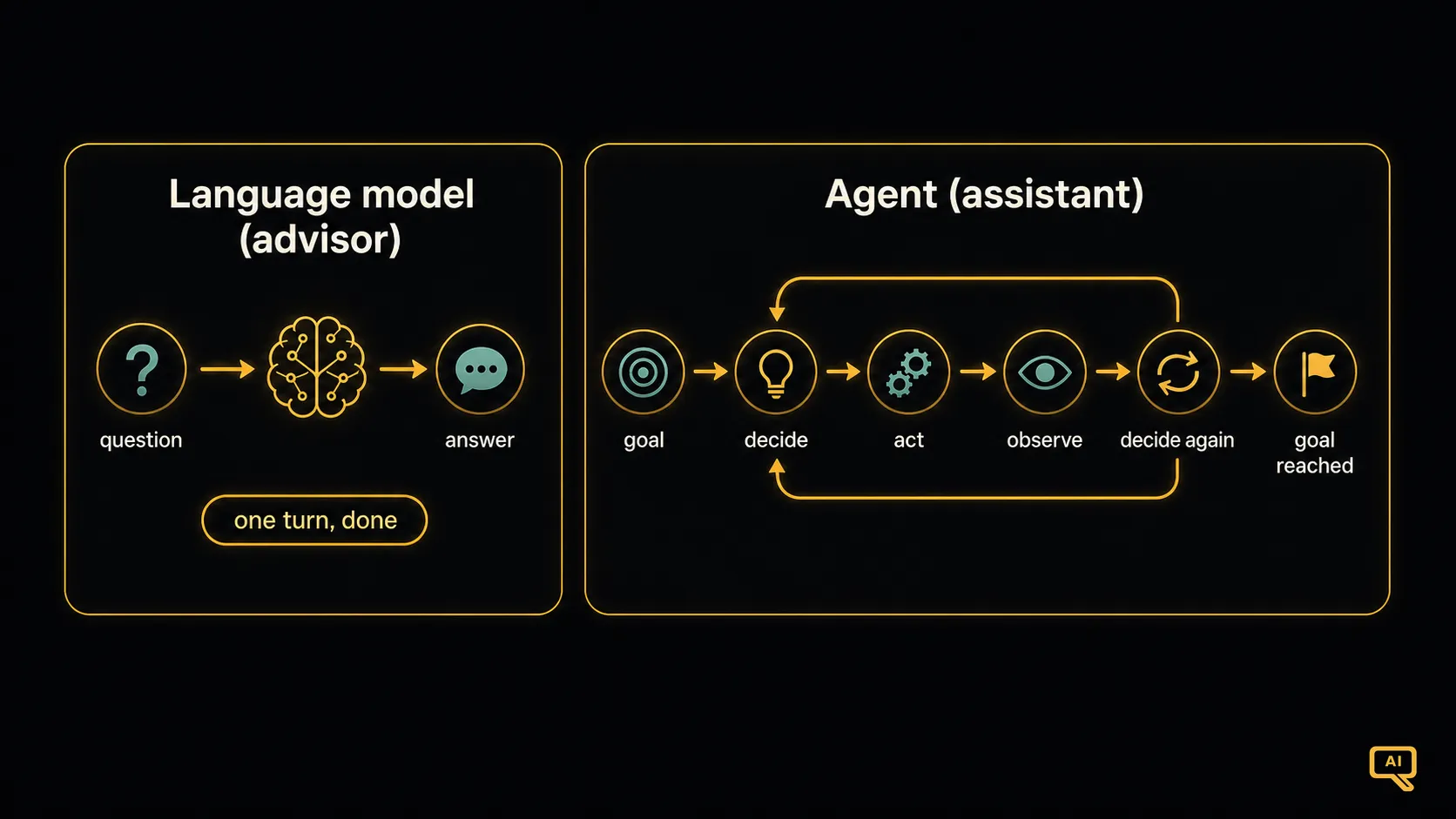 Figure 1: A plain language model answers your question and stops. An agent takes a goal, decides on actions, uses tools to carry them out, observes the results, and keeps going until the goal is done. The shift from answering to doing is what makes something agentic.
Five capabilities that separate agents from chatbots
Buzzwords aside, an agent has five specific capabilities that a plain chatbot doesn’t. If you can point to these five, you’re looking at a real agent. If some of them are missing, you’re probably looking at something simpler dressed up in agent clothing.
1. Goal orientation. An agent operates against a goal, not a single question. “Book me the cheapest flight to Chennai next Tuesday morning” is a goal. It might take five steps or fifty. The agent tracks whether it’s making progress toward it, not just whether each individual response was fluent.
2. Reasoning and planning. Between the goal and the actions, there’s thinking. The agent breaks the goal down into steps, decides which ones to do first, and adapts when things go differently than expected. The chain-of-thought idea from the Prompt Engineering track scaled up into an ongoing planning loop.
3. Tool use. An agent has tools it can call: search the web, query a database, send an email, run some code, hit an API. Tools are how the agent takes action in the world, and this is arguably the single most important capability. We’ll spend a whole article on it (article 4).
4. Memory. An agent remembers what it’s done so far in the current task, and often across tasks. This is what lets it not repeat itself, build on earlier findings, and handle multi-step work coherently. We’ll dig into memory in article 5.
5. Autonomy within bounds. Perhaps the most consequential one. An agent operates with some independence: it decides what to do next without needing you to approve every step. That autonomy exists inside bounds you set (permissions, budgets, approval checkpoints), but it’s genuinely there. Which is where the real power and the real risks come from, and why the security article at the end of this track exists.
Together, these five turn a language model from a very smart chat window into something that can actually get work done. Figure 2 lays them out.
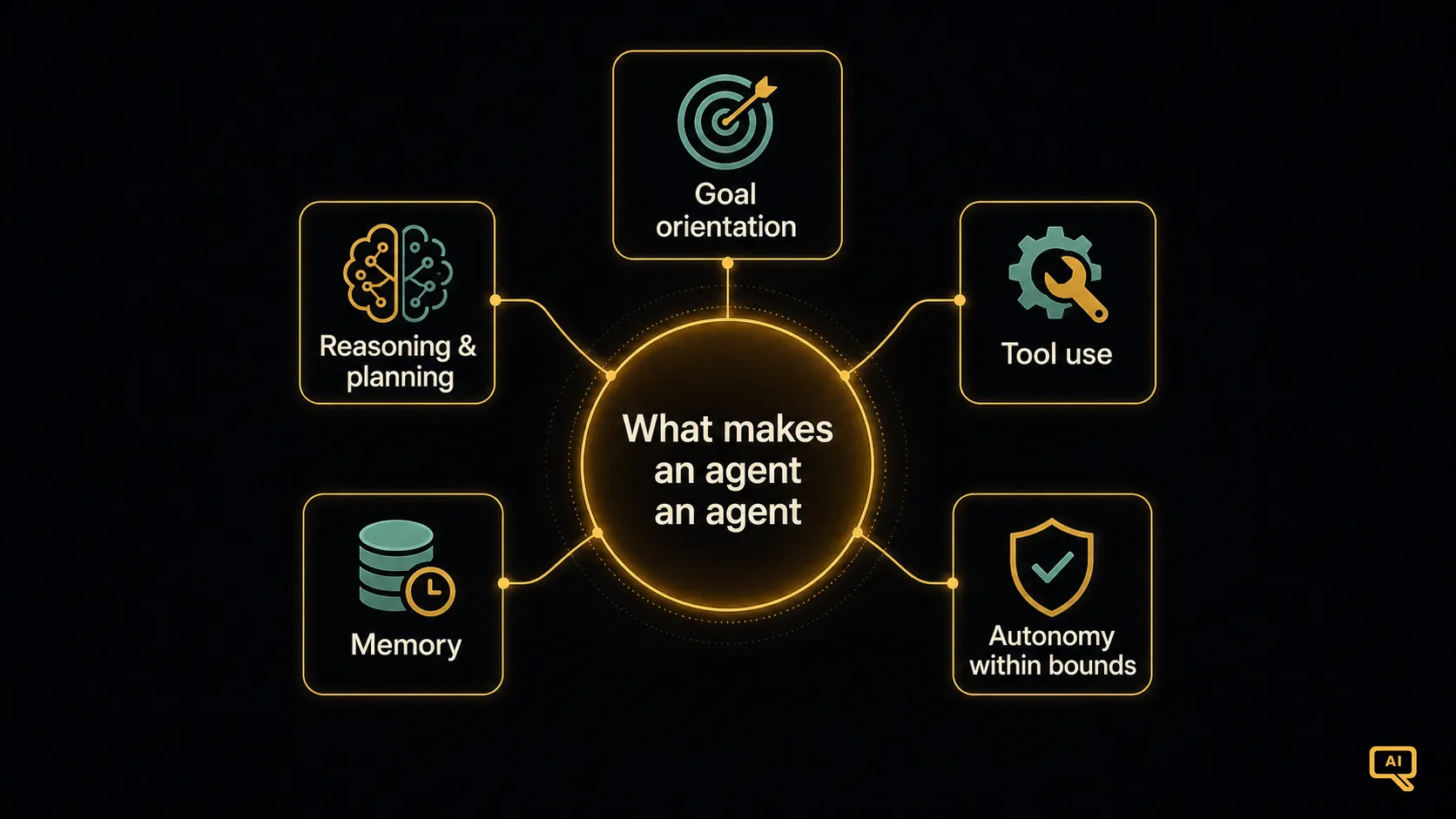 Figure 2: Goal orientation, reasoning and planning, tool use, memory, and autonomy within bounds. Together they distinguish a real agent from a chatbot with a fancy label. If any one is missing, the “agent” is probably just a model call in disguise.
Why 2026 is when this actually landed
Fair question: this isn’t a new idea. People have talked about AI agents for decades. So why does it feel like now is when they’re genuinely working? Three things came together, and they matter enough to name.
The models got good enough at reasoning. Early attempts at agents failed mostly because the underlying model couldn’t reliably plan more than two steps ahead, or would get lost in its own reasoning. The current generation of models can hold a plan across many steps and recover from setbacks, which is what makes multi-step agent work actually work.
Tool use became a first-class capability. Modern models are trained with tool use built in. Instead of the model pretending to have tools by generating text that a wrapper interprets, it directly emits structured tool calls, and the loop of “think → call tool → see result → think again” runs cleanly. This turned a fragile hack into a reliable pattern.
Standard plumbing arrived. For years, every team building agents wrote their own wiring for tool discovery, credentials, and state management. Then a few standards emerged (we’ll cover the biggest, Model Context Protocol, in article 11) that let agents plug into systems the way apps plug into your phone. This is unglamorous, but it’s what turned agents from science projects into things you can actually build on.
Add those three up and you get the shift you’re feeling in 2026: not a new idea, but the first time the idea genuinely works at production quality. That’s why every enterprise you’ve heard of is now piloting agents, and why this track is worth taking seriously.
What agents are not, and where hype misleads
Because so much is written about agents, it’s worth being clear about what an agent isn’t, just to keep the mental model honest.
- An agent isn’t magic. It’s a language model plus a loop plus some tools. Everything an agent does is grounded in the same techniques we’ve built up: prompting, context, tool calls, sometimes retrieval. There’s no separate “agent intelligence.”
- An agent isn’t self-directed in the way a human is. It works toward the goal you give it, using the tools you provided, within the bounds you set. It’s autonomous within that scope, not free-floating.
- An agent isn’t automatically better than a workflow. For many tasks, a simple, predictable workflow (the chain-of-prompts pattern from earlier in the tracks) is more reliable, cheaper, and easier to debug. Agents earn their keep on tasks where the path to the answer genuinely varies. We’ll spend the entire next article on this “agent vs workflow” choice, because it’s one of the most consequential decisions you’ll make.
- An agent isn’t safe by default. Something that can take actions has a genuinely new risk profile. A hallucinating chatbot says something wrong; an agent that hallucinates might do something wrong. This is exactly why the last article of this track is dedicated to security.
Holding these truths alongside the excitement is how you get the value of agents without falling for the marketing.
The value proposition, honestly
So why should you care about all this, really? Two reasons, plainly stated.
The first is that agents genuinely unlock work that language models alone couldn’t do. Any task that involves multiple steps and interactions with real systems was previously either too fragile for a chatbot to handle or too small to justify custom automation. Agents fill exactly that gap. Coordinating a customer refund across three systems. Researching a topic and delivering a briefing. Monitoring a stream of documents and pulling out what matters. Assembling a report from many sources. This is the space where agentic AI is quietly starting to eat real work.
The second reason is that the shift isn’t optional if you’re building anything serious with AI. Whether you love the term “agentic AI” or find it overused (I’d forgive you either way), the pattern it names is where a large share of real-world AI value is now being built. The teams that understand it (when to use it, when not to, how to make it reliable) are going to build far more valuable products than the ones still stuck in “chatbot on top of a document” mode. This track is for making sure you’re in the first group.
The map of the track
Fourteen articles is a lot, so a quick preview of where we’re going. We’ll spend the next few articles on the fundamentals: agents vs workflows (article 2), inside the agent loop (article 3), tool use (article 4), memory (article 5), planning (article 6), and the design patterns that keep agents reliable (article 7). Then we’ll build one hands-on in article 8. From there, we’ll cover multi-agent systems (9), agentic RAG (10), the Model Context Protocol (11), choosing frameworks (12), evaluating and observing agents in production (13), and finally, the security realities of systems that can act (14).
By the end, you’ll have a real, working grasp of how to build, run, and reason about agentic AI systems, not from hype but from mechanism. Let’s start where every good agent starts: with an honest decision about whether an agent is even the right tool for the job.
Next in the series: Agents vs Workflows vs Chatbots, the most consequential decision you’ll make before building anything.