
I have watched more AI programs get stuck on this article’s topic than on any other. Fairness, explainability, and human oversight are the three practices where good governance actually shows up in the day-to-day operation of AI systems. They are also the three practices where the gap between policy language and operational reality is most reliably large.
The gap has a specific shape. The policy says “our AI systems will be fair, explainable, and subject to human oversight.” The system in production has passing accuracy metrics, an incomprehensible model architecture, and a human review checkpoint that a single person is supposed to process in ten seconds. The gap between the sentence and the practice is where regulators look and where enforcement lands.
This article is about closing that gap. It covers what fairness, explainability, and human oversight actually mean in operation. It covers how to design them in rather than bolt them on. It covers the specific ways they show up in the EU AI Act, in APRA’s expectations, in MAS Guidelines, and in the NIST AI RMF. And it covers the honest limits of each of them, because pretending they are more powerful than they are is one of the most common sources of failure.
Fairness: past the definition problem
The first thing you learn if you try to make an AI system “fair” is that there is no single mathematical definition of fairness. There are many, and some of them are mathematically incompatible with each other.
The three definitions that dominate practical work are:
Demographic parity (also called statistical parity): the model’s positive outcomes are distributed equally across protected groups. If 60% of applicants get approved overall, 60% should get approved in each protected group.
Equal opportunity (a form of equalised odds): the true positive rate is equal across protected groups. Among people who should be approved, the same fraction is approved in each group.
Predictive parity: the positive predictive value is equal across protected groups. When the model predicts approval, it is correct at the same rate in each group.
These are not the only definitions, but they cover most of what shows up in real work. Impossibility results in the literature (Chouldechova, Kleinberg-Mullainathan-Raghavan, and others) show that in most realistic settings, you cannot satisfy all three at once. Choosing among them is a policy decision, not a mathematical one. Different choices reflect different value judgements about how to allocate the burden of error.
For a hiring model, if base rates differ across groups (which they usually do, because of pre-existing discrimination in the world the training data reflects), you cannot have both demographic parity and equal opportunity. If you enforce demographic parity, you will approve some candidates who would not otherwise have been approved. If you enforce equal opportunity, you will approve different fractions of each group. You have to choose, and the choice has consequences.
The practical implication is that fairness is not something you achieve; it is something you decide about. The decision has to be documented, defensible, and consistent with the applicable legal and ethical framework. Different jurisdictions and different use cases produce different defensible answers.
What operational fairness looks like
Given the definitional complexity, here is what fairness looks like in a well-run AI program.
A defined fairness definition per use case. For each material AI system, the fairness metric being used is documented, with the justification for why this metric fits the use case. This is a policy decision made at the appropriate governance level.
Disaggregated evaluation. Model performance is evaluated across the protected characteristics relevant to the use case. For an employment tool in most jurisdictions, this includes gender, race or ethnicity, age, disability status, and religion. Different jurisdictions have different protected characteristic lists; check yours.
Fairness testing as part of validation. Before deployment and at defined intervals thereafter, the model is tested for fairness against the chosen metric. Results are documented. Deviations from targets trigger investigation.
Continuous fairness monitoring. Fairness is monitored in production alongside accuracy. Data drift can shift the fairness picture; monitoring catches this.
Mitigation processes. When fairness issues are identified, defined processes exist for investigating, remediating, and re-validating. This includes technical mitigations (rebalancing, reweighting, threshold adjustment) and non-technical ones (changing the use case, adding human review, or discontinuing the system).
Governance sign-off. Fairness decisions with material consequences (choice of metric, target levels, remediation approaches) receive governance sign-off proportionate to the risk tier.
The EU AI Act references fairness through the requirement to examine training data for possible biases (Article 10) and through the emphasis on non-discrimination in Annex III use cases. GDPR requires fair processing. APRA and MAS both reference fairness through their expectations on outcomes. Australia’s Robodebt findings have made fairness in automated decisions a specific supervisory concern.
Explainability: multiple concepts under one word
“Explainability” is a word that means several different things depending on who is using it. Getting the terminology right matters.
Interpretability is a property of the model itself. An interpretable model is one whose internal workings can be inspected and understood. Linear regressions and decision trees are highly interpretable; deep neural networks and large language models are not.
Explainability, in the technical sense, refers to methods for producing explanations of specific model outputs, even when the model itself is not interpretable. LIME, SHAP, and integrated gradients are examples of post-hoc explainability techniques.
Justifiability is a legal or ethical concept. A decision is justifiable when the reason for it can be articulated in terms that are meaningful to the person affected and consistent with the applicable framework.
These are related but different. A decision from an interpretable model can lack justifiability if the interpretable factors are illegitimate. A decision from a non-interpretable model can be justified even without full explainability if the process around the decision, the human review, and the appeal mechanism satisfy the applicable standard.
What operational explainability looks like
In practice, explainability for AI systems has three layers.
Model-level explanation. How does the system work overall? What data was it trained on? What kind of factors influence its outputs? This information should be available in the model card and system documentation. It supports transparency and internal governance.
Case-level explanation. For an individual output or decision, what factors influenced it most? For a model that denied a loan application, what were the primary reasons? This is where post-hoc explainability techniques apply. For high-stakes decisions, particularly those with legal consequences, case-level explanations may be required by law (adverse action notices under US ECOA, GDPR Article 22 in the EU, and similar provisions elsewhere).
Process-level explanation. What is the overall process the AI system fits into? What human review or appeal is available? How can the decision be challenged? This is often the most important explanation for the affected individual, and it is the easiest to provide well.
Note that not all use cases require all three layers. A recommendation engine for internal knowledge search does not typically require case-level explanation; a decision engine for insurance underwriting does.
Under the EU AI Act, Article 14 requires that high-risk systems be designed to enable human oversight, which includes the ability to correctly interpret outputs. Article 13 requires clear and comprehensive information to deployers. Article 26 requires deployers to inform affected individuals that they are subject to the use of a high-risk AI system. These provisions collectively require explainability approaches that vary by use case.
Under GDPR Article 22, automated decisions that produce legal or significant effects require meaningful information about the logic involved and the significance and consequences of processing. This has been interpreted to require more than a black-box output but does not require full technical detail.
Under APRA expectations, transparency and accountability throughout the AI lifecycle are named requirements, with specific attention to “meaningful and accountable” human involvement in high-risk decisions.
Figure 1: The layers of explanation
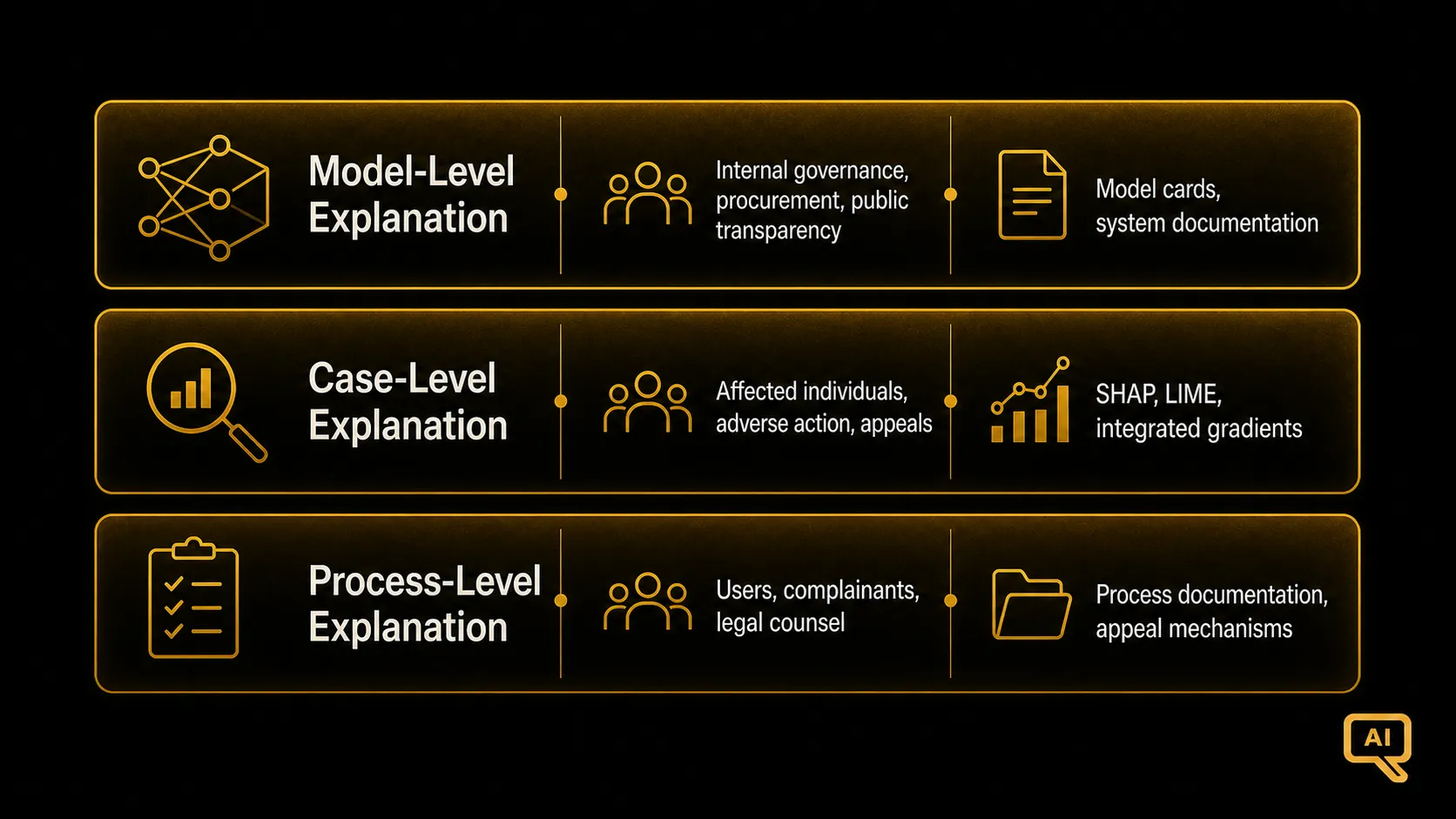
Figure 1 shows the three layers of explanation for AI systems, mapped to their typical audiences and the governance instruments that address them. Model-level explanation supports internal governance, procurement, and public transparency. Case-level explanation supports affected individuals, adverse action processes, and appeal rights. Process-level explanation supports users, complainants, and legal counsel. Each layer is served by different tools and documentation; getting the right layer to the right audience is the operational challenge.
Human oversight: the frequent failure point
Human oversight is where AI governance most often falls short in practice.
The pattern is familiar. The policy requires human review of high-risk decisions. The design places a “review” step in the workflow. The person performing the review sees hundreds of cases per day, with the AI’s recommendation prominently displayed and a “confirm” button prominently available. Under time pressure and cognitive load, the human approves what the AI suggested, quickly, without independent analysis. The system is technically overseen but operationally not.
This is automation bias, and it is one of the best-documented findings in the human factors literature on AI-assisted decision-making. Humans presented with an AI recommendation, particularly a confident one, tend to accept it even when they should not.
Under the EU AI Act, Article 14 explicitly requires that human oversight measures “enable those to whom human oversight is assigned to remain aware of the possible tendency of automatically relying or over-relying on the output produced by a high-risk AI system, in particular for high-risk AI systems used to provide information or recommendations for decisions to be taken by natural persons.” The word “aware” is doing important work there. The Act is not just requiring oversight; it is requiring oversight designed to counter automation bias.
What operational human oversight looks like
Effective human oversight has several design elements.
The human has meaningful capacity. If the review workload exceeds what a human can meaningfully process, the oversight is nominal. Design the workflow so review has adequate time.
The human has necessary information. The reviewer needs to see the inputs, the model’s output, the case-level explanation, and any relevant context. If they only see the output, they cannot review it.
The human has authority. The reviewer must have real authority to change or override the model’s output, without excessive friction. If overriding requires escalation to three managers, the reviewer will approve to avoid the friction.
The workflow supports independent judgement. The presentation of the model’s output should not psychologically anchor the reviewer. Ordering, defaults, and emphasis all matter. Some organisations require the reviewer to record their own assessment before seeing the model’s output for high-risk cases.
Sampling and audit. Human review of every case is not always feasible. For lower-risk applications, structured sampling combined with independent audit of the sampled cases provides risk-proportionate oversight.
Escalation paths. The reviewer must have clear paths to escalate concerns beyond the immediate decision. This includes concerns about individual cases and concerns about the model’s overall performance.
Feedback loops. What the reviewer sees, decides, and reports feeds back into the AI system’s operation. If the reviewer consistently overrides certain classes of case, the model or its use should be reconsidered.
Training and support. Reviewers need training in the specific system they are reviewing, in the risks it presents, and in the automation bias tendencies to counter. This is not a one-time training; it is ongoing.
When human oversight is not enough
There are cases where the standard “human in the loop” model is inadequate and needs replacement or augmentation.
High-volume, low-latency decisions (fraud alerts, content moderation, ad placement) cannot support case-by-case human review. For these, human oversight operates through model monitoring, sampled review, appeal mechanisms, and governance-level reassessment rather than per-decision review.
Highly consequential decisions (medical diagnosis, criminal justice, high-value credit) may require more than a human in the loop. They may require human-led decisions with AI as decision support, where the human makes the decision and the AI provides input, rather than the other way around.
Novel or adversarial situations may require human-out-of-the-loop safeguards. If a system encounters conditions outside its designed range, escalating to human decision may be the right response, but only if the human has the context and capability to respond appropriately.
The choice among these models is a design decision, informed by the risk tier, the regulatory framework, and the specific use case.
Figure 2: The responsible AI operating model
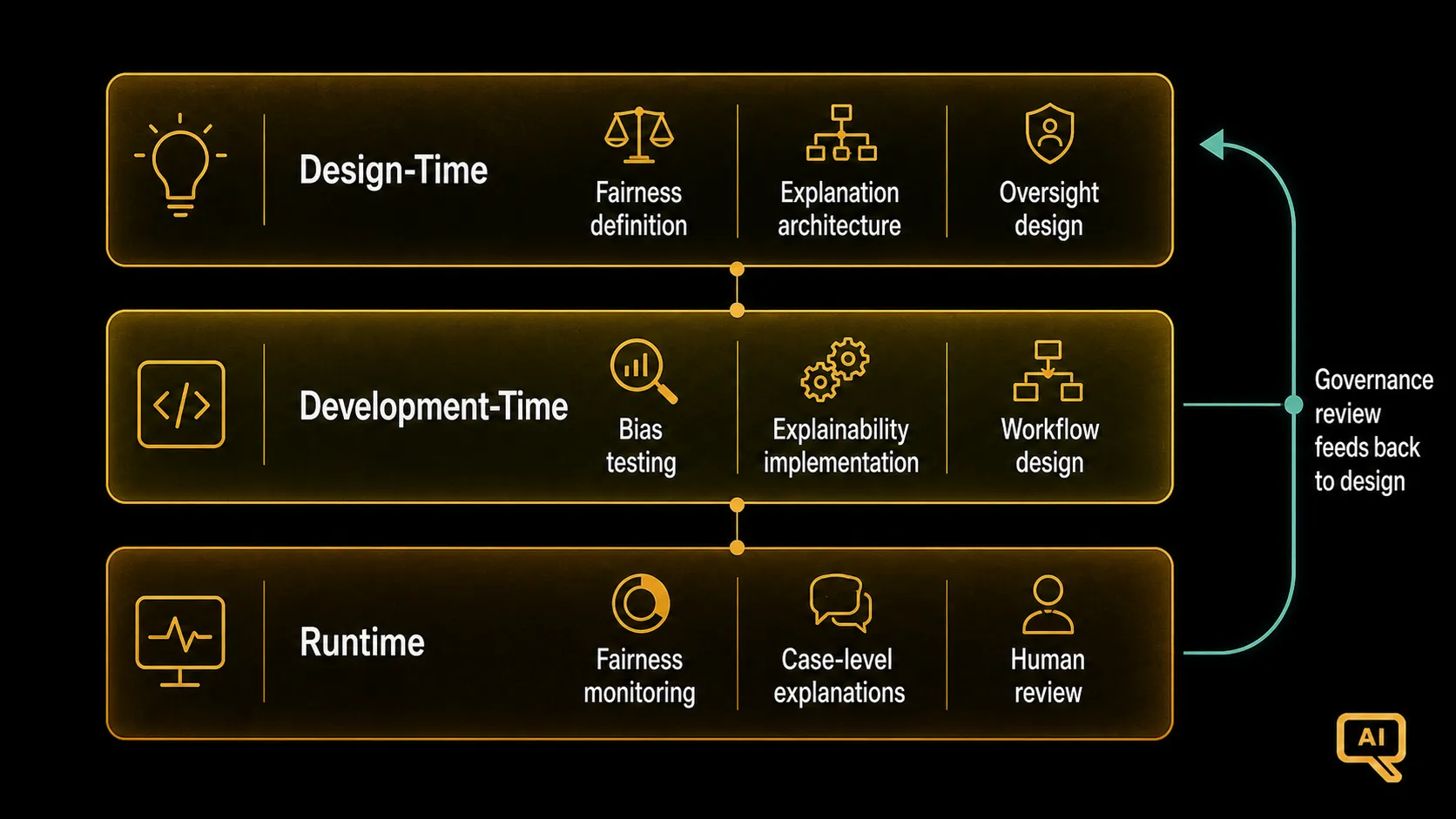
Figure 2 shows an operating model for responsible AI at deployment. Design-time practices (fairness definition, explanation architecture, oversight design) sit at the top. Development-time practices (bias testing, explainability implementation, workflow design) sit in the middle. Runtime practices (fairness monitoring, case-level explanations, human review) sit at the bottom, feeding continuously back into design decisions through governance review. The model emphasises that responsible AI is not a checkbox at any single stage; it is the through-line from design intent to production practice.
The honest limits
Three limits worth naming, because pretending they do not exist is one of the ways responsible AI programs fail.
Fairness cannot be perfect. The mathematical impossibility results are real. Different fairness metrics conflict. Different value judgements produce different reasonable answers. The most a program can achieve is documented, defensible, monitored fairness against a chosen definition, with appropriate mitigation when limitations manifest.
Explainability has real limits for LLMs and complex models. Post-hoc explanation techniques for LLMs are less mature and less faithful than for traditional models. Some outputs are effectively unexplainable in the case-level sense. Responsible governance may involve avoiding LLM use for cases that require case-level explanation, or accepting that the case-level explanation is process-based (what human review was performed) rather than model-based.
Human oversight is bounded by human capability. Automation bias is not fully solvable through workflow design. Sufficient training and workload management reduce it; they do not eliminate it. Some use cases should not depend on human oversight as the primary safeguard, because the reliance is unrealistic.
Recognising these limits is not defeatism. It is honest governance. It leads to better system design (avoiding use cases where the safeguards cannot work), better process design (adding structural checks beyond human review), and better regulatory engagement (being frank about what is and is not possible).
What all this means for a governance program
Fairness, explainability, and human oversight are not three items on a checklist. They are three related design commitments that show up throughout the AI system lifecycle. When they are handled well, they are visible in the design decisions, in the development practices, in the deployment configuration, in the monitoring outputs, and in the documentation. When they are handled poorly, they are visible in the paperwork that says they are handled well and in the operational reality that they are not.
The next article moves into a category of AI system where these disciplines are hardest to apply: agentic AI. When AI systems take actions rather than produce recommendations, fairness gets more complex, explainability gets harder, and human oversight has to be reinvented. Article 15 goes into what changes and how to govern the change.