What Is Agentic AI? From Chatbots to Autonomous Agents
Subhra
1/25/20266 min read
For the last couple of years, the story of generative AI has been a story about answers. You ask, it responds. You prompt, it produces. The chatbot — brilliant, fluent, occasionally maddening — has been the face of the whole revolution. But a chatbot, for all its eloquence, is fundamentally passive. It waits for you. It answers your question and stops. It can tell you how to do something, but it can't go and do it.
Agentic AI is the shift from answering to acting — and it is the most consequential change in how we'll use AI since the chatbot itself. If 2023 was the year AI learned to talk, the years that followed are the years it's learning to act: to take a goal, make a plan, use tools, take steps in the world, observe the results, and adjust — with meaningful autonomy. This article explains what that actually means, why it's a genuine leap rather than just hype, and where the limits really are.
The core distinction: from tool to teammate
Let me draw the line as sharply as I can, because everything else depends on it.
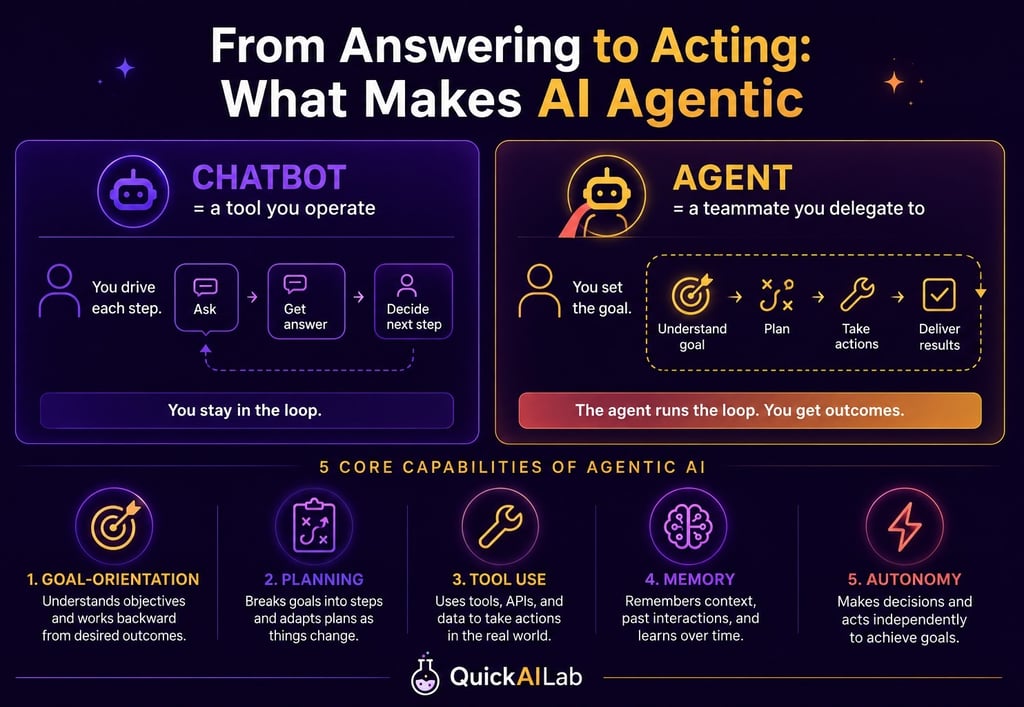
A traditional LLM application is a tool. You operate it. You ask a question, you get an output, and you decide what to do next. If solving your problem takes ten steps, you drive all ten — prompting, copying, pasting, re-prompting. The intelligence is real, but the agency is entirely yours.
An AI agent is closer to a teammate you delegate to. You give it a goal — not a single question, but an objective — and it figures out the steps itself. It decides what information it needs and goes and gets it. It chooses which tools to use and uses them. It takes an action, looks at what happened, and decides what to do next. It keeps going until the goal is met or it gets stuck. You delegate the outcome; it handles the process.
The difference between "tell me how to book a meeting room" and "book me a meeting room for the team next Tuesday" is the entire difference between generative AI and agentic AI. The first wants an answer. The second wants a result — and is willing to take the steps to get there.
The five capabilities that make an agent an agent
"Agentic" isn't a marketing label you can sprinkle on any chatbot. A genuine agent has five capabilities working together, and it's the combination that matters.
1. Goal-orientation. It works toward an objective, not a single response. It holds the goal in mind across many steps and measures its progress against it.
2. Planning and reasoning. It can break a goal into steps, sequence them, and reason about how to proceed — and crucially, re-plan when a step doesn't go as expected. (How this works mechanically is the subject of Inside the Agent Loop.)
3. Tool use. This is the superpower. An agent can use tools — search the web, query a database, run code, call an API, send an email, read a file. Tools are how an agent reaches beyond the limits of its training data and acts on the world instead of just talking about it. An LLM that can only generate text is a brain in a jar; tools give it hands.
4. Memory. It remembers what's happened earlier in the task (and sometimes across tasks), so it can build on prior steps rather than starting fresh each time. Memory is what lets an agent work on something complex over many steps without losing the thread.
5. Autonomy. It can take multiple steps without asking you to approve each one — operating with a degree of independence, within boundaries you set. This is the most powerful and the most dangerous capability, and it's why agents demand more careful design than chatbots ever did.
Take away tool use and you have a clever reasoner that can't do anything. Take away planning and you have a tool-user that can't handle complexity. Take away autonomy and you're back to a chatbot. It's the five together that create something new.
A concrete example: the difference in action
Abstractions are slippery, so let's make this real. Suppose you want to research competitors and produce a summary.
With a chatbot, you do the orchestration. You ask it to list competitors. You go find their recent news yourself. You paste each article in and ask for a summary. You ask it to compare them. You assemble the final report. The AI helped at each step, but you were the project manager, the researcher, and the glue. Ten steps, all driven by you.
With an agent, you say: "Research our top three competitors' product launches this quarter and write me a one-page comparison." Then it goes to work — deciding to search the web for each competitor, reading what it finds, pulling out the launches, noticing it's missing pricing on one and searching again, structuring a comparison, and handing you the finished page. You delegated the outcome; it owned the process. You stepped in once, at the start, and once at the end.
That's the leap. Not better answers — delegated work.
Why this is happening now
Agents aren't a new idea; researchers have chased autonomous AI for decades. What changed is that LLMs finally became good enough at the one thing agents were always missing: reasoning flexibly about novel situations and deciding what to do next. Earlier attempts at agents were brittle because they couldn't handle the messy, open-ended judgment that real tasks require. Modern LLMs can — well enough, often enough, to make agents genuinely useful.
Add the maturing ecosystem around them — reliable tool-calling, standards for connecting agents to external systems, frameworks for building them — and the pieces finally fit. The brain got good enough, and the hands became available at the same time. That convergence is why "agentic" went from research curiosity to the dominant theme of the field in a remarkably short window.
The honest limitations (because the hype is loud)
I'm bullish on agents, which is exactly why I want to be straight with you about where they fall short today. Believing the hype uncritically is how you get burned.
They compound errors. An agent taking ten steps has ten chances to go wrong, and a mistake early can cascade. A chatbot's wrong answer is one wrong answer; an agent's wrong step can derail everything after it.
Autonomy cuts both ways. The same independence that makes agents powerful makes them risky. An agent that can send emails can send the wrong email. An agent that can run code can run harmful code. Giving an AI the ability to act means giving it the ability to act badly, which is why boundaries, oversight, and guardrails aren't optional.
They can be expensive and slow. Multi-step reasoning with many tool calls burns far more tokens — and time — than a single chatbot response. Cost and latency are real design constraints, not afterthoughts.
Reliability is still maturing. Today's agents are genuinely impressive and genuinely inconsistent. They shine on some tasks and stumble unpredictably on others. The right posture for now is "powerful assistant that needs supervision," not "set it loose and walk away."
These aren't reasons to dismiss agents — they're reasons to deploy them thoughtfully. The difference between a chatbot, a workflow, and an agent matters enormously for getting this right, and so does knowing when an agent is the wrong tool entirely.
Where this is all going
Step back and the trajectory is clear. We're moving from AI that informs our work to AI that does portions of it — from a tool we operate to a set of capable digital colleagues we delegate to and supervise. The interesting questions are shifting accordingly: not "what can it tell me?" but "what can I trust it to do, within what boundaries, with what oversight?"
For practitioners, this means a new skill set: designing agents, giving them the right tools, setting the right guardrails, and building the systems to supervise them. For leaders, it means a new strategic question: which work in your organisation can be delegated to agents, and how do you do that responsibly? (That's the subject of the Enterprise Agentic AI Playbook.)
Agentic AI isn't a better chatbot. It's a different relationship with the machine — one where the machine doesn't just answer, it acts. Understanding that distinction is the foundation for everything you'll build, buy, or govern in the next phase of AI. The chatbot taught the machine to speak. The agent is teaching it to work.
----------------------------------------------------
Curious whether agentic AI is genuinely useful for your situation, or trying to separate the real capability from the hype before you invest? That clear-eyed assessment is exactly the kind of conversation I enjoy most. Reach out for a free consultation.